

Vending Machine Licenses and Permits: Food Health Approval, Sales Tax, and Municipal Checks
Determining what permits you need for a vending machine in the United States starts by separating a vending machine license or permit into business registration (LLC, corporation, or sole proprietorship filing with the state plus a DBA), tax registration (a federal EIN and a state sales tax permit, also called a seller's permit or retail merchant certificate), local licenses (city or county business license and, in some cities, a vending license or tag for every machine), and product permits (health department licensing for food and drinks, and separate rules for tobacco, vape, alcohol, and cannabis), as summarized by VMFS USA. According to VendBuddy, there is no federal vending license, and if every slot in a machine is shelf-stable—such as chips, candy, and canned soda—most jurisdictions treat the operator like a packaged-goods vendor with limited health department oversight, whereas adding perishable or refrigerated food classifies the machine as a retail food establishment requiring a county or city health permit, plan review, annual inspection, 41°F temperature control and logging, a food-handler certification such as ServSafe, sourcing from a licensed commercial kitchen or approved distributor, and a machine-level permit decal in states like California and New York. On our commercial vending machine catalog, 特拼科技 operates VendingMachineSource across flowers, perfume sprays, trading cards, cosmetics, packaged snacks and drinks, packaged ice, sealed bottled water, ice cream, and coffee equipment, while explicitly stating that installation, payment processing, and local repairs are not assumed in a machine listing and must be confirmed separately.
Share your products, site and payment requirements with our team.
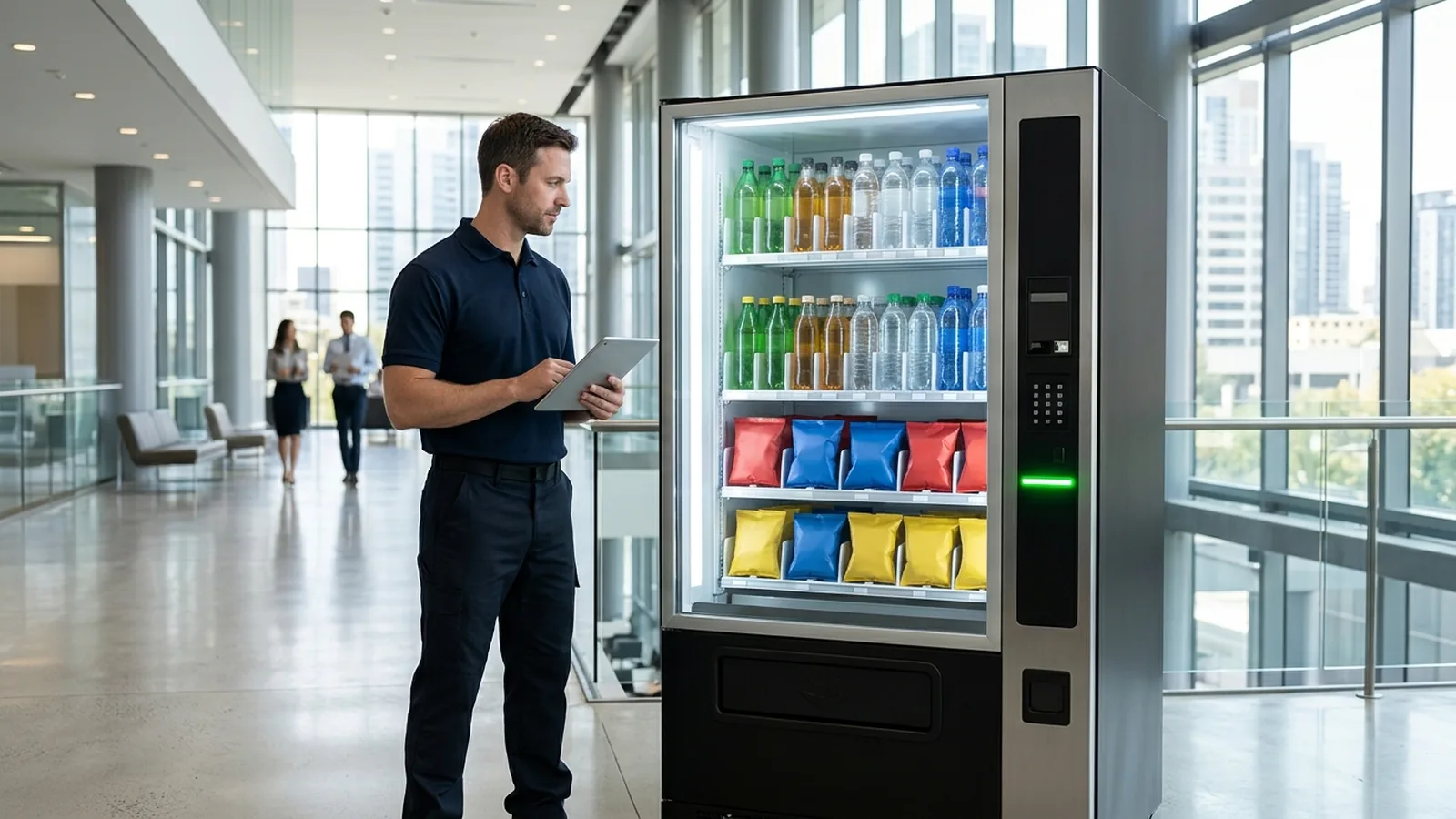
1. Business Entity, Federal Tax, and Local Licensing Foundations
According to Neuroshop, buying a vending machine in the U.S. requires no permit, but operating one commercially triggers federal tax obligations (an IRS EIN and self-employment tax at 15.3% on net earnings), state sales tax collection, city or county business registration, ADA accessibility compliance in public or semi-public locations, and local health department registration and inspections for food and beverage machines, which can take 4 to 8 weeks to process.
According to Vending Connection, an operator does not necessarily have to designate a vending machine business as a Limited Liability Company (LLC), though an LLC is commonly recommended to protect personal finances and property in case of legal action while passing profits and losses through to the owner's personal tax return, alongside state or local municipal requirements such as a beverage license or food service inspection certification from the health department.
As Vending Times reported on September 25, 2026, The Vending Club (based in Woodstock, Georgia) published an online 50-state regulatory reference covering vending machine regulations in all states, where each state page addresses licensing and registration, sales tax treatment, health rules for food and beverage machines, and restricted products (nicotine, vaping, hemp, alcohol, and public health supplies such as naloxone), and directs operators to the appropriate local authority where rules vary by county or municipality.
2. Food vs. Non-Food Vending Machine Permits and Statutory Exemptions
State food statutes draw a bright regulatory line between shelf-stable prepackaged snacks and perishable foods: under Ohio Revised Code Section 3717.42(B)(9), a vending machine location is exempt from the requirement to be licensed as a food service operation when the only foods dispensed are prepackaged foods that are not potentially hazardous, or nuts, panned or wrapped bulk chewing gum, or panned or wrapped bulk candies, and under Section 3717.42(B)(10) and (11), a place servicing the vending machines at a vending machine location described in division (B)(9) and a commissary servicing vending machines that dispense only milk, milk products, or frozen desserts under a state or federal inspection and analysis program are also exempt.
Under Ohio Revised Code Section 3717.42(B)(12), a controlled location vending machine location is exempt from food service operation licensing when (a) the vending machines dispense only foods that are not potentially hazardous, (b) the machines are designed to be filled and maintained in a sanitary manner by untrained persons, and (c) minimal protection is necessary to ensure against contamination of food and equipment.
Under Ohio Administrative Code 3717-1-01(B)(125), Time/temperature controlled for safety food or TCS food means a food that needs time/temperature control for safety to limit pathogenic microorganism growth or toxin formation—including an animal food that is raw or heat-treated, or a plant food that is heat-treated or consists of raw seed sprouts, cut melons, cut leafy greens, or cut tomatoes—whereas under 3717-1-01(B)(125)(b)(ii), TCS food does not include a food in an unopened hermetically sealed container that is commercially processed to achieve and maintain commercial sterility under conditions of non-refrigerated storage and distribution.
When a permit is required, facility layout determines how many location licenses apply: under Ohio Administrative Code 3717-1-01(130), a vending machine means a self-service device that automatically dispenses on the insertion of currency, token, card, key, by electronic transaction, or similar means a predetermined unit serving of food, either in bulk or in package, without having to be replenished after each use, and under 3717-1-01(131), a vending machine location means an area or room where one or more vending machines are installed and operated, except that if the machines within an area are separated by more than one hundred fifty feet, each area separated by that distance constitutes a separate vending machine location.
In Washington State, under WAC 246-215-08305(1) and (2), the regulatory authority may exempt a person from the provisions of WAC 246-215-08600(1) and 246-215-08300 to operate without a food establishment permit if the person does not use any food prepared in a residential kitchen or other nonapproved facility, limits food served to subsection (4), and submits a written application for an exemption at least 14 calendar days before providing food service; under WAC 246-215-08305(4), eligible non-TCS foods include (b) popcorn and flavored popcorn prepared from commercially packaged non-TCS food ingredients, (d) crushed ice drinks containing only non-TCS food ingredients and dispensed from a self-contained machine that makes its own ice, (g) roasted nuts, roasted peanuts, and roasted candy-coated nuts, and (j) cotton candy.
According to LivePlan, state food exemptions differ sharply across the country: in Wisconsin, a vending machine operator license ($125 plus $9 per machine annually) through the Department of Agriculture, Trade and Consumer Protection is required only for machines dispensing cold or hot cup beverages, ice cream, hot foods, or dairy products, whereas machines selling only prepackaged candy, gum, chips, or canned soda are explicitly exempt, and in Massachusetts the Division of Food Protection license excludes non-food and cigarette machines.
3. Health Department Hardware Rules: Automatic Shutoffs, Thermometers, and Sanitation
Both under Ohio Administrative Code 3717-1-04.1(Y)(2) and Washington Administrative Code WAC 246-215-04246 (FDA Food Code 4-204.111)(2), when the automatic shutoff within a machine vending Time/Temperature Control for Safety (TCS) food is activated: (a) in a refrigerated vending machine, the ambient temperature cannot exceed 41°F (5°C) for more than thirty minutes immediately after the machine is filled, serviced, or restocked; or (b) in a hot holding vending machine, the ambient air temperature cannot be less than 135°F (57°C) for more than one hundred twenty minutes immediately after the machine is filled, serviced, or restocked.
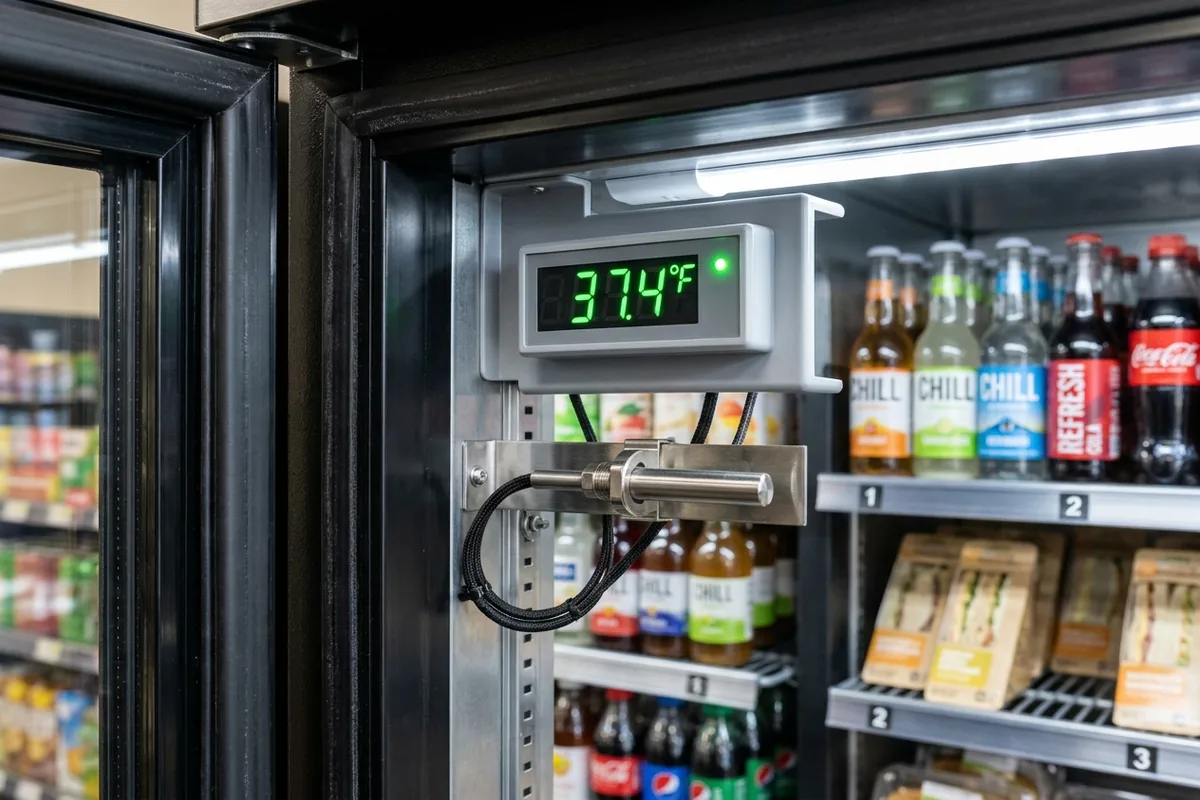
Commercial vending controllers enforce even tighter operational timers: according to the Royal Vendors RVV NG PCCD Service Manual (Health Sensor Operation), at power up the VMC checks the cooling compartment temperature and displays "Out of Order" if above 41°F (5°C), starting a 30-minute timer after the door is closed when temperature starts at 41°F (5°C) or below, while any time the vender is in a normal operating mode and the temperature reaches above 41°F (5°C), a 15-minute timer will start and the vender will display "Out of Order" if the temperature remains above 41°F (5°C) after 15 minutes.
Under Ohio Administrative Code 3717-1-04.1(Z)(1) and (5), in a mechanically refrigerated or hot food storage unit, the sensor of a temperature measuring device is to be located to measure the air temperature or a simulated product temperature in the warmest part of a mechanically refrigerated unit and in the coolest part of a hot food storage unit, and food temperature measuring devices are to have a numerical scale, printed record, or digital readout in increments no greater than two degrees Fahrenheit or one degree Celsius in the intended range of use.
Third-party sanitation certification cannot be waived for vending hardware: under Ohio Administrative Code 3717-1-04.1(LL)(1) and (2), food equipment must be approved by a recognized food equipment testing agency for sanitation, and the Ohio department of agriculture, the Ohio department of health, or the licensor may approve the use of non-tested food equipment only for equipment other than vending machines, bulk water machines, and equipment that displays TCS food in a micro market; additionally, under 3717-1-04.1, dispensing equipment in which TCS food in a homogenous liquid form is maintained outside of standard temperature control requirements must maintain commercial sterility of aseptically packaged food and conform to NSF/ANSI 18-2020 "Food and Beverage Dispensing Equipment."
Physical enclosure and drainage details are also inspected: under Ohio Administrative Code 3717-1-04.1(R)(1), the dispensing compartment of a vending machine must have a self-closing door or cover if located in an outside area without enclosure protection or if available for self-service during hours when not under the full-time supervision of a food employee; under 3717-1-04.1(II)(1) and (2), machines storing beverages in paper-product containers need diversion devices and retention pans or drains, while bulk liquid food or bulk water machines require an internally mounted waste receptacle and an automatic shutoff device that places the machine out of operation before the waste receptacle overflows; and under 3717-1-04.1(KK)(1) and (2), doors, access opening covers, and exterior wall service connection openings must be tight-fitting or closed by sealants, clamps, or grommets so openings are no greater than one-sixteenth inch or 1.5 millimeters (with interface surfaces at least one-half inch or thirteen millimeters wide where applicable).
Automated hot-food and smart-cooler systems combine these sanitation and safety rules: according to PizzaForno, vending machines serving hot prepared food such as hot pizza require local health department permits and inspections and adherence to FDA labeling rules; almost every state requires a general business license; a state seller's permit is essential for taxable goods; and zoning regulations may require specific permits depending on placement; as Vending Times reported on October 9, 2026, Primepick's MealMate automated hot-food vending system (offered in 91-meal and 320-meal configurations) targets 0 degrees Fahrenheit in frozen storage and permanently marks affected meals as scrap and moves them into a quarantine position if temperature or holding-time limits are breached; and as Kiosk Industry reported from the NAMA 2026 Show, Aeritek Holdings showcased its NSF-approved, PCI-compliant, and ADA-compliant Pop Cooler smart cooler, Cantaloupe Inc. showcased its Hot Hold vending machine maintaining food at up to 158 degrees Fahrenheit, and Crave Robotics showed a hot-food vending machine with 140 individual slots whose front ordering touchscreen meets the ADA requirement of being 48 inches from the floor.
4. State Sales Tax Permits, Gross Receipts Formulas, and Machine Decals
In Texas, under 34 Texas Administrative Code Section 3.293(h)(1), a seller of taxable food and beverages must obtain a sales tax permit, file sales tax returns, and remit the tax to the comptroller under Section 3.286: under 34 Texas Administrative Code Section 3.293(a)(3) and (a)(9), food sold through vending machines means food dispensed from a machine that accepts payment (distinct from a bulk vending machine that randomly dispenses unsorted items), and under 34 Texas Administrative Code Section 3.293, a Texas vending machine operator must remit sales tax on the total gross receipts from sales of soft drinks and candy without any deduction for spoilage, waste, or other losses, and must remit sales tax on 50% of the total gross receipts from sales of food products without any deduction for spoilage, waste, or other losses.
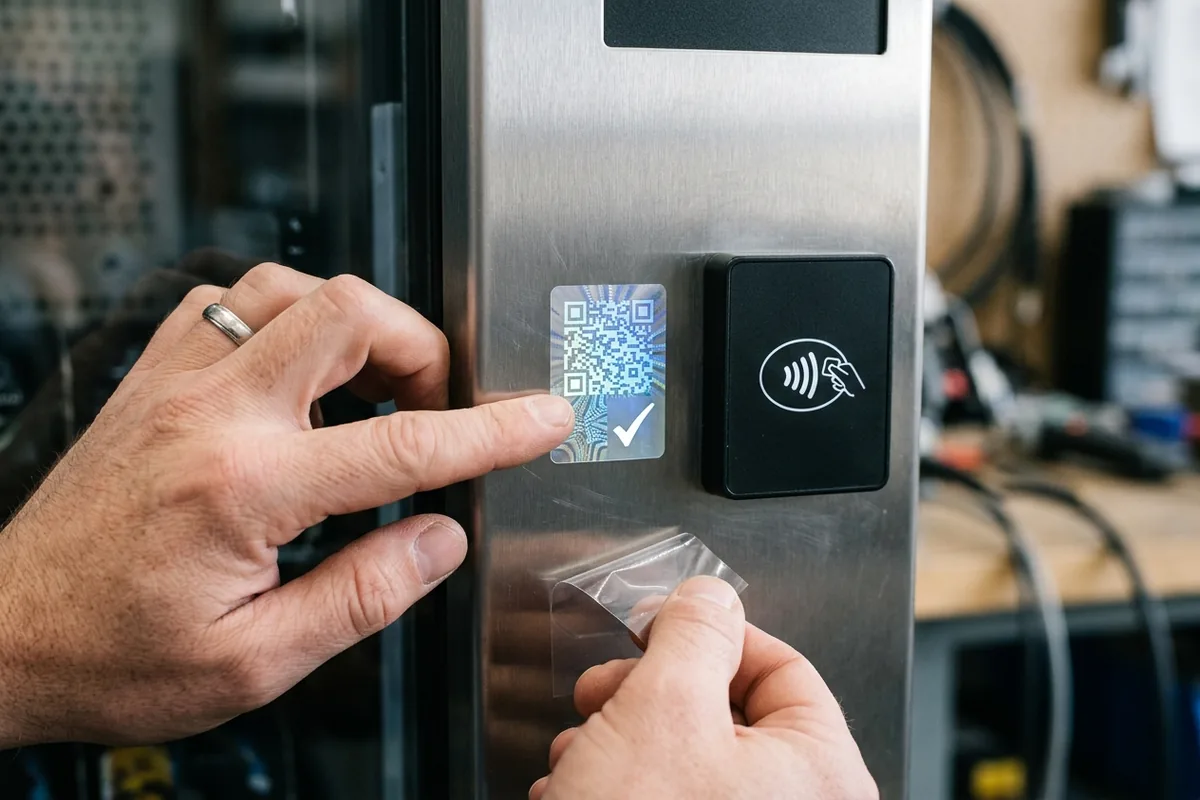
Under 34 Texas Administrative Code Section 3.293, water—including bottled water, spring water, sparkling water, or mineral water—is exempt from Texas sales tax so a vending machine operator is not required to remit sales tax on receipts from sales of water, and the operator must place a sign on the vending machine stating that the vended price includes sales tax; additionally, under 34 Texas Administrative Code Section 3.293(e)(1), food, gum, candy, and toys sold for $0.50 or less from a bulk vending machine as defined in subsection (a)(3) are exempt from Texas sales tax, and an operator with only exempt bulk vending machine sales may choose to obtain a sales tax permit.
In California, under Title 18, Section 1574(2) and (3), adequate and complete records must be kept by the operator showing the location or locations of each machine and its serial number, with a schedule attached to the return showing the tax allocable to each county if operated in more than one county; under Title 18, Section 1574, sales of purified drinking water through vending machines where water enters through local supply lines and is dispensed into the customer's own containers are exempt under Revenue and Taxation Code Section 6353, and the operator is the consumer (not retailer) of food products, including candy and confectionery, sold at retail for 15 cents or less and of unsorted food, candy, and confectionery sold through a coin-operated bulk vending machine for twenty-five cents ($0.25) or less; furthermore, under Title 18, Section 1574(C), beginning January 1, 1988, a partial exemption applies to gross receipts from cold food products, hot coffee, hot tea, and hot chocolate (77% taxable for calendar year 1988, 55% for calendar year 1989, and 33% thereafter, excluding other hot prepared food products), where under Title 18, Section 1574, taxable receipts for the year 1990 and forward are calculated using the cold food factor percentage = 100 / [3.0303 + tax rate (decimal form)], which equals 32.2289% at a 7.25% tax rate, 32.2160% at 7.375%, and 32.2030% at 7.50%.
In Florida, under Administrative Code Rule 12A-1.044(3), owners or operators of vending machines must obtain a separate Sales and Use Tax Certificate of Registration (Form DR-11) for each county in which the machines are located (one Form DR-11 is sufficient for all machines within a single county); under Rule 12A-1.044, if the machine owner has constructive possession and control while the location owner has physical possession, the operator is determined by who has the key to the money box and is responsible for removing the receipts; and receipts from vending machines owned and operated by churches or synagogues are exempt, as are food and drinks sold for 25 cents or less through a coin-operated vending machine sponsored by a nonprofit corporation under Section 501(c)(3) or (4) of the Internal Revenue Code of 1986, and food and beverages sold through vending machines in student lunchrooms or dining rooms of schools attended by pupils of grades K through 12.
According to VMFS USA, state machine decal or tag rules usually come from food licensing or tax laws—for example, Iowa Code 137F.6 requires each licensed food and beverage vending machine to bear a readily visible identification tag or decal with the licensee's business address, phone number, and assigned company license number, and Florida DBPR requires affixing the license decal in a prominent place on licensed food vending machines—whereas the Texas $60 coin-operated machine occupation tax applies to game, music, and amusement machines and excludes merchandise vending machines.
5. Federal FDA Calorie Labeling, Randolph-Sheppard Permits, and DOE Energy Rules
At the federal level, under 21 CFR Section 101.8, covered vending machine food means an article of food sold from a vending machine that does not permit the prospective purchaser to examine the Nutrition Facts label before purchasing the article and is operated by a person engaged in the business of owning or operating 20 or more vending machines (or by an operator voluntarily registered with FDA, who must register every other year within 60 days prior to the expiration of current registration); an article is exempt from separate calorie declaration signage when the prospective purchaser can view the calories, serving size, and servings per container on the Nutrition Facts label without any obstruction or on a reproduction that complies with Section 101.9, and covered machines must list the operator's name, telephone number, and mailing address or email address.
For vending facilities on Federal property under the Randolph-Sheppard program (34 CFR Section 395.1, 93-516, 20 U.S.C., ch. 6A, Sec 107), a license means a written instrument issued by the State licensing agency to a blind person authorizing operation of a vending facility on Federal or other property, whereas a permit means the official approval given a State licensing agency by a department, agency, or instrumentality in control of Federal property (or person in control of other property) to establish a vending facility; under 34 CFR Section 395.1(q), a satisfactory site requires an area fully accessible to patrons having, effective on March 23, 1977, a minimum of 250 square feet available for the vending and storage of articles necessary for the operation of a vending facility, plus sufficient electrical, plumbing, heating, and ventilation outlets in accordance with applicable health laws and building codes.
Equipment energy standards also separate beverage coolers from perishable food machines: under 10 CFR Section 431.292, Class A means a refrigerated bottled or canned beverage vending machine that is not a combination vending machine and in which 25 percent or more of the front surface area is transparent (while Combination B is a combination vending machine not considered Combination A), and under 10 CFR Section 431.296(b), each refrigerated bottled or canned beverage vending machine manufactured on or after January 8, 2019 shall have a daily energy consumption (in kilowatt hours per day) not exceeding 0.052 × V + 2.43 for Class A, 0.052 × V + 2.20 for Class B, 0.086 × V + 2.66 for Combination A, and 0.111 × V + 2.04 for Combination B, where V is the refrigerated volume (ft 3) pursuant to 10 CFR 429.52(a)(3); under the EPA ENERGY STAR Version 4.0 specification, refrigerated food vending machines are not eligible for ENERGY STAR, beverage vending machine maximum daily energy consumption limits (kWh/day) are 0.04836V + 2.2599 for Class A, 0.04576V + 1.936 for Class B, 0.07998V + 2.4738 for Combination A, and 0.09768V + 1.7952 for Combination B (with a 3% credit for refrigeration low power mode), and machines that house temperature sensitive products, such as milk, shall not have the refrigeration low power state enabled on site due to the risk of product spoilage.
6. Site Electrical, Stock Storage, and Hardware Selection Before You Apply
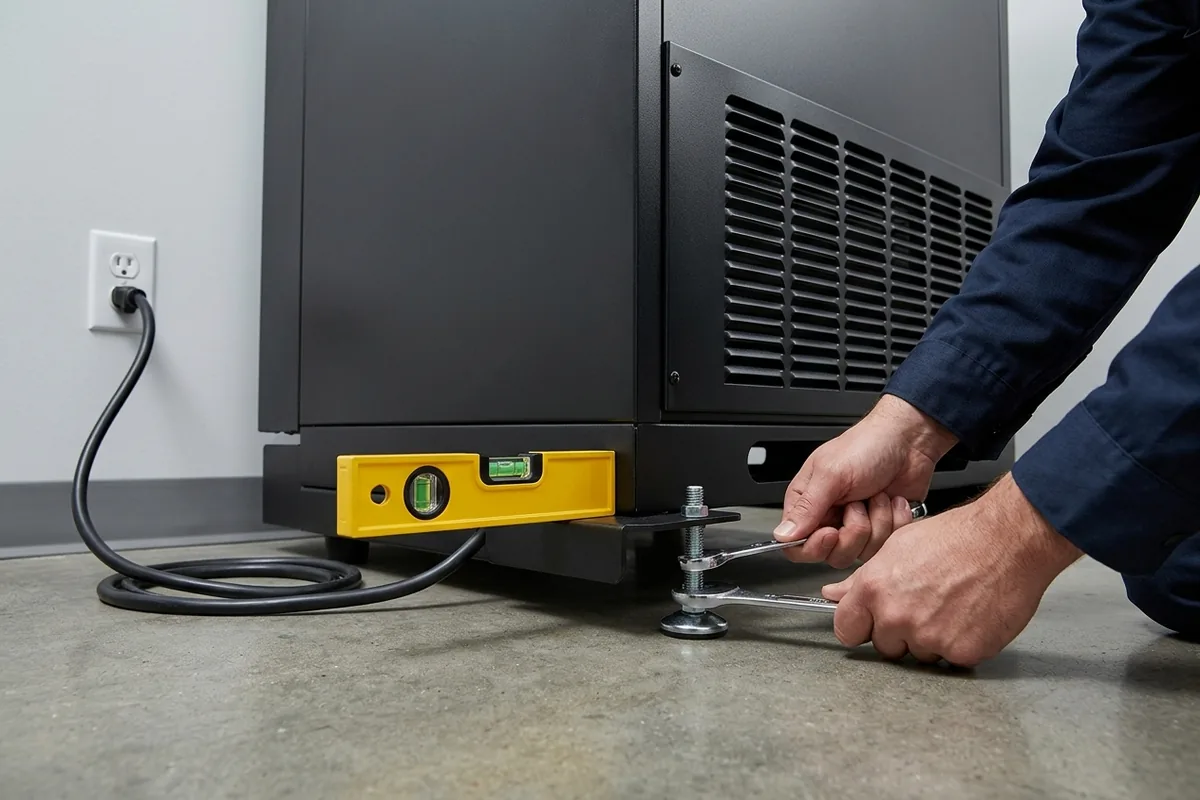
Local health and building inspectors verify both stock storage and electrical connections on site: under WAC 246-215-03351 (FDA Food Code 3-305.11)(1), (2), and (3), food must be stored in a clean, dry location at least six inches (15 cm) above the floor, except that food in packages and working containers may be stored less than six inches (15 cm) above the floor on case lot handling equipment under WAC 246-215-04268, and pressurized beverage containers, cased food in waterproof containers such as bottles or cans, and milk containers in plastic crates may be stored on a clean floor not exposed to floor moisture; meanwhile, according to the Royal Vendors RVV NG PCCD Service Manual, the vender is designed to operate at 115 volts AC, 60 Hertz on the minimum of a 15 amp service that should be on a dedicated circuit (with service outlet voltage not exceeding 129 VAC or falling below 103 VAC) and must be plugged via its three-wire grounding cord into a grounded electrical outlet without using an extension cord unless authorized by a certified electrician.
Matching the cabinet format to the regulatory category simplifies permitting across our catalog: on our combo vending machines page, the AI Smart Combo Vending Machine, Pro Combo Elevator AD Vending Machine, and Slim Combo Vending Machine are configured around the buyer's products, packaging, installation site, and requested cooling conditions; on our bottled-water vending machines page, the Water Bottle Vending Machine dispenses a finished packaged drink, whereas water refill equipment meters water into a customer container and requires a separately specified source-water, treatment, metering, and local operating review (no refill model is currently listed); and on our trading card vending machines page, non-food trading card vending machines (including the TCG Vending Machine, PRO XL Trading Card Vending Machine, Sports Card Vending Machine, and Trading Card Vending Machine) are configured around sealed booster packs, sleeves, protective cases, tins, and boxed collections, with explicit notice that Pokémon names identify the intended merchandise only and that card stock, artwork permissions, and machine configuration are separate project requirements.
Cross-checking thermal zones, cabinet security, and corridor dimensions before ordering prevents site rejections: on our what sells in vending machines guide, the Thermal Zone Matrix spans Ambient, Chilled (≤41°F), Floral (31°F–39°F), and Deep-Frozen (≤0°F) States, including Chilled Beverages and TCS Perishable Foods (36°F to 41°F / 2.2°C to 5°C); on our micro market versus vending machine guide, a closed vending machine keeps merchandise inside a locked cabinet until payment is authorized and verifies delivery with an optical drop sensor and NAMA Multi-Drop Bus VEND FAILURE specification, whereas Maryland grants a micro-market person-in-charge exemption when packaging, dating, and 41°F self-closing self-locking cooler rules are satisfied; and on our vending machine installation guide, the Slim Combo record lists cabinet dimensions of 76.5 x 28.7 x 31.2 in (H x W x D) and approximately 474 lbs from an authorized catalog snapshot dated 13 September 2026, while the Royal Vendors RVV Gen II service manual (printed April 2017) lists its 280-capacity version at 72 in H x 39 in W x 36.5 in D with an approximate empty weight of 720 lbs (327 kg), and the University of Maryland vending specification page does not allow any part of a corridor to be narrowed below 44 inches.
Sources
Ohio General Assembly — Ohio Revised Code Section 3717.42 (Exclusions from Food Service Operation Licensing); Ohio Department of Health and Department of Agriculture — Ohio Administrative Code 3717-1-01 (Uniform Food Safety Code Definitions) and 3717-1-04.1 (Equipment, Utensils, and Linens: Design and Construction); Washington State Department of Health — WAC 246-215-04246 (FDA Food Code 4-204.111 Vending Machine Automatic Shutoff), WAC 246-215-03351 (FDA Food Code 3-305.11 Food Storage), and WAC 246-215-08305 (Exemptions from Food Establishment Permit Requirements).
Texas Comptroller of Public Accounts — 34 Texas Administrative Code Section 3.293 (Food; Food Products; Meals; Food Service — Vending Machine Sales Tax Rules); California Department of Tax and Fee Administration — 18 CCR Section 1574 (Sales and Use Tax Regulations: Vending Machine Operators); Florida Department of Revenue — Florida Administrative Code Rule 12A-1.044 (Sales and Use Tax: Vending Machines).
U.S. Food and Drug Administration — 21 CFR Section 101.8 (Vending Machines Calorie Labeling and Operator Contact Identification); U.S. Department of Education — 34 CFR Section 395.1 (Randolph-Sheppard Vending Facility Program Definitions for Permits on Federal Property); U.S. Department of Energy — 10 CFR Section 431.292 and Section 431.296 (Energy Conservation Standards for Refrigerated Bottled or Canned Beverage Vending Machines); U.S. Environmental Protection Agency — ENERGY STAR Program Requirements for Refrigerated Beverage Vending Machines, Version 4.0.
Royal Vendors — RVV NG PCCD Service Manual (Health Sensor Operation & Electrical Installation); PizzaForno — Permitting a Vending Machine in the United States; LivePlan — How to Start a Vending Machine Business; Neuroshop — Do You Need a License for a Vending Machine?; VMFS USA — Vending Machine Permits in the United States; CandyMachines.com — Permits and Licensing Requirements for Your Vending Business; VendBuddy — Vending Machine Permits & Requirements by State; Vending Connection — Do I Need an LLC for a Vending Machine Business?; Vending Times — The Vending Club 50-State Regulatory Reference and Primepick MealMate Automated Hot-Food Safety Controls; Kiosk Industry — NAMA 2026 Show Report; VendingMachineSource — Commercial Vending Machines, Combo Vending Machines, Water Vending Machines, Trading Card Vending Machines, What Sells in Vending Machines, Micro Market Versus Vending Machine, and Vending Machine Size and Installation.
Permit Triage Matrix: Food vs. Non-Food Vending Machine Permits
| Product & Cabinet Type | Health Department Food Permit | Sales Tax Seller's Permit | Hardware & Site Compliance Checkpoints |
|---|---|---|---|
| Non-food retail merchandise (trading card vending machines, cosmetics, perfume sprays) | Excluded from food protection licensing (Massachusetts Division of Food Protection excludes non-food and cigarette machines per LivePlan) | State seller's permit required for taxable retail property (California 18 CCR Section 1574(1) requires a permit and operator statement on each machine) | Closed cabinet locks merchandise until payment and verifies delivery via optical drop sensor and NAMA Multi-Drop Bus VEND FAILURE per VendingMachineSource |
| Shelf-stable prepackaged snacks, bulk gum/candy/nuts, and canned soda | Exempt from food service operation licensing under Ohio Revised Code Section 3717.42(B)(9) and exempt from Wisconsin's $125 plus $9 per-machine food operator license per LivePlan | Texas 34 TAC Section 3.293 taxes the total gross receipts of soft drinks and candy and 50% of food product gross receipts while exempting food, gum, candy, and toys sold for $0.50 or less from a bulk vending machine | Unopened hermetically sealed containers maintaining commercial sterility without refrigeration are excluded from TCS classification under Ohio Administrative Code 3717-1-01(B)(125)(b)(ii) |
| Refrigerated TCS foods and chilled dairy/meals in combo vending machines | Retail food establishment health permit, plan review, annual inspection, 41°F control, and ServSafe certification required per VendBuddy (4 to 8 weeks processing per Neuroshop) | California 18 CCR Section 1574(C) taxes 33% of cold food receipts after 1989 using cold food factor 100 / [3.0303 + tax rate] (32.2289% at 7.25%) | Automatic shutoff locks vending if cabinet exceeds 41°F (5°C) for more than thirty minutes after restocking under WAC 246-215-04246(2)(a) or 15 minutes in normal mode on Royal Vendors RVV NG PCCD |
| Hot-holding and automated hot-food vending machines | Local health permits and inspections required; zoning permits may apply per PizzaForno | California 18 CCR Section 1574(C) partial exemption excludes hot prepared food products other than hot coffee, hot tea, and hot chocolate | Automatic shutoff locks vending if ambient air falls below 135°F (57°C) for more than one hundred twenty minutes after restocking under WAC 246-215-04246(2)(b); Primepick MealMate targets 0 degrees Fahrenheit in frozen storage per Vending Times |
State Sales Tax, Water Exemptions, and Machine Decal Rules Compared
| State & Rule | Registration & Machine Decal Scope | Food & Beverage Tax Base | Water & Low-Price Bulk Exemptions |
|---|---|---|---|
| Texas — 34 TAC Section 3.293 | Seller must obtain a sales tax permit under Section 3.286 and post a sign on the vending machine stating that the vended price includes sales tax; Texas $60 coin-operated occupation tax excludes merchandise vending machines per VMFS USA | Tax applies to the total gross receipts on soft drinks and candy and 50% of total gross receipts on food products without any deduction for spoilage, waste, or other losses | Bottled water, spring water, sparkling water, and mineral water are exempt from Texas sales tax, and food, gum, candy, and toys sold for $0.50 or less from a bulk vending machine are exempt under Section 3.293(e)(1) |
| California — 18 CCR Section 1574 | One seller's permit covers all machines of one operator; each machine must bear a conspicuous statement with operator name, address, and permit number plus serial-number location records and multi-county allocation schedules | Partial exemption sets taxable cold food, hot coffee, hot tea, and hot chocolate receipts at 33% after 1989 (cold food factor 32.2289% at 7.25%, 32.2160% at 7.375%, and 32.2030% at 7.50%) | Purified drinking water entering through local supply lines into the customer's own containers is exempt under Revenue and Taxation Code Section 6353, and operator is consumer of food products, including candy and confectionery, sold at retail for 15 cents or less and of unsorted food products, including candy and confectionery, sold through a coin-operated bulk vending machine for $0.25 or less |
| Florida — Rule 12A-1.044 | Separate Sales and Use Tax Certificate of Registration (Form DR-11) required for each county (one Form DR-11 covers all machines in a single county); Florida DBPR requires a prominent decal on licensed food machines per VMFS USA | Operator responsibility is determined by who holds the key to the money box and removes receipts when the location owner has physical possession of the machine | Exempts machines owned and operated by churches or synagogues, food and drinks sold for 25 cents or less through a coin machine sponsored by a 501(c)(3) or (4) nonprofit under the Internal Revenue Code of 1986, and K through 12 school dining room machines |
Common questions
Do I need a health department permit for a vending machine selling only prepackaged snacks and canned soda?
Under Ohio Revised Code Section 3717.42(B)(9), a vending machine location is exempt when dispensing only prepackaged foods that are not potentially hazardous or nuts, panned or wrapped bulk chewing gum, or panned or wrapped bulk candies, and according to LivePlan, Wisconsin exempts machines selling only prepackaged candy, gum, chips, or canned soda from its $125 plus $9 per-machine annual vending operator license.
What triggers an automatic health lockout on a refrigerated or hot-food vending machine?
Under Washington Administrative Code WAC 246-215-04246 (FDA Food Code 4-204.111)(2) and Ohio Administrative Code 3717-1-04.1(Y)(2), an automatic shutoff must prevent vending if ambient temperature in a refrigerated vending machine exceeds 41°F (5°C) for more than thirty minutes or in a hot holding vending machine falls below 135°F (57°C) for more than one hundred twenty minutes immediately after filling, servicing, or restocking, while the Royal Vendors RVV NG PCCD Service Manual specifies a 15-minute timer during normal operating mode if cooling compartment temperature rises above 41°F (5°C).
Do I need a separate sales tax permit for every vending machine I operate?
State rules determine whether registration is statewide or per county: under California Code of Regulations Title 18, Section 1574(1), one seller's permit is sufficient for all machines of one operator statewide provided each machine displays the operator's name, address, and permit number, whereas under Florida Administrative Code Rule 12A-1.044(3), an operator must obtain a separate Sales and Use Tax Certificate of Registration (Form DR-11) for each county in which machines are located, with one Form DR-11 covering all machines within that single county.
When do FDA calorie labeling rules apply to vending machines?
Under 21 CFR Section 101.8, federal calorie disclosure and operator contact signage rules apply to covered vending machine food sold by a person engaged in the business of owning or operating 20 or more vending machines (or a voluntarily registered operator who renews registration every other year within 60 days prior to expiration), and an item is exempt from separate calorie signage when the prospective purchaser can view the calories, serving size, and servings per container on the Nutrition Facts label without obstruction or on a compliant Section 101.9 reproduction.
Can I enable ENERGY STAR refrigeration low-power mode on a vending machine stocked with milk or perishable food?
No: under the EPA ENERGY STAR Version 4.0 specification for refrigerated beverage vending machines, refrigerated food vending machines are not eligible for ENERGY STAR, and beverage vending machines that house temperature sensitive products, such as milk, shall not have the refrigeration low power state enabled on site due to the risk of product spoilage.
How do permits differ between sealed bottled-water vending machines and bulk water refill machines?
On VendingMachineSource, bottled-water vending dispenses a finished packaged drink from a refrigerated cabinet (and unflavored bottled, spring, sparkling, or mineral water is exempt from Texas sales tax under 34 TAC Section 3.293), whereas bulk water refill equipment meters water into a customer's container (exempt from California sales tax under 18 CCR Section 1574 and Revenue and Taxation Code Section 6353 when entering through local supply lines) and must meet Ohio Administrative Code 3717-1-04.1(II)(2) and (KK)(1) rules for internal waste receptacles, automatic overflow shutoffs, and tight-fitting doors with openings no greater than one-sixteenth inch or 1.5 millimeters.
Continue exploring
Vending Machine Range
Vending machine manufacturing by 特拼科技. Explore product configurations, sample checks, payment integration and factory acceptance for your operating site.
Trading Card Vending Machines
Trading Card Vending Machines for commercial projects. Review product fit, configuration, sample checks, payment requirements and factory acceptance with our team.
Cosmetic Vending Machines
Cosmetic Vending Machines for commercial projects. Review product fit, configuration, sample checks, payment requirements and factory acceptance with our team.
Bottled Water Vending Machines
Bottled Water Vending Machines for commercial projects. Review product fit, configuration, sample checks, payment requirements and factory acceptance with our team.
Vending Machine Size and Installation: Check the Route Before You Order
There is no standard vending machine size. Compare the quoted unit's cabinet and packed dimensions with every door, turn, lift and final position, and name who signs each check.
Discuss your vending project
Send the items in the project brief above to discuss the selected configuration, sample checks and delivery scope. Share your products, site and payment requirements with our team.