

Updated October 2026
Micro Market Versus Vending Machine: Shrinkage, Staffing, and Access Control Trade-Offs
Choosing between a closed vending machine and an open micro market starts with your building access boundary, theft and shrinkage risk, product handling method, and daily replenishment routine. Under Maryland health regulations, a micro market is an unstaffed, self-checkout retail food service facility that includes one or more micro market displays, has an automated payment kiosk, is located indoors and within a separate business, and is generally accessible only to individuals within the building. Maryland definitions state that a micro market display means the place where food being sold by a micro market is displayed—including an open rack, a refrigerator or a refrigerated cooler, a freezer, a vending machine, a beverage dispenser, or a single-serve coffee machine—whereas a vending machine means a self-service device that dispenses either packaged or unpackaged food. Use this comparison to evaluate closed vending machine vs open micro market trade-offs across shrinkage protection, unstaffed health-code exemptions, cold-chain lockout rules, refrigeration energy standards, payment architecture, and cabinet selection. Operating as 特拼科技, VendingMachineSource is a vending machine manufacturer whose range covers flowers, perfume sprays, trading cards, cosmetics, packaged snacks and drinks, packaged ice, sealed bottled water, ice cream, and coffee equipment. The project specification identifies the cabinet, product handling, storage conditions, payment interface, and replenishment access, while installation, payment processing, and local repairs are not assumed.
Closed vending machine vs open micro market format matrix
| Evaluation dimension | Closed vending machine | Smart unlock cooler | Open micro market |
|---|---|---|---|
| Site access boundary | Public corridors, lobbies, and shared spaces | Supervised or semi-public indoor breakrooms and offices | Indoor breakrooms accessible only to building occupants |
| Merchandise security | Locked cabinet with single-unit dispensing after payment | Locked door that releases after card tap and relocks on close | Open racks and reach-in coolers with surveillance where required (for example Texas 24/7 video) |
| Checkout and refund control | Selection keypad or touchscreen with delivery or drop sensing where fitted | Tap, unlock, take, and close sequence with automatic settlement | Self-checkout barcode kiosk with posted permit-holder signage |
| Perishable food safety | Automatic shutoff control that blocks vending on temperature fault | Tamper-evident dated packages in self-closing, self-locking coolers | |
| Daily route servicing | Fill coils or trays, clear bill or product jams, and test sensors | Restock flat shelves, verify product recognition, and check door lock | Rotate dated stock on open racks, inspect coolers, and audit kiosk logs |
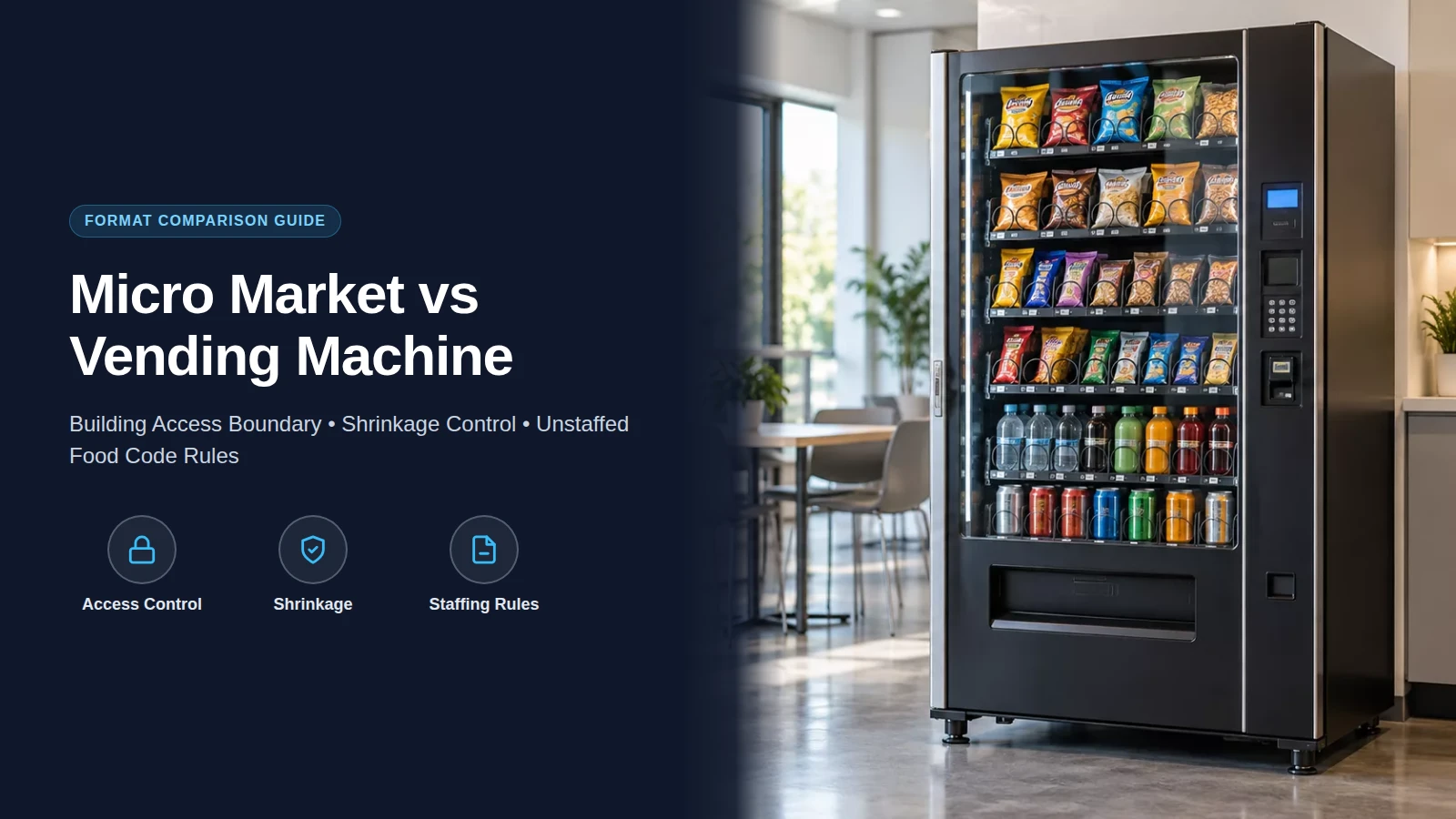
Explore our commercial vending machine catalog and combo vending machines to compare smart unlock cooler and closed elevator cabinet configurations for your site. Review the AI Smart Combo Vending Machine smart unlock cooler alongside the Pro Combo Elevator AD Vending Machine closed elevator cabinet.
Access boundary and footprint: indoor restricted breakrooms vs public corridors
Begin the site review by recording who can enter the room during operating hours and how much floor and wall frontage is available. Under Ohio Food Safety Rules, a micro market offers food items in displays not more than two hundred and fifty linear feet, whereas a vending machine dispenses a predetermined unit serving on the insertion of currency, token, card, or key by electronic transaction, and machines separated by more than one hundred fifty feet constitute a separate vending machine location.
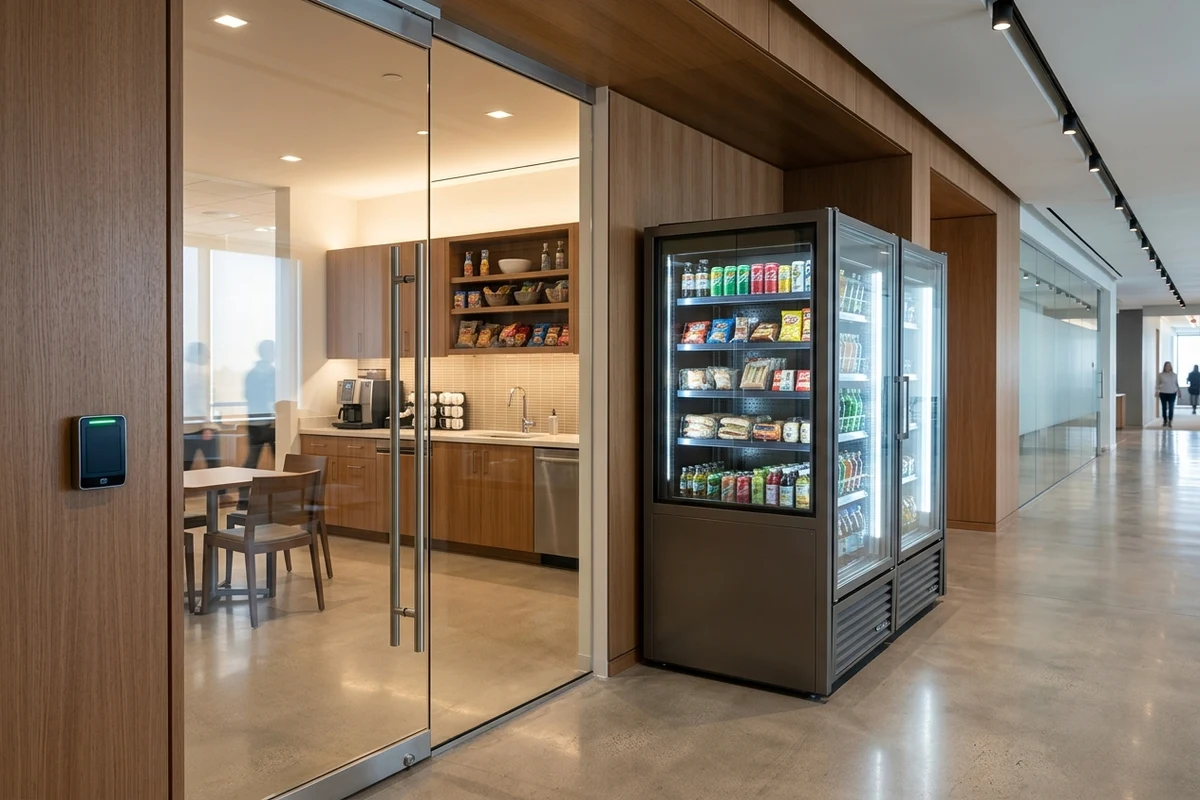
An open micro market relies on the host building to restrict casual walk-in traffic, whereas an enclosed vending cabinet locks inventory behind a physical barrier in corridors, lobbies, and shared common areas. At VendingMachineSource, we configure combo vending machines around your products, packaging, installation site, and daily operating routine, connecting the selected machine to sample checks, payment integration, factory acceptance, mixed-product release, failed-vend handling, snack-and-drink list, package drawings, and requested cooling conditions.
Shrinkage and vend verification: honor-system surveillance vs locked unit dispensing
In an open micro market, shoppers handle products on open racks and reach-in coolers before scanning at the kiosk, so loss prevention depends on tamper-evident packaging, with continuous camera recording required under Texas rules and optional under Maryland rules. Under Texas self-service food market rules, a facility must be equipped with 24/7 video surveillance records of consumers viewing, selecting, handling, and purchasing products and must provide information to the regulatory authority on the responsible party available for routine inspections. In Texas, pre-packaged food sold at a self-service food market must meet the labeling requirements specified in the Food Code and be tamper evident. Maryland micro market rules allow securing the products and premises using video surveillance that operates 24 hours per day, 7 days per week, records consumers viewing, selecting, handling, and purchasing products, is maintained by the owner for 14 days, and is made available for inspection within 24 hours.
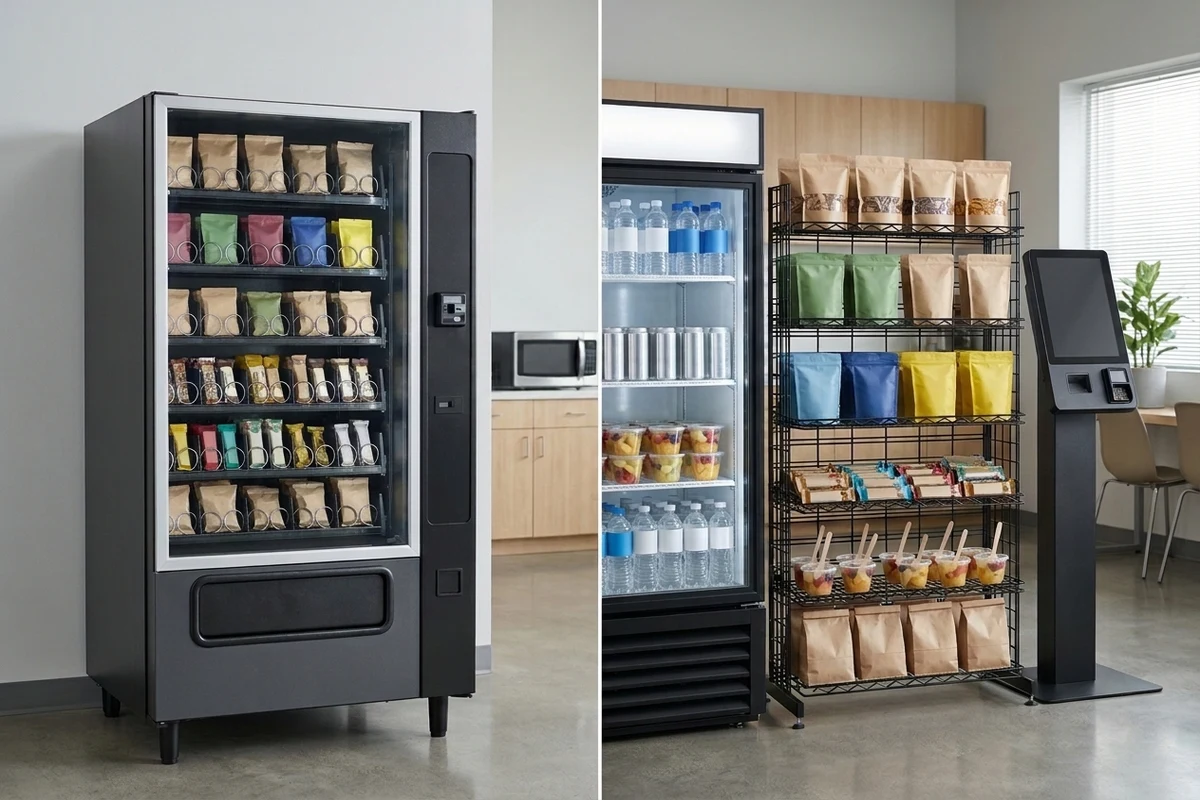
A closed vending machine keeps merchandise inside a locked cabinet until payment is authorized, and some glass-front cabinets (e.g. Royal RVV NG) verify delivery with an optical drop sensor at the chute. In a closed vending machine delivery sensor, an emitter below the product delivery port emits an infrared beam to a receiver above the delivery port, and when a product falls into the delivery port, the infrared beam is broken, signalling to the board that a vend has been made. Under the NAMA Multi-Drop Bus VEND FAILURE specification, when a vend has been attempted at the Vending Machine Controller and a problem is detected so the product was not dispensed, funds should be refunded to the user's account, and for shopping basket vend mode this value should be accumulated by the cashless device for all products with VEND FAILURE.
Unstaffed operation, signage, and route servicing responsibilities
Neither format requires a cashier on site, but Texas grants the unstaffed person-in-charge exemption when packaging, labeling, surveillance, and signage rules are satisfied, while Maryland grants it when packaging, dating, and 41°F self-closing self-locking cooler rules are satisfied. Under Texas retail food rules, a self-service food market must display a sign readily visible from the automated payment kiosk stating the name of the business, address, telephone number, and email, and a compliant facility will not be required to maintain a person in charge onsite. In Maryland, a micro market is not required to have a person-in-charge present if the food sold is prepackaged in tamper-evident packaging with a freshness or expiration date and stored in a unit that maintains an internal temperature of 41°F or lower, has self-closing doors, and has an automated self-locking feature.
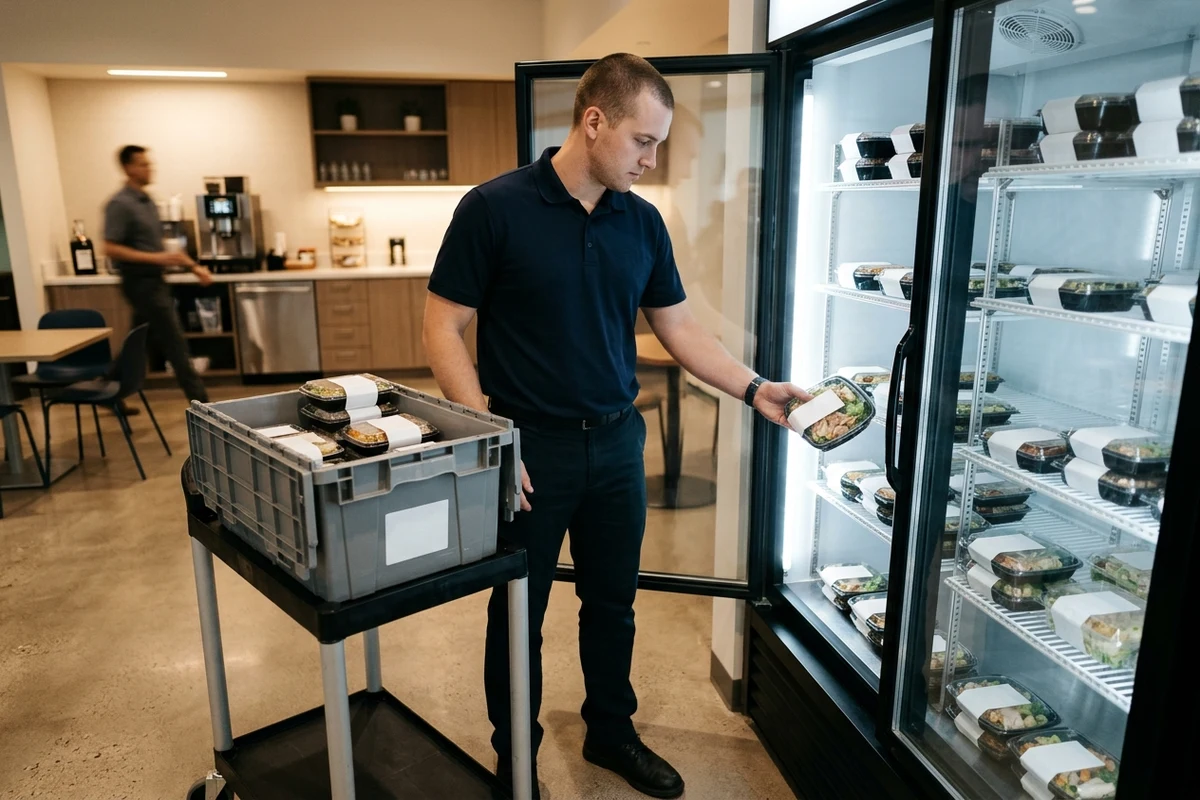
Standard vending servicer tasks include filling machines with products, ingredients, money, and other supplies, maintaining records of machine maintenance and repair, keeping records of merchandise distributed and money collected, and collecting coins and bills from machines to prepare invoices and settle accounts with concessionaires. Document who will perform restocking, date-code rotation, camera review, cleaning, and mechanical service visits before finalizing the site layout.
Cold-chain lockout and refrigeration energy standards
Refrigerated micro-market coolers and refrigerated food vending machines are subject to jurisdiction-specific automatic shut-off or self-locking rules when stocking perishable Time/Temperature Control for Safety food. In Texas, self-service food market display units offering refrigerated time and temperature control for safety foods shall have an automatic shut-off control or a plan approved by the regulatory authority that prevents the market or market equipment from dispensing food if there is a power failure, mechanical failure, or other condition that results in failure to maintain food temperatures. When such a condition occurs, the ambient temperature may not exceed five degrees Celsius (41 degrees Fahrenheit), or seven degrees Celsius (45 degrees Fahrenheit) for a unit holding raw shell eggs only, for more than 30 minutes immediately after the display is filled, serviced, or restocked. In a refrigerated vending machine vending Time/Temperature Control for Safety food under Washington rules, an automatic control must prevent the machine from vending food if there is a power failure, mechanical failure, or other condition that results in an internal machine temperature that cannot maintain food temperatures, until the machine is serviced and restocked with food that has been maintained at required temperatures. When the automatic shutoff is activated, in a refrigerated vending machine the ambient temperature may not exceed 41°F (5°C) for more than thirty minutes immediately after the machine is filled, serviced, or restocked, or in a hot holding vending machine the ambient air temperature may not be less than 135°F (57°C) for more than one hundred twenty minutes immediately after the machine is filled, serviced, or restocked. Under Maryland rules, upon the failure of an automated self-locking unit at a micro market, records are kept for the repair or replacement of the unit and the product description and quantity of products discarded or destroyed, and service receipts are kept for a minimum of 90 days.
Federal energy conservation standards classify refrigerated bottled or canned beverage vending machines into Class A when the machine is not a combination vending machine and 25 percent or more of the surface area on the front side is transparent, Class B when not considered Class A and not a combination vending machine, Combination A when a combination vending machine has 25 percent or more of the surface area on the front side transparent, and Combination B when a combination vending machine is not considered Combination A. Each refrigerated bottled or canned beverage vending machine manufactured on or after January 8, 2019 shall have a daily energy consumption in kilowatt hours per day that does not exceed 0.052 × V + 2.43 for Class A, 0.052 × V + 2.20 for Class B, 0.086 × V + 2.66 for Combination A, and 0.111 × V + 2.04 for Combination B. Under federal commercial refrigerator standards, daily energy consumption in kWh/day is 0.1 × V + 0.86 for Vertical Closed Transparent medium-temperature units, 0.05 × V + 1.36 for Vertical Closed Solid medium-temperature units (VCS.SC.M), and 1.69 × TDA + 4.71 for Vertical Open medium-temperature units. Under ENERGY STAR Version 4.0 criteria for refrigerated beverage vending machines, maximum daily energy consumption in kWh/day is 0.04836V + 2.2599 for Class A, 0.04576V + 1.936 for Class B, 0.07998V + 2.4738 for Combination A, and 0.09768V + 1.7952 for Combination B, with a 3% credit for refrigeration low power mode, though machines housing milk shall not have the refrigeration low power state enabled.
Payment bus architecture and transaction fee structure
Compare how the payment terminal authorizes selections and handles multi-item baskets before selecting hardware. Inside a vending machine, the NAMA Multi-Drop Bus interface is a 9600 baud Master-Slave arrangement where one Master, defined as the Vending Machine Controller, has the capability of communicating with up to thirty-two peripherals. In MDB 4.3, the Basket / Partial Refund feature allows multi-vends in the MDB Cashless session in a single transaction with a single card touch and allows partial refunding for cases when a part of product was not dispensed.
For regulated electronic debit transactions under Federal Reserve Regulation II, each interchange transaction fee received or charged by an issuer for an electronic debit transaction is no more than the sum of 21 cents and 5 basis points multiplied by the value of the transaction. Multi-item basket checkout in a micro market kiosk, a smart cooler, or an MDB shopping-basket vending session consolidates multiple items into one card settlement.
Bridging the gap: smart unlock coolers vs enclosed elevator combo cabinets
Sites that want reach-in shelf browsing without building an open multi-rack micro market can compare a locked smart cooler against a closed elevator combo vending machine. On VendingMachineSource, the AI Smart Combo Vending Machine is a smart cooler configuration using a tap, unlock, take and close shopping sequence, measuring 78.3 in H x 27.6 in W x 28.9 in D and weighing approximately 265 lbs, while buyers confirm supported product recognition and transaction handling. When specifying the smart cooler cabinet, buyers should confirm site exposure, electrical supply, ventilation, and service clearance, match cooling settings to the stocked products, and compare usable loading arrangements against the SKU list, package size and weight, and requested storage conditions.
On VendingMachineSource, the Pro Combo Elevator AD Vending Machine is a refrigerated snack-and-drink configuration with elevator collection and a large customer display, measuring 78.5 in x 44.6 in x 31.6 in and weighing approximately 924 lbs. When specifying an elevator combo cabinet, buyers should select the tray layout around the packaged products, confirm site exposure, electrical supply, ventilation, and service clearance for the selected cabinet, and separate transport size from cabinet size.
Site readiness and specification checklist before equipment selection
| Project checkpoint | Questions to verify at the site | Specification impact |
|---|---|---|
| Building entry control | Confirm whether the room is restricted to badge-holding staff or open to visitors. | Choose locked single-unit vending for public access or open and unlock formats for controlled breakrooms. |
| Shrinkage and surveillance | Confirm camera placement, recording retention, and dispute review workflow. | Use enclosed dispensing where continuous video review or honor-system checkout is impractical. |
| Perishable food lockout | Verify whether the product list includes temperature-sensitive meals or dairy. | Require jurisdiction-specific automatic shutoff or self-locking cooler doors for TCS food, and for ENERGY STAR refrigerated beverage vending machines keep refrigeration low power disabled when housing milk. |
| Payment and multi-item basket | Check whether shoppers buy single drinks or multi-item meal combinations. | Specify shopping-basket support, smart-cooler checkout, or a self-checkout kiosk. |
| Delivery path and doorway clearance | Measure corridor turns, lift capacity, and doorway width against cabinet and crate size. | Compare compact smart-cooler footprints against heavy elevator combo cabinets before ordering. |
Sources
Texas Department of State Health Services — Texas Food Establishment Rules, Self-Service Food Markets
Maryland Department of Health — Code of Maryland Regulations, Food Service Facilities and Micro Markets
Ohio Department of Health and Ohio Department of Agriculture — Ohio Uniform Food Safety Code
Washington State Department of Health — Retail Food Code, Vending Machine Automatic Shutoff
U.S. Department of Energy — Code of Federal Regulations, Commercial Refrigerators and Refrigerated Beverage Vending Machines
U.S. Environmental Protection Agency — ENERGY STAR Program Requirements for Refrigerated Beverage Vending Machines
National Automatic Merchandising Association — Multi-Drop Bus / Internal Communication Protocol
Board of Governors of the Federal Reserve System — Regulation II, Debit Card Interchange Fees and Routing
U.S. Department of Labor / O*NET — Coin, Vending, and Amusement Machine Servicers and Repairers
Royal Vendors — RVV NG PCCD Service Manual
VendingMachineSource (特拼科技) — Commercial Vending Machine and Combo Vending Machine Specifications
Continue exploring
Vending Machine Range
Vending machine manufacturing by 特拼科技. Explore product configurations, sample checks, payment integration and factory acceptance for your operating site.
Cosmetic Vending Machines
Cosmetic Vending Machines for commercial projects. Review product fit, configuration, sample checks, payment requirements and factory acceptance with our team.
AI Smart Combo Vending Machine
AI Smart Combo Vending Machine: A smart cooler configuration using a tap, unlock, take and close shopping sequence.
Pro Combo Elevator AD Vending Machine
Pro Combo Elevator AD Vending Machine: A refrigerated snack-and-drink configuration with elevator collection and a large customer display.
Discuss your vending project
Share your room access boundary, packaged product list, cooling requirements, and preferred checkout interface on WhatsApp to compare a smart unlock cooler or closed combo vending cabinet for your site.