

Updated October 2026
What Sells in Vending Machines: Matching Product State to Machine Family
What sells most reliably in commercial vending machines is determined by whether a product's thermal state and packaging geometry match the cabinet's refrigeration class and dispensing mechanism; mismatching product state to hardware causes 41°F (5°C) health-timer downtime, failed vends, package damage, or costly emulsion spoilage. Federal equipment definitions (10 CFR §431.292) classify refrigerated beverage and combination machine architectures, while product thermal regimes—ambient non-refrigerated shelf-stable, chilled (36°F to 41°F), floral cold-chain (31°F to 39°F), and deep-frozen (0°F or below)—come from FDA cold-food, Food Code TCS, cosmetic storage, and floral postharvest guidance, paired with four mechanical delivery paths from OEM practice: helix coils, conveyor pushers, motorized X-Y elevator lifts, and compartment lockers. Buyers researching what sells in a vending machine or the best vending machine products by location often start with consumer popularity lists, only to find that one cabinet cannot safely hold incompatible storage temperatures or fragile packages. This guide maps high-turnover categories to their required thermal architecture, calculates batch pull-down cooling loads and daily energy ceilings (MDEC), sets OEM coil and elevator loading thresholds, and matches product stability to venue heat and sunlight load.
Product State & Fragility Matrix: Matching Items to Vending Machine Families
| Product state & SKUs | Thermal & environmental zone | Dispensing mechanism | Dominant failure mode & prevention | Target machine family |
|---|---|---|---|---|
| Chilled cans & PET bottles (12-oz / 355 mL cans, 16-oz–20-oz water & soda) | Refrigerated zone at 36°F (2.2°C) average (10 CFR §431.292 Class A glazed or Class B opaque) | Chute or helix coils (10-selection slim cans; 7-count 16-oz water; 6-count at 7 o'clock wide bottles) | Neck hangs over tray if loaded cap-down or in dual snack coils; load bottles bottom-down | Commercial Vending Machines (/vending-machines/) & Bottled Water (/water-vending-machines/) |
| Mixed snacks, glass drinks & chilled TCS items (sandwiches, dairy, salads) | Dual-zone solid-partition (ambient upper + ≤41°F / 5°C lower); shutoff after 30 min >41°F post-fill | 9-count snack coils, dual coils at 7 / 5 o'clock for sandwiches, or X-Y elevator for glass/meals | Warm reload trips 30-min >41°F lockout; tight coils deflate bags—pre-chill TCS stock | Combo Vending Machines (/combo-vending-machines/) — elevator & coil models |
| Packaged cosmetics & skincare cartons (serums, compacts, masks; no OTC drugs) | Indoor ambient zone shielded from sunlight, heat, and humidity (FDA emulsion rules) | Ambient tray or slot delivery as stated on the model page (not assumed elevator) | Sunlight or heat separates emulsions; confirm packaging and delivery on the model page | Cosmetic Vending Machines (/cosmetic-vending-machines/) — ambient packaged-cosmetics models |
| Foil trading card booster packs, blisters & collector boxes (TCG & sports) | Dry indoor ambient enclosure away from humidity and UV fading | Configurable flat-slot pusher lanes with motorized elevator delivery (zero gravity drop) | Spiral coil torque bends foil corners and creases holofoil cards; use flat-slot elevator trays | Trading Card Vending Machines (/trading-card-vending-machines/) — elevator kiosks |
| Fresh cut-flower bouquets (temperate roses, tulips, carnations vs. tropicals) | Chilled floral cabinet: 35°F–39°F (2°C–4°C) general; 31°F (-0.6°C) temperate blooms only | Individually locked compartment doors for hand extraction | Confirm species setpoints with a florist per storage instructions | Flower Vending Machines (/flower-vending-machines/) — refrigerated locker cabinets |
| Prepackaged frozen ice cream novelties vs. fresh-dispense soft-serve cups | Deep-freeze at ≤0°F (-18°C) for packaged novelties; soft-serve models follow their published prep and cleaning steps | X-Y elevator lift for packaged novelties; soft-serve models use their published dispense hardware | 36°F–41°F coolers melt ice cream; follow the model page for soft-serve refill and cleaning | Ice Cream Vending Machines (/ice-cream-vending-machines/) — freezer and soft-serve models |
| Bottled retail fragrances vs. pay-per-spray atomized perfume testing | Indoor ambient enclosure isolated from food cabinets to prevent aroma transfer | Metered atomizing spray nozzles (per-spray) or bottle delivery as stated on the model page | Co-locating scented items with snacks transfers aroma volatiles; glass breaks in chutes | Perfume Vending Machines (/perfume-vending-machines/) — spray & bottle kiosks |
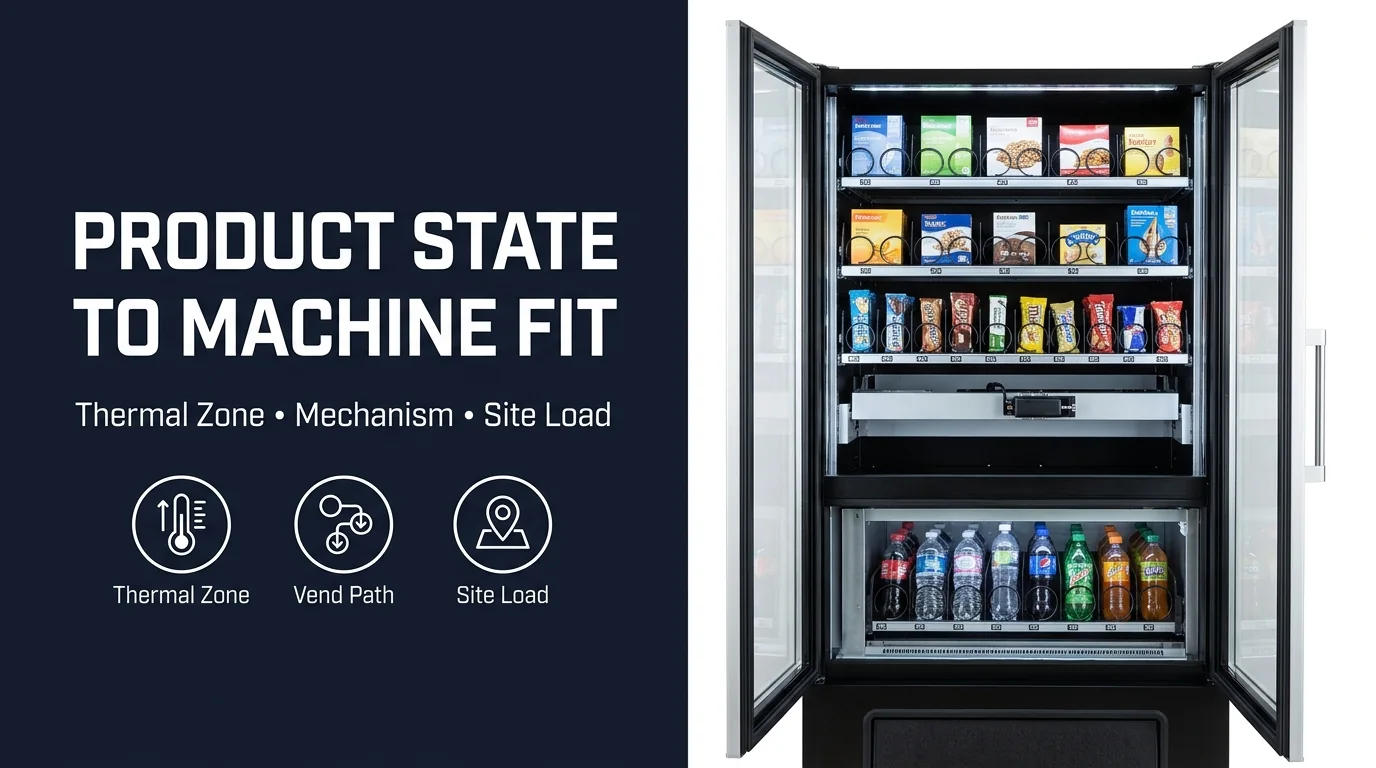
Start with our commercial vending machine catalog to compare cabinet families across thermal and mechanical formats, or go directly to combo vending machines, frozen and soft-serve ice cream vending machines, elevator cosmetic vending machines, trading card vending machines, refrigerated locker flower vending machines, and metered spray and bottle perfume vending machines.
Why Generic Bestseller Lists Fail Equipment Selection: Cabinet Architecture vs. Sales Rank
Generic lists of what sells most in vending machines treat cold sodas, bagged chips, fresh sandwiches, boxed cosmetics, trading card packs, and frozen ice cream bars as interchangeable retail SKUs. In commercial vending engineering, product turnover is governed by cabinet boundary conditions: internal air temperature, partition insulation, drop height, tray pitch, and odor containment. Selecting a cabinet before locking in the physical state of the merchandise leads directly to mechanical jams or automatic controller lockouts.
Under U.S. Department of Energy (DOE) rules in 10 CFR §431.292 and U.S. EPA/DOE ENERGY STAR Version 4.0 Program Requirements for Refrigerated Beverage Vending Machines, commercial equipment separates into three structural classes: • Refrigerated Beverage Vending Machine (Class A and Class B): A commercial refrigerator that cools and dispenses sealed bottled or canned beverages at an integrated average temperature of 36°F (2.2°C), tested using 12-oz (355 mL) cans or 20-oz plastic bottles filled with liquid of density 1.0 g/mL ± 0.1 g/mL. Class A cabinets have 25% or more transparent front area (glass-front merchandisers), whereas Class B cabinets have less than 25% transparent front area (opaque-front vendor doors) and are not combination machines. • Combination Vending Machine (Combination A and Combination B): A cabinet containing two or more compartments separated by a solid internal partition—which may or may not share a delivery chute—where at least one compartment is refrigerated and at least one is unrefrigerated (Combination A has ≥25% transparent front glazing; Combination B has <25%). • Refrigerated Food Vending Machine and Specialty Sub-36°F Cabinets: Machines holding Time/Temperature Control for Safety (TCS) perishable foods, units operating below 36°F (2.2°C) such as deep-freeze ice cream cabinets, and machines with dedicated heating systems are excluded from standard beverage cooler classifications.
Takeaway: Rule of thumb — never buy an unpartitioned cabinet expecting to mix ambient snacks, chilled TCS foods, deep-frozen novelties, or scented items; group target SKUs by thermal zone and packaging fragility first, then assign each group to its matching cabinet class.
Thermal Zone Matrix: Matching Ambient, Chilled (≤41°F), Floral (31°F–39°F), and Deep-Frozen (≤0°F) States
Every commercial vending SKU belongs to one of four thermal regimes governed by microbial, physiological, or chemical stability thresholds. Crossing these boundaries inside a single enclosure causes controller lockout or irreversible spoilage.
1. Chilled Beverages and TCS Perishable Foods (36°F to 41°F / 2.2°C to 5°C): Sealed cans and PET bottles are held near 36°F (2.2°C), whereas perishable foods—sandwiches, dairy cups, salads, and cut fruit—are regulated as Time/Temperature Control for Safety (TCS) foods. U.S. Food and Drug Administration (FDA) Cold Food Safety rules note that bacteria double every 20 minutes at room temperature, requiring cold storage at or below 40°F (4°C) and limiting room-temperature exposure to 2 hours (1 hour above 90°F). Under FDA Food Code Section 4-204.111 (codified in Washington Administrative Code WAC 246-215-04246), any machine vending TCS food must include an automatic shutoff control preventing vending until serviced and restocked if: • In a refrigerated vending machine, ambient cabinet temperature exceeds 41°F (5°C) for more than 30 minutes immediately after filling, servicing, or restocking; or • In a hot-holding vending machine, ambient cabinet temperature falls below 135°F (57°C) for more than 120 minutes immediately after filling, servicing, or restocking.
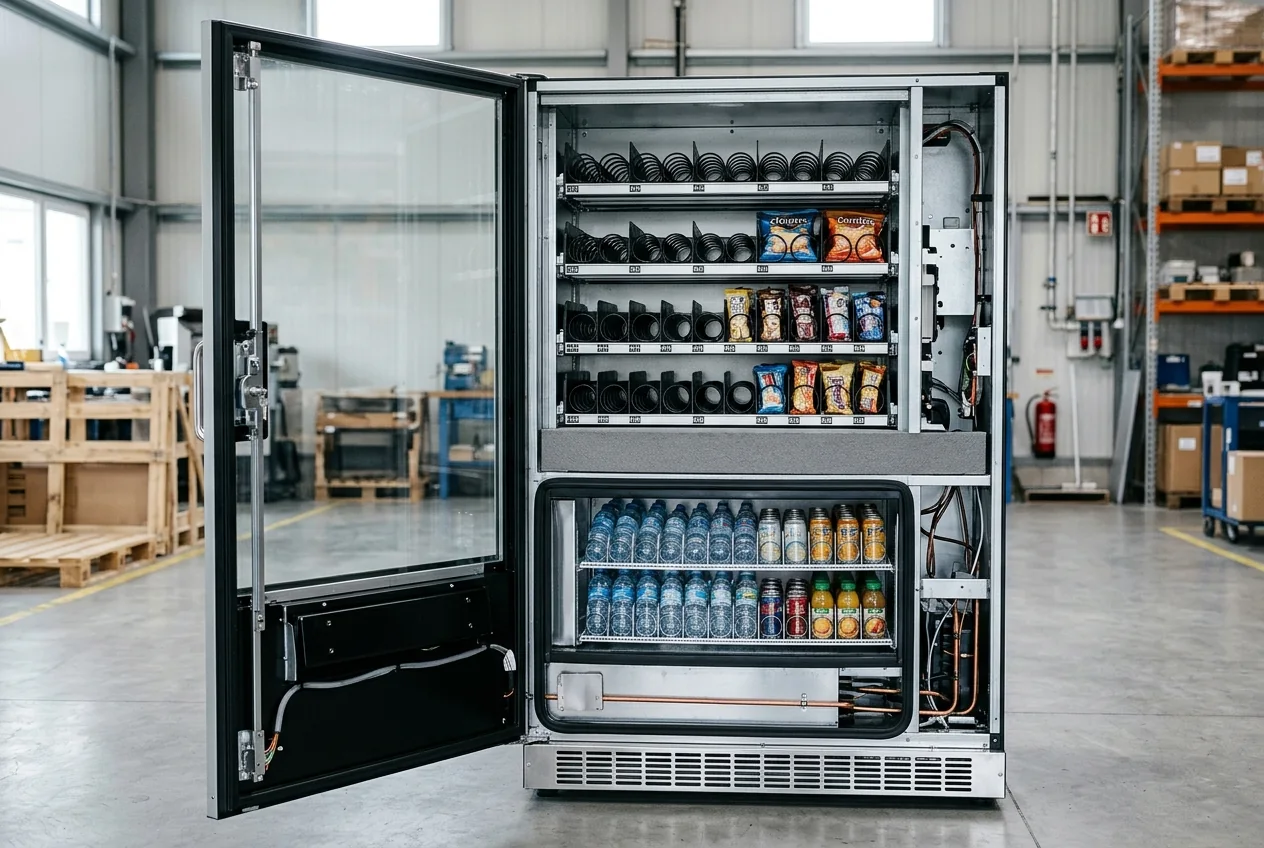
In the Royal Vendors RVV NG PCCD service manual, the microprocessor Health Sensor grants a 30-minute recovery window after door closure to reach 41°F (5°C) or below. If cabinet air stays above 41°F (5°C) past 30 minutes after restocking, or exceeds 41°F (5°C) for more than 15 minutes during normal operation, the controller trips a Health Safety Failed lockout and displays "Out of Order." Pulling a warm reload down to setpoint in a 75°F (24°C) room requires up to 24 hours of continuous evaporator fan operation (Pull-Down Mode), with a 30-minute defrost cycle every 3 hours.
To quantify why warm restocking trips a TCS lockout, use the batch sensible cooling load formula: Q_sensible (kWh) = [m × c_p × (T_load - T_target)] / 3600 P_required (kW) = Q_sensible / t_window Where m is product mass (kg), c_p is aqueous specific heat (4.184 kJ/[kg·°C]), T_load is initial temperature (°C), T_target is target temperature (°C), and t_window is recovery time (h).
Worked Calculation Example (Warm Reload vs. 30-Minute Health Timer): Loading 500 cans (355 mL each, ~180 kg total mass) from a 24.0°C (75°F) warehouse into a cabinet targeting 2.2°C (36°F) introduces: Q_sensible = [180 × 4.184 × (24.0 - 2.2)] / 3600 = 16,417.9 kJ / 3600 = 4.56 kWh (15,560 Btu) Extracting 4.56 kWh inside a 0.5-hour (30-minute) health timer window requires P_required = 4.56 / 0.5 = 9.12 kW of net cooling—an illustrative load that aligns with OEM guidance allowing about 24 hours for warm-beverage pull-down rather than relying on the 30-minute recovery window. Over a 24-hour beverage pull-down cycle, that load averages 0.19 kW. Any cabinet with an active 41°F (5°C) TCS lockout must be loaded exclusively with pre-chilled inventory.
2. Cut-Flower Cold Chain (31°F to 39°F / -0.6°C to 4°C): American Floral Endowment (AFE) and North Carolina State University research shows standard floral storage operates at 35°F to 39°F (2°C to 4°C). Near-freezing storage down to 31°F (-0.6°C) extends longevity for temperate species (roses, carnations, tulips, peonies); in the cited AFE/NC State work, tuberose stems were not viable after holding at either 31°F or 39°F. Our refrigerated Flower Vending Machine uses individual locker compartments; set holding temperature per florist and species guidance.
3. Deep-Frozen Ice Cream States (≤0°F / -18°C): FDA rules require freezer temperatures at or below 0°F (-18°C). Our ice cream lineup separates prepackaged frozen novelty elevator cabinets from fresh-dispense soft-serve machines (separate ingredient, preparation, and cleaning workflow).
4. Ambient Merchandise (non-refrigerated indoor storage): U.S. FDA Office of Cosmetics and Colors guidance warns that heat, sunlight, and moisture can separate oil-and-water emulsions (mixtures of water and oil) and degrade preservatives. Products with SPF or acne claims are regulated as OTC drugs requiring stability testing and expiration dates; our cosmetic vending cabinets cover individually packaged cosmetics and beauty tools and exclude medicines, medical devices, and on-site mixing.
Takeaway: Rule of thumb — for TCS machines with the 41°F (5°C) / 30-minute shutoff, load only pre-chilled inventory; set floral cabinets to 35°F–39°F (31°F only when species-appropriate); use ≤0°F (-18°C) freezer cabinets for ice cream.
Dispensing Mechanism Matrix: Helix Coils, Conveyor Pushers, X-Y Elevator Lifts, and Compartment Lockers
Once thermal compatibility is established, mechanical delivery physics determines whether packages vend without jamming or crushing.
1. Helix / Spiral Coils (Gravity Free-Fall Drop): Metal spirals suit aluminum cans, rigid PET bottles, and pillow-bag snacks that tolerate dropping into a delivery bin. Wittern / Vendnet OEM Product Loading Best Practices specify four coil rules: • Bottle Orientation: Load bottles bottom-down. Never load bottles cap-down or in dual-coil snack selections; otherwise, the helix climbs the bottle wall and hangs the neck over the tray edge. • Coil Pitch vs. Diameter: Use 10-selection beverage trays only for slim cans/bottles. Specify a 6-count coil with the tip at 7 o'clock for wide bottles, and a 7-count coil for 16-oz water bottles. • Bagged Snacks: Use 9-count coils for bagged snacks resting flat on the tray floor. Never cram puffed snack bags into tight coils, which squeezes out protective headspace air and accelerates staleness. • Standing Sandwiches: On dual-helix trays, align the left coil tip at 7 o'clock and the right coil tip at 5 o'clock.
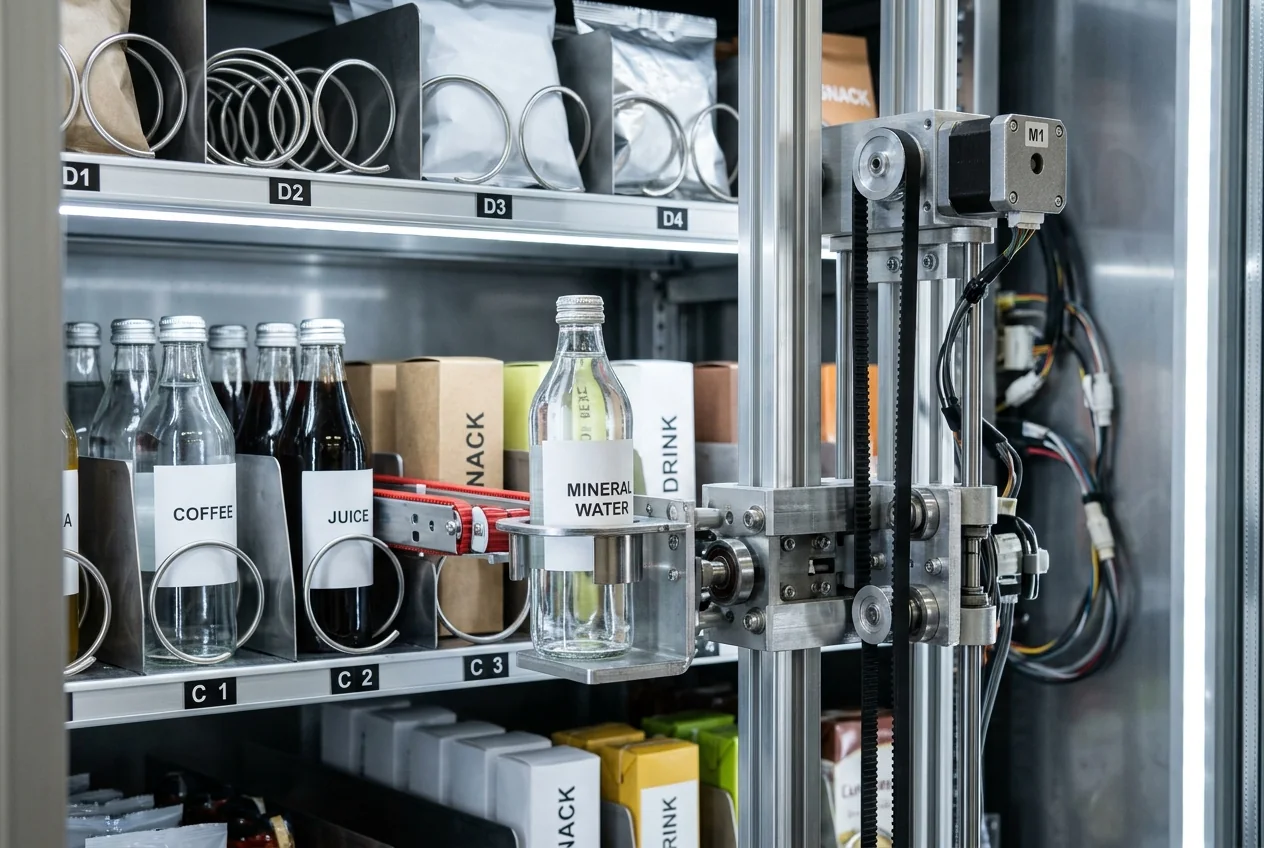
2. Motorized X-Y Elevator Lifts and Conveyor/Pusher Trays (Zero Free-Fall): Glass bottles, frozen ice cream cups, and trading card packs cannot survive gravity drops. In Royal Vendors RVV NG PCCD elevator architecture, a Delivery Mechanism Controller (DMC) drives an X-axis and Y-axis motorized elevator carrying a delivery cup assembly (plunger motor, drive motor, tachometer, position sensor, product detector) to the selected shelf, receives the item horizontally, and lowers it to the port verified by a +5 VDC infrared sensor beam.
In our catalog, elevator or flat-slot delivery protects three high-value categories: • Combo Elevator Vending Machines (Pro Combo Elevator Vending Machine / Pro Combo Elevator AD) handle packaged snacks and drinks with elevator collection. • Trading Card Vending Machines (Trading Card Vending Machine with adjustable conveyor trays and elevator delivery) for sealed booster packs and boxes; confirm fit per format. • Prepackaged Frozen Ice Cream Elevator Machines (Elevator Pro Ice Cream Vending Machine) deliver packaged frozen novelty cups and bars. Cosmetic Vending Machines (Cosmetics Vending Machine and Mini Cosmetics Vending Machine) cover ambient packaged cosmetics and skincare; do not assume elevator delivery unless a specific model page states it.
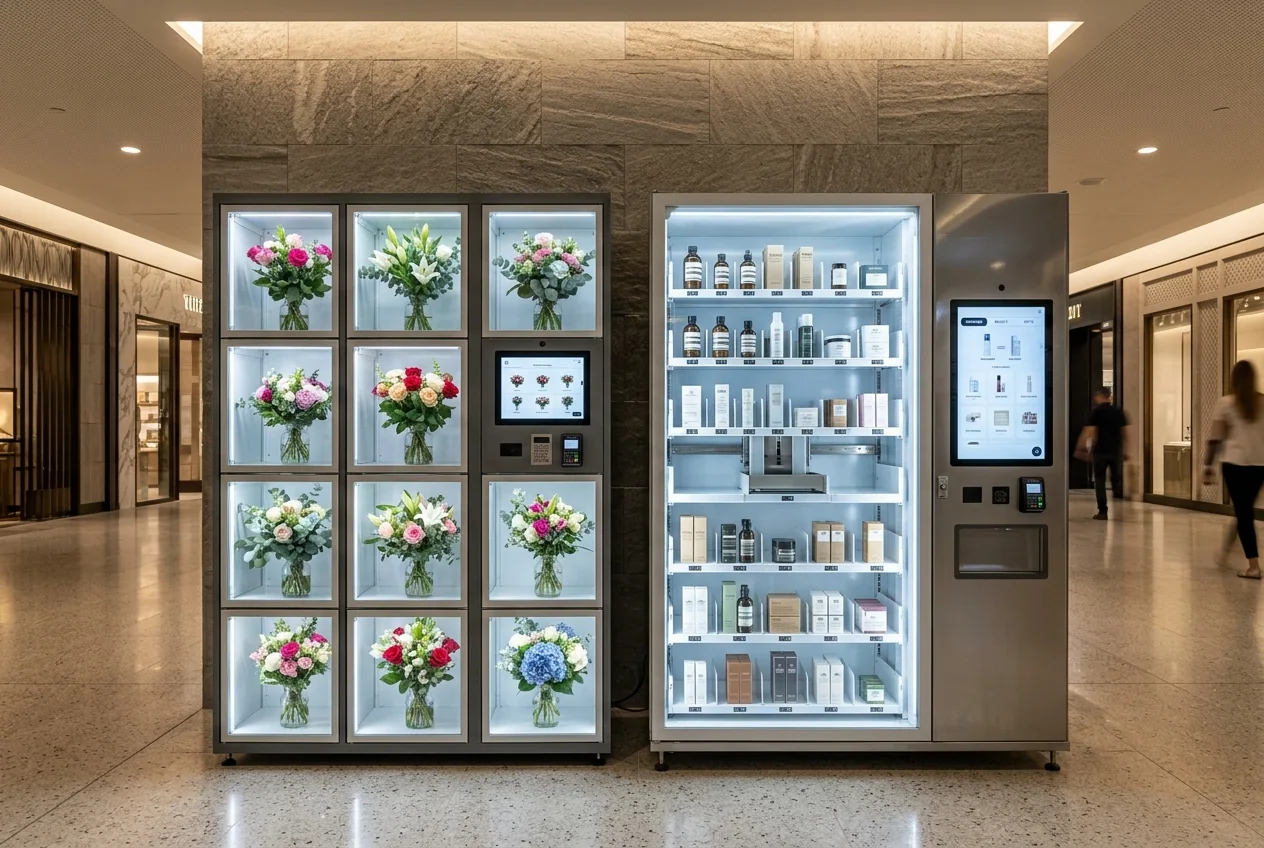
3. Compartment Lockers and Metered Spray Modules: Our Flower Vending Machine uses refrigerated locker doors that unlock after payment for bouquet retrieval. Our perfume lineup separates packaged bottle dispensers from metered perfume spray vending machines (Perfume Spray Vending Machine and Smart Touch Screen Perfume Vending Machine), which dispense a calibrated mist per paid selection.
Takeaway: Rule of thumb — restrict free-fall helix coils to cans, bottom-loaded PET bottles (6-count coil at 7 o'clock for wide bottles, 7-count for 16-oz water), and uncramped 9-count snack bags; specify an X-Y elevator lift for glass, boxed cosmetics, frozen cups, and trading cards, and specify refrigerated compartment lockers for bouquets.
Location Environment vs. Product Stability: Evaluating Heat Load, Sunlight, and Energy Duty by Venue
Evaluating the best vending machine products by location requires matching venue thermal load, sunlight exposure, restocking frequency, and odor isolation to cabinet engineering.
1. Glazing Ratio and Daily Energy Consumption (MDEC Equations): Glass-front cabinets increase impulse visibility for beverages, cosmetics, flowers, and trading cards, but conduct more heat than opaque doors. Under 10 CFR §431.292 and U.S. EPA/DOE ENERGY STAR eligibility criteria (Table 1; refrigerated volume V per ASHRAE Standard 32.1-2010 Appendix C; test at 36°F / 2.2°C), Maximum Daily Energy Consumption (MDEC, in kWh/day) scales with refrigerated volume V (ft³): • Class A (fully cooled beverage, ≥25% transparent front): MDEC_ClassA = 0.04836 × V + 2.2599 • Class B (fully cooled beverage, <25% transparent front): MDEC_ClassB = 0.04576 × V + 1.936 • Combination A (solid-partition ambient/chilled, ≥25% transparent front): MDEC_ComboA = 0.07998 × V + 2.4738 • Combination B (solid-partition ambient/chilled, <25% transparent front): MDEC_ComboB = 0.09768 × V + 1.7952
Worked Calculation Example (30 ft³ Cabinet Comparison at DOE FEMP $0.099/kWh): For V = 30 ft³ operating 365 days/year: • Class B Opaque Beverage Cooler: MDEC = 0.04576 × 30 + 1.936 = 3.31 kWh/day (1,208 kWh/year, $120/year). • Class A Glass-Front Beverage Cooler: MDEC = 0.04836 × 30 + 2.2599 = 3.71 kWh/day (1,354 kWh/year, $134/year under ENERGY STAR v4.0; DOE FEMP Table 1 benchmarks the federal baseline at 3.99 kWh/day [1,456 kWh/year, $144/year] and best-available Class A units at 3.23 kWh/day [1,179 kWh/year, $117/year]). • Combination A Glass-Front Split Cabinet: MDEC = 0.07998 × 30 + 2.4738 = 4.87 kWh/day (1,779 kWh/year, $176/year)—31.3% above Class A and 47.3% above Class B under higher Combination A MDEC coefficients in ENERGY STAR Table 1.
2. Direct Sunlight, Restocking Cadence, and Odor Isolation: Class A and Combination A machines are defined with ≥25% transparent front (ENERGY STAR / 10 CFR), and separately FDA Office of Cosmetics and Colors guidance warns that heat and sunlight can separate oil-and-water cosmetic emulsions—keep cosmetic cabinets out of unshaded window exposure. Glass-front cabinets must stand against interior walls out of window glare. Match TCS perishables only to routes that can load pre-chilled totes on a stated restock interval, and never co-locate scented perfumes or personal-care items in food cabinets.
Takeaway: Rule of thumb — use the 10 CFR 431 MDEC volume formulas to budget site electrical load, place ≥25% glazed Class A and specialty display cabinets away from window sunlight, isolate scented cosmetics/perfumes from food enclosures, and match perishable SKUs to your pre-chilled restocking cadence.
Scope & Specification Variables: What to Prepare Before Requesting a Machine Quotation
Prepare three engineering inputs before requesting a vending machine quotation:
1. Product Thermal State and Regulatory Scope: Specify the regime for every SKU—indoor ambient (non-refrigerated), chilled beverage (36°F / 2.2°C), TCS perishable food with 41°F (5°C) 30-minute post-fill shutoff (FDA Food Code 4-204.111 / WAC 246-215-04246), cut-flower storage (35°F–39°F general or 31°F temperate-only), or deep-frozen novelty/soft-serve (≤0°F / -18°C). Confirm cosmetic exclusions (packaged cosmetics only; no OTC drugs, medicines, medical devices, or on-site mixing) and isolate scented products from food.
2. Package Dimensions and Dispensing Path: Measure Height × Width × Depth (mm or in) and weight (g or oz) for every SKU. Match mechanism to fragility: helix coils (6-, 7-, 9-count, or 10-selection) for cans, bottom-loaded PET bottles, and snack bags; motorized X-Y elevator lift for glass, cosmetics, frozen cups, and trading cards; refrigerated lockers for bouquets; or metered nozzles for perfume spray.
3. Venue Power and Access: Provide a dedicated indoor AC circuit matching the quoted model nameplate rating, with interior shade, condenser clearance, and doorway access.
Primary References Cited: U.S. EPA/DOE ENERGY STAR Refrigerated Beverage Vending Machines eligibility criteria (Sections 1, 2, 3.2.1 Table 1; ASHRAE Standard 32.1-2010 Appendix C for refrigerated volume V; ANSI/AHAM Standard 32.1-2010 for vendible capacity); U.S. DOE FEMP Purchasing Energy-Efficient Refrigerated Beverage Vending Machines (Dec 2023, Table 1 economics at $0.099/kWh); Washington DOH WAC 246-215-04246 (FDA Food Code 4-204.111); U.S. FDA Cold Food Safety Chart; U.S. FDA Office of Cosmetics and Colors Shelf Life Q&A; American Floral Endowment / NC State Cut-Flower Cold Storage (Sept 2023); Royal Vendors RVV NG PCCD Service Manual (Apr 2017, pp. 8–9, 12–14); Wittern / Vendnet Product Loading Best Practices.
Location Environment & Product-State Compatibility Check by Venue Type
| Venue type & profile | Best-fit product states | Environmental & operational risks | Hardware & energy specification |
|---|---|---|---|
| Offices, universities & breakrooms | Chilled cans/PET bottles (36°F), snacks, and pre-chilled TCS foods (≤41°F) | Loading warm cases into a TCS machine exceeds 41°F for >30 min and trips "Out of Order" lockout | Combination A solid-partition (/combo-vending-machines/; MDEC = 0.07998 × V + 2.4738) |
| Malls, airports & hotel lobbies with window glare | Cosmetics (/cosmetic-vending-machines/), trading cards (/trading-card-vending-machines/), perfume (/perfume-vending-machines/), bouquets (/flower-vending-machines/) | Solar radiation through ≥25% glazed fronts separates cosmetic emulsions and wilts flowers | Place glass-front elevator and floral lockers on interior walls out of sunlight |
| Fitness centers & athletic clubs | Chilled water (16-oz–20-oz PET), electrolyte drinks, protein bars, and glass smoothies | Wide bottles jam 10-selection narrow trays; glass bottles shatter in gravity drop chutes | Class A beverage or combo elevator (/vending-machines/, /combo-vending-machines/) with 6-/7-count lanes |
| Hospitals & 24-hour transit concourses | Floral bouquets (35°F–39°F), sealed cold drinks, and packaged frozen ice cream (≤0°F) | Holding at 31°F is species/cultivar-specific; confirm bouquet temperature plan with florist storage instructions before quoting a near-freezing setpoint | Locker flower unit (/flower-vending-machines/) at 35°F–39°F + ≤0°F ice cream unit (/ice-cream-vending-machines/) |
| Industrial plants & warehouses (high-heat sites) | Chilled canned/bottled hydration and durable snacks; avoid chocolate and TCS foods in high heat | High ambient heat raises compressor load; FDA room-temp limit drops to 1 hour above 90°F | Class B opaque beverage vendor (MDEC = 0.04576 × V + 1.936) or Class A with condenser clearance |
Common questions
Can one combination vending machine dispense frozen ice cream alongside ambient snacks and chilled sodas?
No. Under 10 CFR §431.292 and ENERGY STAR Version 4.0, a combination machine uses a solid partition to separate an ambient snack zone from a 36°F–41°F (2.2°C–5°C) beverage zone. Prepackaged frozen ice cream requires a ≤0°F (-18°C) freezer cabinet (/ice-cream-vending-machines/).
Why does a refrigerated vending machine lock out sales and display "Out of Order" right after restocking?
Machines vending Time/Temperature Control for Safety (TCS) foods enforce FDA Food Code 4-204.111 (WAC 246-215-04246). In controllers like the Royal Vendors RVV NG PCCD, if cabinet air stays above 41°F (5°C) for >30 minutes post-fill—or >15 minutes in normal operation—vending locks out. Because warm cases take up to 24 hours to pull down, always load pre-chilled TCS inventory.
When should an operator specify a motorized X-Y elevator lift instead of standard helix coils?
Specify an X-Y elevator lift whenever packages cannot tolerate coil compression or gravity drop. Helix coils suit cans, bottom-loaded PET bottles, and snack bags in 6-, 7-, or 9-count spirals. Glass bottles, frozen ice cream cups (/ice-cream-vending-machines/), and trading card packs (/trading-card-vending-machines/) require elevator or flat-slot delivery. Ambient packaged cosmetics (/cosmetic-vending-machines/) are a separate category—confirm the model page before assuming elevator hardware.
Can sunscreen, acne treatments, or fragrance sprays share a vending cabinet with snacks and beverages?
No. Under U.S. FDA rules, products with SPF or acne claims are regulated as OTC drugs requiring stability testing and expiration dates; our cosmetic machines (/cosmetic-vending-machines/) cover packaged cosmetics only and exclude medicines. Additionally, scented cosmetics and perfumes (/perfume-vending-machines/) emit volatile compounds that permeate snack wrappers and require dedicated non-food cabinets.
Continue exploring
Vending Machine Range
Vending machine manufacturing by 特拼科技. Explore product configurations, sample checks, payment integration and factory acceptance for your operating site.
Cosmetic Vending Machines
Cosmetic Vending Machines for commercial projects. Review product fit, configuration, sample checks, payment requirements and factory acceptance with our team.
Ice Cream Vending Machines
Ice Cream Vending Machines for commercial projects. Review product fit, configuration, sample checks, payment requirements and factory acceptance with our team.
Discuss your vending project
Send your target product list, package size/weight (H × W × D), storage state (ambient, chilled ≤41°F, floral 31°F–39°F, frozen ≤0°F, or fragile), and site type on WhatsApp to match a compatible vending machine family and request a project quote.