

Cost Structure Behind a Vending Machine Business: Location Split, Spoilage, and Operating Inputs
Are vending machines a profitable business? Start by separating the merchandise calculation from the operating budget. For businesses that sell products, gross profit is net receipts less cost of goods sold. Treat that as the starting line for your location assessment, then enter the location agreement, stock losses, service work and payment charges in a separate operating worksheet. Use this guide to assemble your vending machine operating cost inputs before choosing equipment. Work through the location terms, stock-handling plan, electricity assumptions and route responsibilities, then compare the proposed machine with your intended product list.
Share your products, site and payment requirements with our team.
Explore the vending machine catalog with your product list and location worksheet.
Start with receipts and merchandise cost
Net receipts are gross receipts less returns and allowances. Dividing gross profit by net receipts measures the average spread between merchandise cost of goods sold and the selling price.
Keep a separate entry for gross receipts, returns, net receipts and merchandise cost. Label the gross-profit calculation explicitly. For your investment decision, place the machine purchase, installation quote and ongoing operating budget alongside it; do not substitute a sales target for those inputs.
Ask for the actual location records or build a clearly labelled planning scenario. Keep planned sales and recorded sales in separate columns. Review the same accounting period throughout the worksheet.
Location split: write down the agreement before the forecast
Rent is an amount paid for the use of property you do not own.
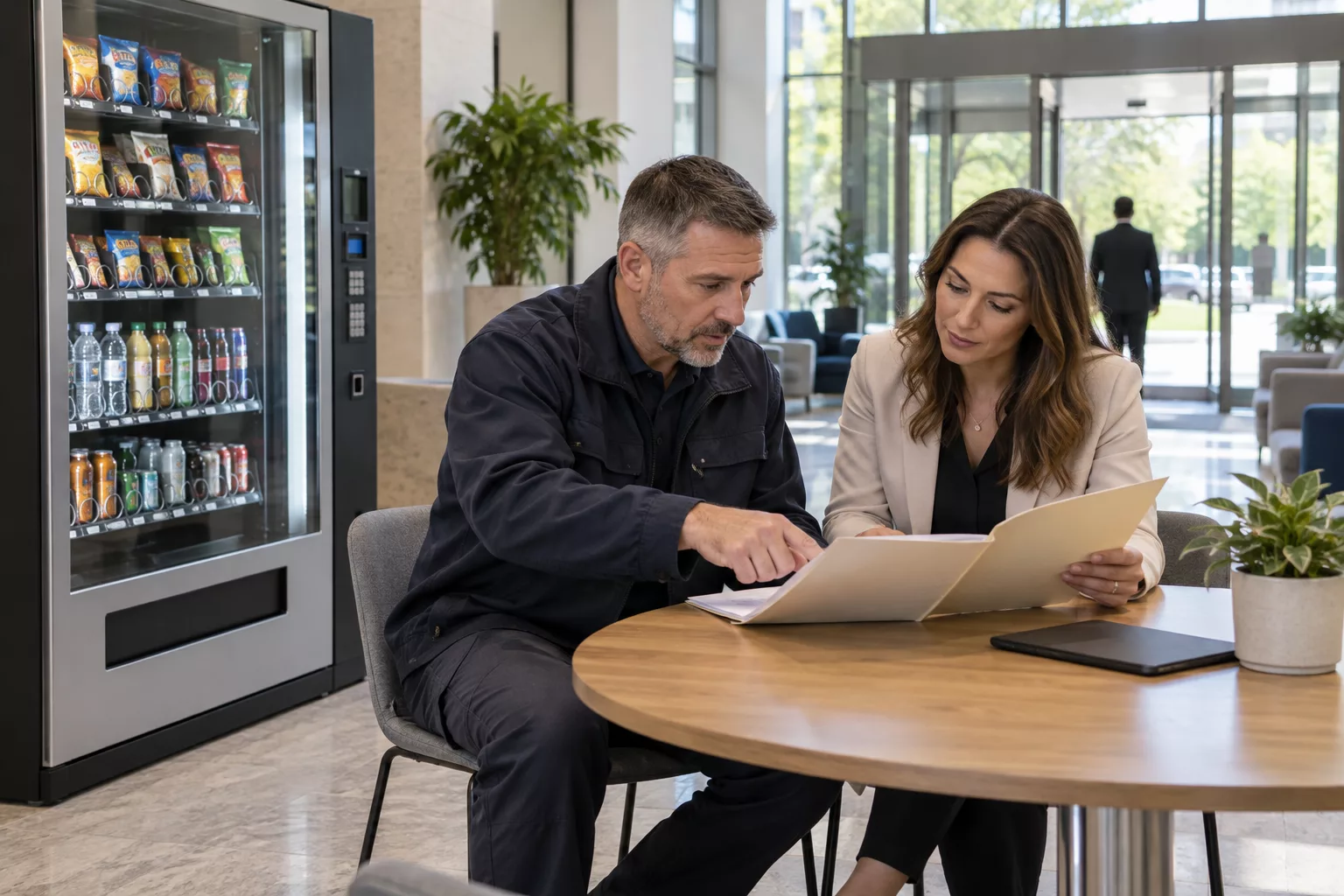
Ask the location owner to specify the proposed payment basis: fixed rent, a share of receipts, or another written arrangement. For a receipts-based split, identify the sales base, treatment of refunds, payment timing and responsibility for electricity. Enter the agreed terms rather than a generic commission benchmark.
Record access arrangements for restocking and servicing. Assign responsibility for site preparation, cleaning around the machine and moving the machine at the end of the agreement. Put each unanswered item beside the party who must resolve it.
Spoilage and stock handling: inspect the package as well as the count
Pushing snacks into coils that are too tight can release air from the bag and make the product become stale faster.
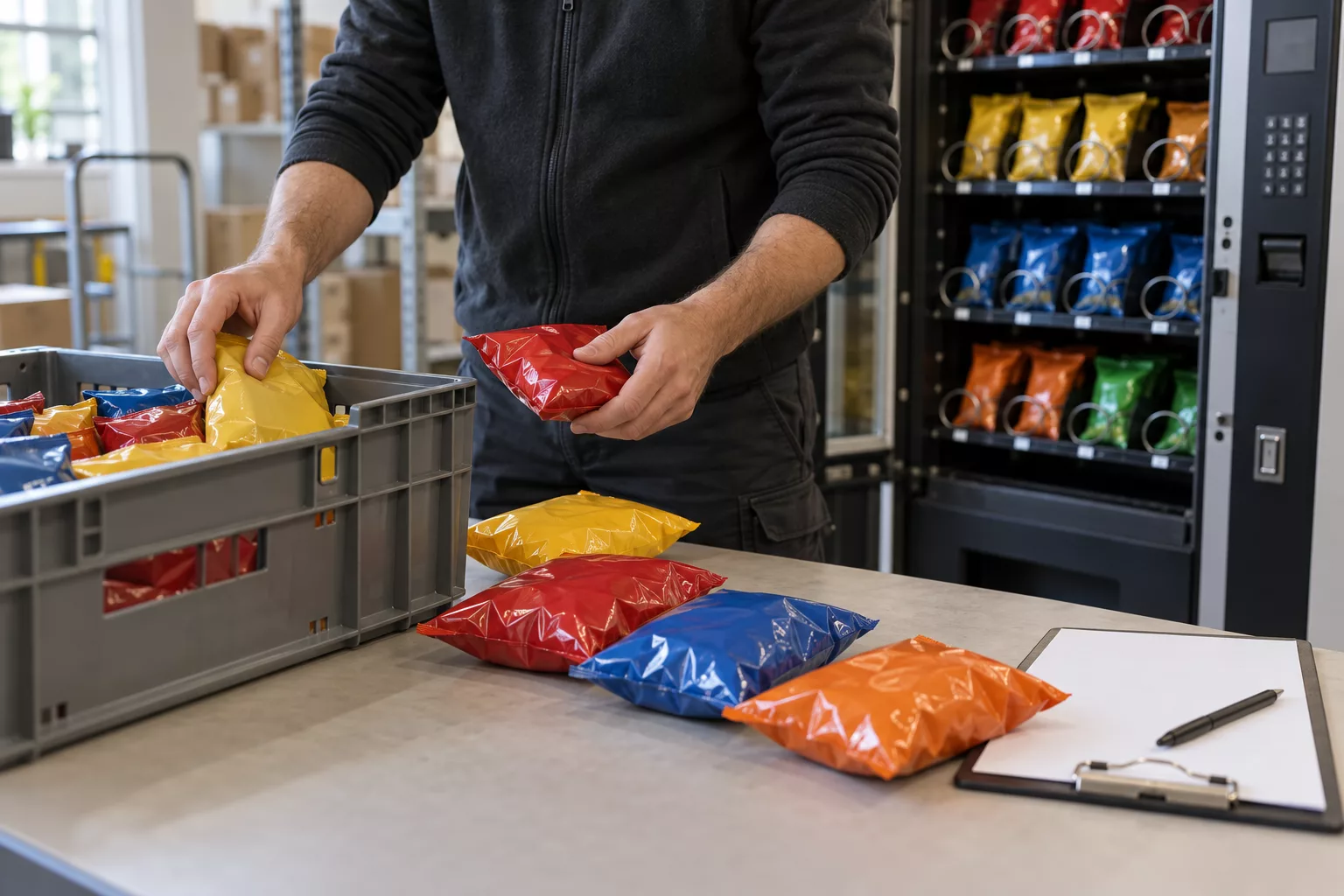
Build a stock log around the products you intend to sell. Record stock received, stock loaded, stock remaining and stock removed, with a reason for each removal. Inspect the intended packages during loading trials, and record damaged bags separately from unsold stock.
For perishable-food projects, include the applicable food-temperature controls in the equipment review. In Washington, a machine vending Time/Temperature Control for Safety food must have an automatic control that prevents the machine from vending food if there is a power failure, mechanical failure, or other condition resulting in an internal machine temperature that cannot maintain food temperatures, until the machine is serviced and restocked.
Assign a person to review stock removals and service interruptions. Include the replacement stock and the associated visit in your planning worksheet.
Electricity: keep the model assumptions attached to the cost
The DOE FEMP comparison assumes Class A beverage vending machines with 30-ft 3 refrigerated volume operating 365 days per year. Its annual energy cost calculation uses an assumed electricity price of $0.099/kWh.
In that comparison, annual energy use is 1,179 kWh/year for the Best Available model, 1,354 kWh/year for the ENERGY STAR model and 1,456 kWh/year for the Less Efficient model. The corresponding annual energy costs are $117, $134 and $144.
Use this comparison as a model for documenting assumptions. For the proposed installation, enter the selected machine’s documented energy consumption, your electricity tariff and the operating schedule. Identify who pays the electricity bill in the location agreement. Keep any modelled energy figure labelled with its test or calculation basis.
Route work and payment reconciliation
Vending service tasks include filling machines, inspecting malfunctions, fixing minor problems such as jammed bills or stuck products, maintaining repair records, and cleaning and oiling machine parts. The occupation also includes recording transactions, keeping records of merchandise distributed and money collected, and settling accounts with concessionaires.
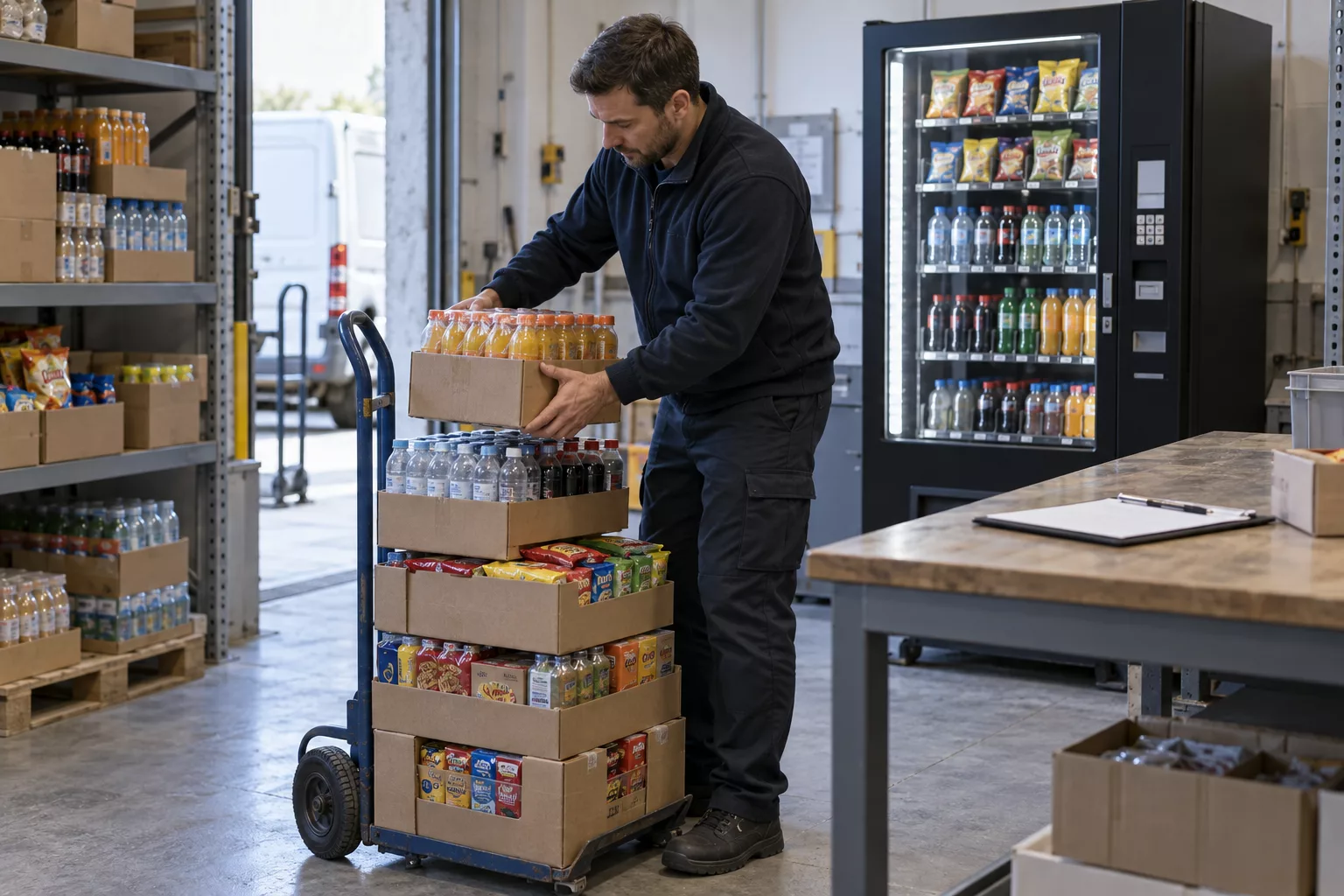
Allocate time in the worksheet for stock preparation, travel, loading, cleaning, cash handling and service calls. Name the person responsible for each task. Record your own working time as well as paid visits when comparing locations.
For cashless payment proposals, request the complete charging schedule and the settlement and refund procedure. Under the NAMA MDB/ICP VEND FAILURE procedure, funds should be refunded to the user’s account when a vend has been attempted but the product was not dispensed. Review failed-vend records alongside payment settlements and stock records.
Bring the cost inputs into equipment selection
Complete the worksheet below for the proposed site. Keep quoted inputs, recorded performance and planning assumptions distinct. Revisit the equipment choice after the location agreement and product list are ready.
Prepare your intended products, package samples, site access details and operating responsibilities for the equipment discussion. Use the vending machine catalog to compare the relevant equipment families.
Vending operating-cost input worksheet
| Input to collect | Record to attach | Decision to make |
|---|---|---|
| Location payment | Written site terms | Define the payment basis and electricity responsibility. |
| Merchandise and removed stock | Purchase and stock logs | Choose the planned product list and review removals. |
| Energy | Machine energy information and site tariff | Document the model and tariff assumptions. |
| Route and service work | Visit log and service proposal | Assign the tasks and planned time. |
| Payment handling | Provider schedule and settlement records | Confirm charges and the refund procedure. |
| Equipment and installation | Equipment and site-work quotes | Review the upfront budget alongside operations. |
Sources
Internal Revenue Service — Tax Guide for Small Business
U.S. Department of Energy — Purchasing Energy-Efficient Refrigerated Beverage Vending Machines
O*NET OnLine — Coin, Vending, and Amusement Machine Servicers and Repairers
Wittern Group / Vendnet — Vending Machine Product Loading Best Practices
Washington State Department of Health — Vending Machine, Automatic Shutoff
NAMA — Multi-Drop Bus / Internal Communication Protocol
Discuss your vending project
Send the items in the project brief above to discuss the selected configuration, sample checks and delivery scope. Share your products, site and payment requirements with our team.