

Updated October 2026
Ice Vending Machine Cost, Utility Requirements, and ROI Inputs
Planning an ice vending deployment starts with separating prefilled-bag freezer merchandisers from standalone on-site ice-and-water production kiosks before budgeting equipment, site preparation, utilities, and payback. VendBuddy groups commercial ice vending machine equipment costs into three tiers: $4,000 – $10,000 for a small countertop or compact bagged-ice unit, $20,000 – $40,000 for a mid-size standalone unit, and $50,000 – $100,000+ for a large self-serve ice-and-water kiosk. Beyond the machine price, VendBuddy lists site-prep and installation expenses of $1,000 – $5,000 for a concrete pad or site prep, $500 – $3,000 for plumbing hookup, $500 – $2,000 for a dedicated 240V electrical circuit, $200 – $800/year for permits and health certificates, and $500 – $2,500 for installation and freight. All-in startup costs to get a standalone ice vending kiosk operational run $25,000 – $110,000, with manufacturer financing terms often running 60–72 months, while a site with no accessible water line can add $5,000+ in plumbing costs. At VendingMachineSource, a packaged-ice vending cabinet sells filled bags supplied through an existing ice production or wholesale arrangement and does not make ice, treat water, or establish a production output rating. At VendingMachineSource, the published Mixology Ice Vending Machine lists a 49-inch interactive display touchscreen, dimensions of 78 in H x 45.8 in W x 37.1 in D, and a weight of approximately 1,037 lbs. The published Mixology Ice Vending Machine at VendingMachineSource is a freezer vending configuration for prefilled ice bags that stores and dispenses ice produced elsewhere and does not require a claim about water treatment or ice production.
Commercial ice equipment format and utility comparison matrix
| Evaluation dimension | Manual or automatic ice bagger | Packaged-ice freezer merchandiser | On-site ice-and-water vending kiosk |
|---|---|---|---|
| Core operating role | Back-of-house bagging frame or bin dispenser filled from a separate ice maker | Locked deep-freeze cabinet storing and dispensing prefilled bags of ice | Self-contained automated station producing, storing, bagging, and dispensing ice on site |
| Potable water connection | No direct water line on manual frames; separate ice head requires potable feed | No product water feed or water treatment required at the cabinet | Dedicated pressurized potable water feed sized for peak harvest and filtration |
| Drainage and reject routing | Bin melt-water gravity drain routed to a floor sink | Cabinet defrost condensate handling only; no reverse-osmosis reject stream | Separate reverse-osmosis reject and gravity drain lines discharging over an air gap |
| Site preparation scope | Indoor backroom floor space beside existing ice production equipment | Level floor or pad with electrical circuit and condenser ventilation clearance | Concrete pad, electrical service, potable water trenching, and sanitary sewer access |
| Replenishment workflow | Staff scoop or load empty wicket bags and seal filled bags for storage | Route driver restocks prefilled frozen bags across adjustable shelves or lockers | Operator refills bag rolls, replaces filter cartridges, and performs periodic descaling |
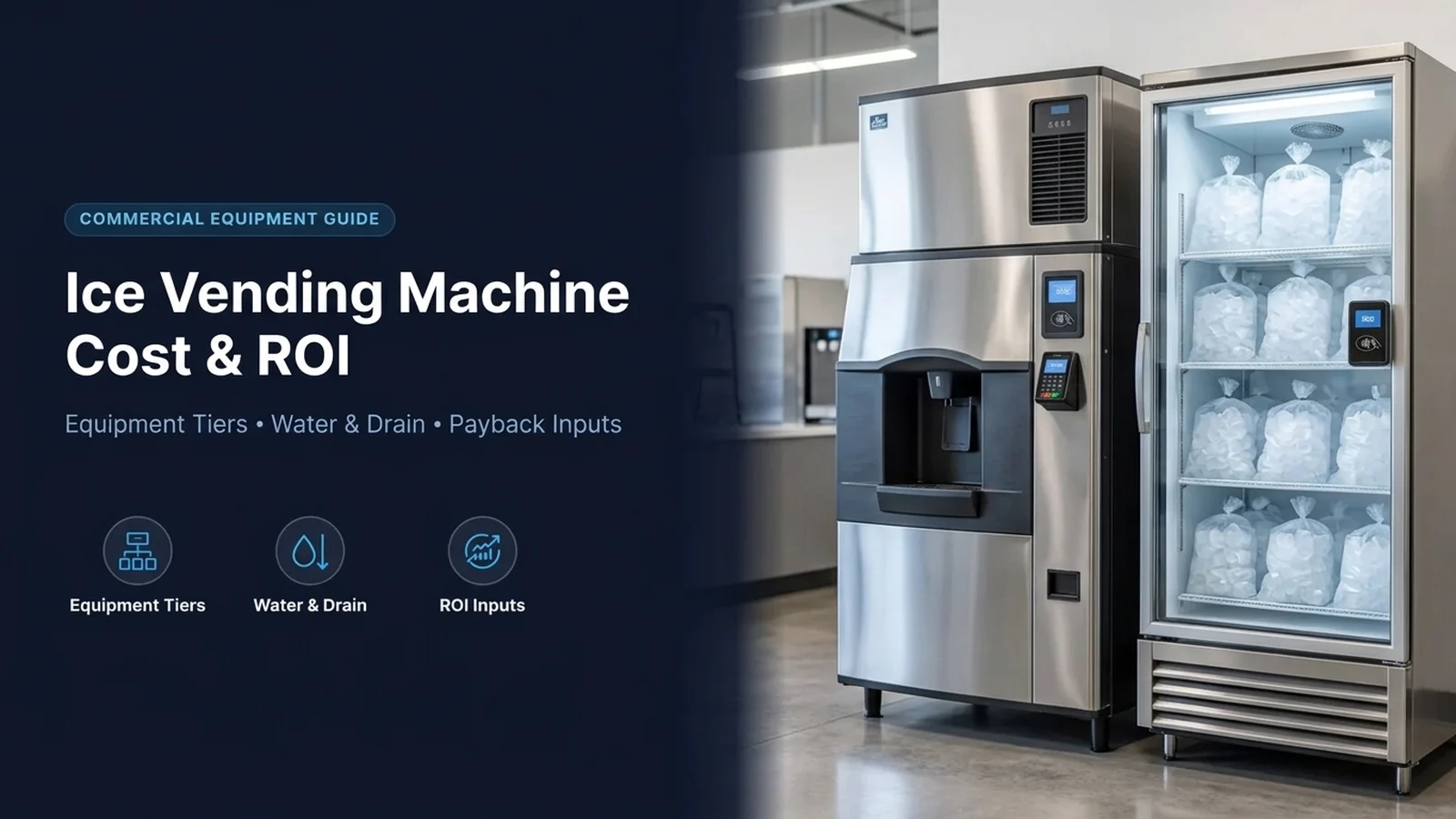
Explore our packaged-ice vending machine category, bottled-water vending machines, and commercial vending machine catalog to connect these cost and utility checks to your site layout. For prefilled ice bags, review the Mixology Ice Vending Machine freezer cabinet configuration.
Equipment cost tiers: bagged-ice merchandisers vs self-bagging kiosks
Commercial ice equipment quotes vary widely because search listings group back-of-house bagging frames, indoor display freezers, and outdoor ice-making buildings under the same category label. Naixer separates the search term "bagged ice machine" into three product types: a manual bagger kit ($184–$253, requiring 30–60 seconds of labor per bag), an automatic bagging system ($10,161–$25,124), and a self-bagging vending machine ($2,899–$70,000). Manual ice bagger kits do not make ice and include the Avantco Ice Bagger at around $184 (handling 8 lb, 10 lb, and 20 lb bags), generic bagger frames from $191, and the Choice Ice Bagger Kit at around $253 (with 8 lb bags, tape, and dispenser). In published U.S. equipment listings, commercial automatic ice bagging systems are priced at $10,161 for the Follett DEV1350SG (1,360 lb bin), $17,587 for the ICEDOSER Semi-Automatic, $19,596 for the Follett DB650SA (650 lb), $22,235 for the Hoshizaki HCD-1000B (1,078 lb), $23,409 for the Follett DB1000 (1,000 lb), and $25,124 for the Follett DB1000SA (220 V, 1,000 lb). In published U.S. equipment listings, Fogel ICB-1 and ICB-2 ice merchandiser display freezers cost $4,452–$6,384, new smaller marketplace self-bagging vending units cost $2,899–$8,399, and pre-owned automated self-bagging vending units sell for up to $70,000.
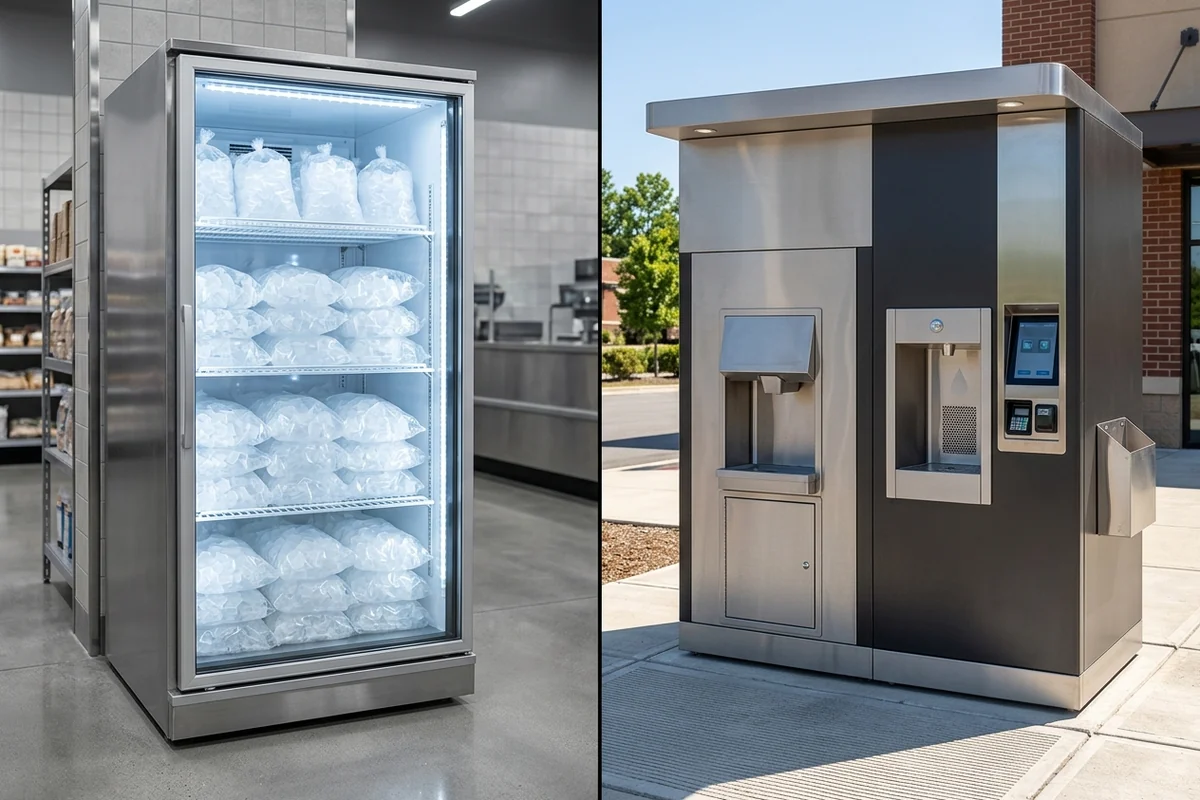
Published U.S. listings across eight ice vending manufacturers in October 2026 span a thirteen-fold spread from $4,948 for a Manitowoc SPA312 floor dispenser (holding 180 lb, requiring a separate ice maker head) to $67,050 for a Polar Station MX (with 1,200 lb ice storage). In published U.S. equipment listings, Leer outdoor bagged-ice vending models are priced at $8,784 for the Leer L040UASVP 47" (80 × 10 lb bags, 110 V), $8,789 for the Leer VM40-R290 47" (outdoor, R-290, auto defrost), $9,840 for the Leer Model 85, and $10,409 for the Leer VM85-R290 84" (outdoor, R-290, steel doors). In competitor VMFS USA's retail listing, the Mixology Ice Vending Machine is listed at $14,075.00 with 45 adjustable selections, 270 to 500 packaged ice units across five shelves, elevator delivery, deep freeze down to minus 0.4°F, and a 6 - 12 weeks lead time, with optional upgrades of $450.00 for a credit card reader, $450.00 for a coin & bill acceptor, $1,100.00 for a custom wrap, $250.00 for +1 year warranty, and $95.00 for a 4G module. In published U.S. equipment listings, Naixer factory-direct ice and water vending machines are quoted at $5,500 – $6,500, Kooler Ice vending machines range from $12,000 to $22,000 (K810), with published capacity across the range spanning 90 to 400+ bags/day, and Ice Depot high-capacity units list at $21,211. Kooler Ice manufactures five models (IM600 XL, IM1000 SIII, IM1500, IM2500, and Hydration Pro) with published capacity spanning 90 to over 400 bags per day, optional water vending, ICETalk remote monitoring, and 18+ years in the category.
Ice House America (IHA) has over 4,000 machines deployed and offers four models ranging from $60,000 to $150,000 with a one-year manufacturer warranty, no franchise fees, a 20-year life expectancy when properly maintained, a 10-second dispense time, and structures capable of withstanding 150 mph winds. The Everest Summit ice and water vending machine uses the VersaVend dispensing system (patented in 2008) with only one moving part and over 20 million vends without a jam, a 12ga galvanneal steel enclosure with a 3-inch height reduction, and twin Everpure 4FC 0.2-micron filters lasting up to 30,000 gallons each (reducing filter changes by up to 50% each year). Argosy Foodservice's Dual Vend 500 (DV500) ice and water vending station holds 500 pounds of ice before needing to create more, reduces the number of people handling the ice to zero, and includes water vending with a Five Stage Ultra Purification System and web-based remote telemetry.
Daily production capacity, storage bins, and theoretical bag output
When evaluating on-site ice-production kiosks, separate daily icemaker harvest capacity from insulated bin storage and footprint geometry. Ice House America's maximum three-icemaker (1, 2, or 3 maker) option produces up to 13,000 lbs per day, compared with approximately 4,500 lbs per day for the Ice Kiosk and up to 250 10 lb bags for the Merchant and Inline models. Ice House America's The Ice House model stores 6,500 lbs of ice, offers a choice between bagged or direct-to-cooler dispensing with sediment, water softener, carbon, and reverse osmosis filtration, and can serve up to 50,000 customer visits per year. Ice House America's mid-capacity Ice Kiosk offers 2,400 lbs or 3,000 lb storage bins, produces 2,500 to 4,500 lbs of ice every 24 hours (with 1, 2, or 3 ice makers), occupies a 6’8 W x 12-16 D footprint (80 to 110 sq ft), and vends 10 or 20 lb bags. Ice House America's compact Ice Merchant has a 750lbs storage capacity, produces 800 to 2,400 lbs of ice daily, and occupies a 4 D x 6 W x 8’5 H footprint (24 sq ft). Ice House America's built-in Inline Merchant fits into an existing building facade with a 1,000 lbs storage capacity, 800 to 3,200 lbs of ice produced every 24 hours, 10lb bag dispensing, and a 4 D x 6 W x 8’5 H footprint.
Theoretical daily bag output (calculated as 24-hour ice output divided by bag weight) is 37 (8 lb), 30 (10 lb), or 15 (20 lb) bags for a 300 lb (136 kg) machine; 62 (8 lb), 50 (10 lb), or 25 (20 lb) bags for a 500 lb (227 kg) machine; and 87 (8 lb), 70 (10 lb), or 35 (20 lb) bags for a 700 lb (318 kg) machine. Theoretical daily bag output is 125 (8 lb), 100 (10 lb), or 50 (20 lb) bags for a 1,000 lb (454 kg) machine and 187 (8 lb), 150 (10 lb), or 75 (20 lb) bags for a 1,500 lb (680 kg) machine, while Reddy Ice's industrial in-store bagging system is rated for up to 425 bags a day (roughly 3,400–4,250 lb of ice daily at 8–10 lb bags).
Federal DOE energy and condenser water conservation rules
Compare ice-making head and self-contained machine efficiency using federal test metrics rather than unconditioned brochure figures. Under 10 CFR § 431.132, Harvest rate means the amount of ice (at 32 degrees F) in pounds produced per 24 hours; Energy use is stated in kilowatt hours per one-hundred pounds (kWh/100 lb) of ice in multiples of 0.01; Condenser water use is in gal/100 lb in multiples of 1; Potable water use is in gal/100 lb in multiples of 0.1; and Ice hardness factor divides latent heat capacity (Btu/lb) by 144 Btu/lb. Under 10 CFR § 431.134, representations of automatic commercial ice maker energy use or efficiency on or after October 27, 2023 (for capacities up to 4,000 lb/24 h) must use AHRI Standard 810 (I-P)-2016 with Addendum 1 and ANSI/ASHRAE Standard 29-2015, with 3 feet maximum rear clearance and 30.0 percent minimum average ambient relative humidity (±2.0 percent accuracy); ice-hardness factor calorimetry trials under the same section are conducted at 70 °F ± 1 °F room air and 90 °F ± 1 °F initial water. Under 10 CFR § 431.136(c), batch-type automatic commercial ice makers (50 to 4,000 lb) manufactured on or after January 28, 2018 have maximum energy use limits (in kWh/100 lb ice) for air-cooled Ice-Making Heads of 10-0.01233H (< 300), 7.05-0.0025H (≥ 300 and < 800), 5.55-0.00063H (≥ 800 and < 1,500), and 4.61 (≥ 1500 and < 4,000), and for air-cooled Self-Contained units of 14.79-0.0469H (< 110), 12.42-0.02533H (≥ 110 and < 200), and 7.35 (≥ 200 and < 4,000). Under 10 CFR § 431.136(c), water-cooled batch-type Ice-Making Heads (manufactured on or after January 28, 2018) have maximum condenser water use limits of 200-0.022H gal/100 lb ice below 2,500 lb and 145 gal/100 lb from ≥2,500 to <4,000 lb, while water-cooled Self-Contained units are capped at 191-0.0315H gal/100 lb below 2,500 lb and 112 gal/100 lb from ≥2,500 to <4,000 lb. Under 10 CFR § 431.136(d), continuous-type automatic commercial ice makers (50 to 4,000 lb) manufactured on or after January 28, 2018 have maximum energy use limits (in kWh/100 lb ice) for air-cooled Ice-Making Heads of 9.19-0.00629H (<310), 8.23-0.0032H (≥310 and <820), and 5.61 (≥820 and <4,000), and for air-cooled Self-Contained units of 14.22-0.03H (<200), 9.47-0.00624H (≥200 and <700), and 5.1 (≥700 and <4,000).
Under 10 CFR § 431.296(b), refrigerated beverage vending machines manufactured on or after January 8, 2019 (measured per § 431.294) have maximum daily energy consumption limits (in kilowatt hours per day, where V is refrigerated volume in ft3) of 0.052 × V + 2.43 for Class A, 0.052 × V + 2.20 for Class B, 0.086 × V + 2.66 for Combination A, and 0.111 × V + 2.04 for Combination B. In U.S. DOE FEMP's life-cycle cost comparison for a 30-ft3 Class A refrigerated vending machine operating 365 per year over a 13.5-year lifetime at $0.099/kWh (3% discount rate), a less efficient baseline unit uses 3.99 kWh (1,456 kWh/year, $144/year, $1,386 lifetime), an ENERGY STAR unit uses 3.71 kWh (1,354 kWh/year, $134/year, $1,289 lifetime, saving $97), and the best available unit uses 3.23 kWh (1,179 kWh/year, $117/year, $1,122 lifetime, saving $264). The theoretical minimum water requirement to produce 100 lbs of ice is 12 gallons, while ENERGY STAR-certified air-cooled ice makers use 15 to 25 gallons of water per 100 pounds of ice—a water use reduction of at least 75% compared with traditional water-cooled units that use more than 100 gallons per 100 pounds of ice (though water-cooled units use approximately 15% less electricity). By ice type, commercial cube ice makers use 2–5 gal/hour (~15–25 gal per 100 lbs ice), flake ice makers use 3–7 gal/hour, nugget ice makers use 3–6 gal/hour, and countertop/under-counter units (~24 lbs/day) use 2.5–3 gal (~10–13 gal per 100 lbs); ENERGY STAR-certified batch-type ice makers are about 20% more water-efficient and certified continuous-type ice makers are about 16% more energy-efficient.
Potable water feed, reverse osmosis recovery, and air-gap drainage
Sites installing on-site ice-and-water vending machines must size incoming potable water lines, reverse osmosis membranes, and air-gapped floor drains around both permeate demand and concentrate reject volume. According to U.S. EPA WaterSense at Work Section 7.1 (EPA 832-F-23-003, March 2024), microfiltration removes particles down to 0.1 micron, ultrafiltration down to 0.01 micron, nanofiltration down to 0.001 micron, and reverse osmosis (RO) less than 0.0001 micron. U.S. EPA WaterSense reports that commercial and institutional reverse osmosis (RO) units typically achieve permeate recoveries of 50 to 75 percent and reject 25 to 50 percent of incoming feed water to the sanitary sewer (while fully optimized multi-stage or recycle systems can exceed 90 percent recovery), and efficient cation-exchange water softeners use 4 gallons (15 liters) of water or less per 1,000 grains of hardness removed and achieve at least 3,500 grains of hardness per pound of salt. Foodservice Equipment Reports (FER) notes that some RO systems strip out around 95% of total dissolved solids (TDS), that a base foodservice RO system might yield from 75 gallons up to about 1,000 gallons of purified water per day depending on membrane size, that one manufacturer says standard water recovery has improved from 25% (three gallons to drain per gallon recovered) to 50% (one gallon to drain per gallon recovered), and that one manufacturer specifies that its 20-gallon bladder tank would supply 13 gallons of water at 60 psi incoming pressure. Commercial foodservice RO models profiled by FER include the 3M SGLP200-CL-BP Series (200 gal. per day and 100 gpd, with a 2-gal. tank), Southeastern Filtration CookSpec RO-175 NE (175 gpd, plus 250 or 450 gpd, with a ½-gal. tank delivering 32 oz.), Antunes AQ-RO-100 (100 gpd and 600 gpd), and Pentair Everpure EZ-RO 375/16G (375 gpd, plus 200 or 650 gpd, 50% recovery vs. 25%, with a 16-gal. hydropneumatic tank).
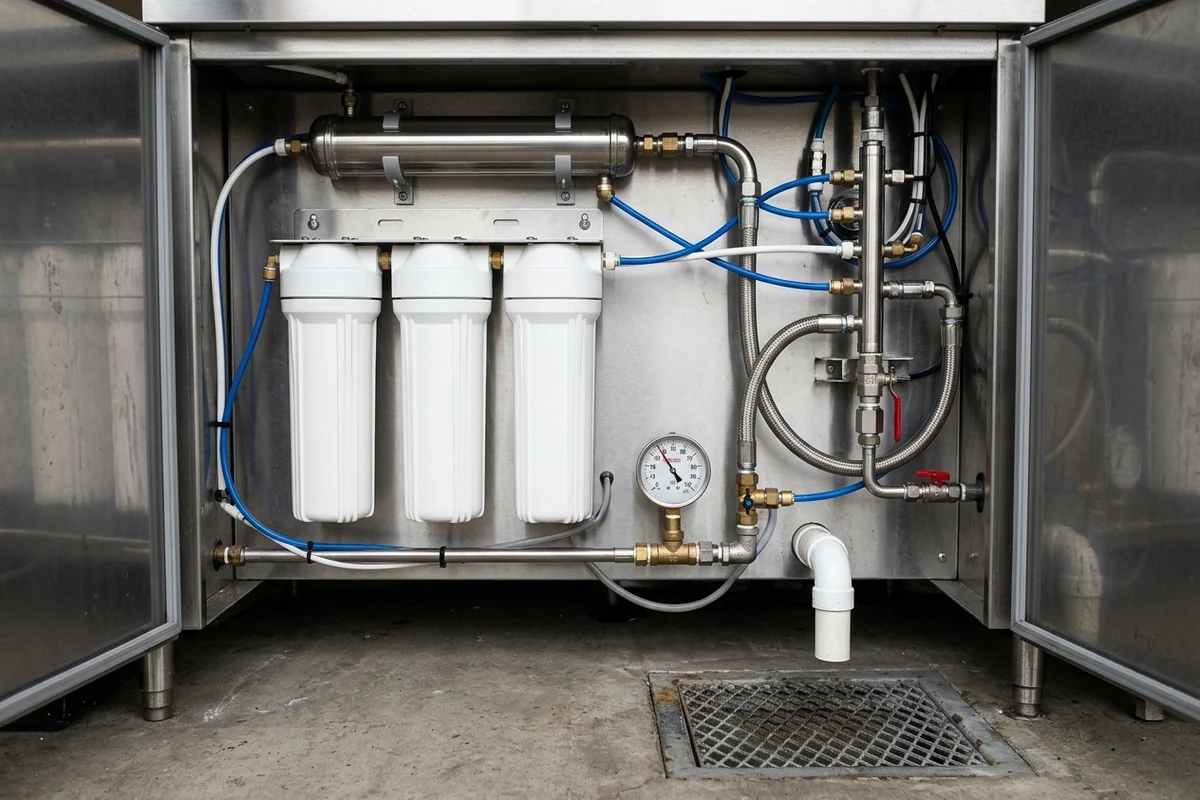
In PureDrops Corporation's Operation & Maintenance Manual for the Model WB-2000 Reverse Osmosis Water Vending Machine, the cabinet measures 70 in high, 43 in deep, and 64 in wide with an 850 lbs dry shipping weight, 3 dispensers at 2 GPM Max., feed water requirements of 40 PSI min to 100 PSI max at 4 GPM Min., plumbing connections of ¾" FNPT feed water, ½" Quick Connect reject water, and ¾" FNPT gravity drain water, and a 120 VAC, grounded 60 Hz, 20A electrical supply. The PureDrops Model WB-2000 RO vending system uses a Fleck 5600 activated carbon controller, 5-micron sediment pre-filters, a low-pressure switch that shuts down below 5 psi, and a rotary pump pressurizing feed water to 150 to 200 PSI across a Thin Film Composite (TFC) RO membrane removing 90% to 99% of TDS (98% in Figure 1), with an auto-flush cycle adjustable from 1 to 60 seconds and a typical 40 percent permeate recovery (40% product water and 60% reject water). For the PureDrops Model WB-2000 installation, feed water must contain 500 ppm TDS or less (0 PPM chlorine, pH 4 to 10, 40 deg F to 100 deg F, 40 PSI to 90 PSI), customer gravity drain lines must be 1" ID Min. for drain water and 1/2" ID Min. for reject water, both reject and drain lines must be installed with a minimum 2 inches (2”) air gap at the floor sink or sewer, and the manual warns: "Do Not Manifold Reject & Drain Water Lines Together." The U.S. FDA states (content current as of 03/05/2024) that the average American buys four bags of packaged ice each year, with 80 percent of it between Memorial and Labor Day—and regulates packaged ice in interstate commerce as a food under Current Good Manufacturing Practices (CGMPs), inspecting whether facility plumbing prevents contamination of the ice water supply or stored ice and whether water meets U.S. EPA drinking water standards, while retail stores making and packaging ice only for intrastate sales are regulated by State and local authorities modeled on the FDA Food Code.
Operating expenses, condenser clearance, cashless fees, and service reserves
Ongoing ice vending operating costs depend on kWh draw per kilogram of ice, airflow clearance around the condenser coils, filter and descaling intervals, and cashless payment processing fees. Hicon International reports that a commercial ice machine typically consumes 0.10 to 0.25 kWh per kilogram of ice ($0.02–$0.04 per kg in electricity at $0.15 per kWh), keeping direct production cost at $0.03–$0.10 per kg, and a well-maintained commercial machine has a realistic service life of 5–10 years. Hicon International states that two ice machines with identical daily output can differ by 15–30% in energy consumption, a machine pushed into a tight, warm corner runs 10–20% longer for the same output, installations with less than 15–20 cm of clearance on the intake and exhaust sides run hotter, longer, and less efficiently, and a condenser packed with dust and grease increases energy use by 20% or more (raising a 90 kg/day machine's electricity bill from $650 to $900 per year). At $0.15 per kWh, Hicon International estimates annual commercial ice machine electricity costs of $250–$450 for a 30 kg/day machine, $350–$600 for a 45 kg/day machine, $650–$1,200 for a 90 kg/day machine, $1,100–$2,000 for a 160 kg/day machine, and $1,800–$3,200 for a 250 kg/day machine. For a mid-size 90 kg/day commercial ice machine, Hicon International estimates monthly operating costs of $60–$110 for electricity, $15–$35 for water and drainage, $20–$40 for cleaning solution and sanitizer (every 2–4 weeks), $15–$30 for water filter cartridges (every 3–6 months), $40–$90 for maintenance reserve, and $60–$120 for operator cleaning/check time (1–2 hours per week). CFESA master technician Dustin Hensley (Refrigerated Specialist Inc.) advises cleaning the condenser, replacing water filters, and descaling and sanitizing an ice machine about every six months; when routine cleaning fixes scale buildup, downtime is a couple hours and costs a few hundred dollars, whereas severe overlooked scale that damages the evaporator plate can cost thousands of dollars.
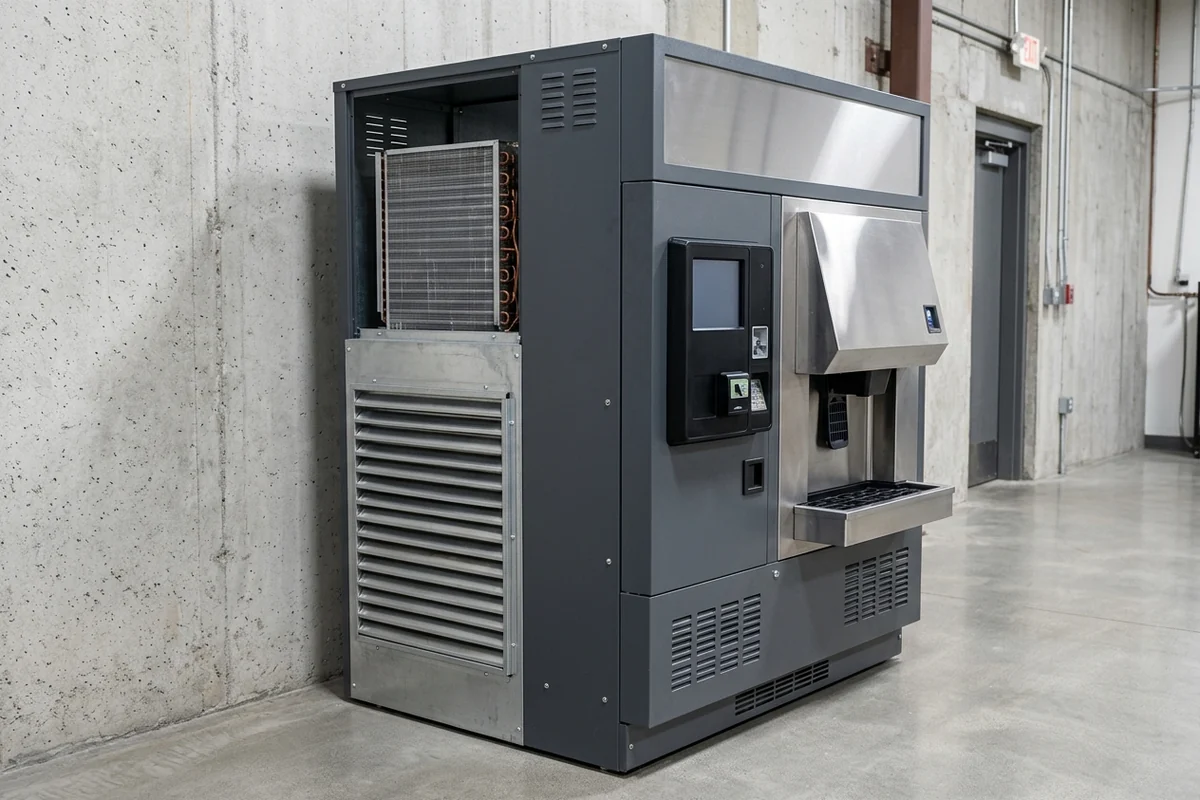
NAMA published Version 4.3 of the Multi-Drop Bus (MDB) standard after MDB Version 4.2 had not been revised for eight years; revisions appear only in Section 7 – Cashless Devices, introducing 7 new changes including mobile phone app remote vend, basket, and coupon functionality. In VendBuddy's card reader comparison, adding a cashless card reader lifts vending machine revenue 30–50% within 60 days: Nayax costs $249–$399 for hardware (or $0 with contract), $7.95–$12.95/month, and 5.95% + $0.05–$0.15 per transaction; Cantaloupe (Seed) costs $199–$399 hardware, $7.95–$10.95/month, and 5.95% + $0.10; and 365Pay costs $199–$349 hardware, $6.95–$11.95/month, and 5.9% + $0.10. Vending machine repairs average $50–$150 monthly ($15 to $400 for most jobs), including $200–$400 for a new bill validator ($100–$180 refurbished), $150–$300 for a coin mech, $30–$80 for a thermostat, $60–$120 for professional condenser cleaning, $450–$1,050 all-in for a compressor replacement ($300–$800 parts + $150–$250 EPA 608 labor), and $400–$800 for an aftermarket MDB/DEX control board ($600–$1,200 OEM), while technicians bill $95 to $150/hr plus a $75 trip charge. Vending.com's general commercial vending machine cost guide lists new machine prices of $3,850-$13,000+ ($300-$1,000+ delivery and installation) and monthly operating expenses per machine of $200 - $600+ for inventory, $10 - $50 for electricity, 3% - 7% of sales for payment processing, $0 - $75+ for maintenance & repairs, $0 - $30 for insurance, 10% - 30% of revenue for location fees, and 1% - 5% of inventory for product loss/spoilage. Under the ADA Standards for Accessible Design, Section 305.3 requires a clear floor or ground space of 30 inches (760 mm) minimum by 48 inches (1220 mm) minimum, Section 308.2.1 sets unobstructed forward and side reach ranges at 48 inches (1220 mm) maximum high reach and 15 inches (380 mm) minimum low reach, and Section 309.4 requires operable parts to be operable with one hand at 5 pounds (22.2 N) maximum force.
Per-bag unit economics, seasonal revenue concentration, and ROI payback inputs
Evaluating an ice vending machine business requires modeling direct variable cost per bag alongside landlord revenue share, summer peak seasonality, and equipment capital cost. For Naixer's ZD-160-A320/420A ice and water vending machine (160kg / 350 lbs daily ice production, 100kg / 220 lbs storage capacity, $15,000 to $25,000 commercial configuration or $7,000 payback baseline), selling 25-40 bags/day at $2.00 – $3.00 per bag generates $1,500 – $3,600 in monthly revenue. In Naixer's per-bag unit economics breakdown for a $2.50 selling price, water and electricity cost $0.20 – $0.30 and the ice bag costs $0.05 – $0.10, yielding a total cost per bag of $0.25 – $0.40, a profit per bag of $2.10 – $2.25, and an 84% – 90% gross profit margin. Across traffic tiers at $2.50/bag for the Naixer ZD-160-A320/420A, low traffic (15-20 bags/day) generates $1,125 – $1,500/month, medium traffic (25-35 bags/day) generates $1,875 – $2,625/month, and high traffic (40-60 bags/day) generates $3,000 – $4,500/month; assuming a $200-$400/month site lease and a $7,000 machine cost, payback is 6 months at $1,200 monthly net profit (20 bags/day), 4 months at $1,800 net (30 bags/day), and 3 months at $2,400 net (40 bags/day), or 10-24 months overall. Hicon International compares three commercial ice business models: in-house production saves 55–75% of avoided cost with a 6–24 months payback; retail bagged ice (selling 3–8 kg bags, such as a 3.6 kg bag for $2.50 with $0.25–$0.40 total cost) yields a 70–85% gross margin ($800 to $3,000 monthly net income) and an 8–24 months payback; and wholesale or bulk supply yields a 25–45% average margin ($0.10–$0.20 per kg net) and a 12–30 months payback. In Hicon International's monthly cash flow scenarios, a single bagged ice vending point generates $1,200–$4,500 in monthly retail sales with $250–$600 in operating costs for +$800–$3,800 net cash flow, whereas a small wholesale bulk route with one large machine generates $3,000–$9,000 in monthly bulk sales with $1,200–$3,000 in operating costs for +$1,500–$6,000 net cash flow.
VendBuddy reports that a well-placed ice vending machine typically generates $1,000 to $4,000 per month in gross revenue (requiring 350 to 2,700 transactions/month at $1.50 to $3.00 per bag or fill): $800 – $1,200/month at a quiet suburban gas station, $1,500 – $2,800/month at a busy rural highway stop or lake community, and $2,500 – $4,000+/month at peak at a marina, beach town, or campground, with net margins typically running 50–65% of gross after a 10–20% property owner cut. In the Sun Belt and Southeast, 60–70% of annual ice vending revenue arrives between May and September; at $2,500/month average gross and a 60% net margin, a $50,000 machine generates roughly $18,000/year net for a payback period of roughly 2.8 years, whereas at $1,500/month gross on a slower site payback stretches past five years. In a documented operator case study from Panama City Beach, Florida, entrepreneur Steve Slagle purchased two Everest high-capacity ice and water vending machines in November 2021 for $50,000 each (paying 50% / $50,000 down and financing 50% through Leaf Financial), generated $33,000 in gross revenue between February and October 2022, earns $2,000 to $3,000 in monthly profit, and spends 2 hours a week on maintenance. Ice House America's SmartIce remote management platform reports aggregated performance across 2,000+ monitored machines over 12 consecutive months of $3,420.47 average monthly sales, $112.37 daily sales, $312.77 weekend sales, and a $3.02 average price for 20 lbs of ice, while noting that traditional delivered-bunker stores buy bags at $2.00 and sell at $2.50 compared with on-site production at thirty to fifty cents per bag.
Site utility, maintenance, and ROI verification checklist before ordering
| Project checkpoint | Site verification question | Procurement and ROI impact |
|---|---|---|
| Sale format boundary | Confirm whether the site will restock prefilled bags from a wholesale plant or produce ice on site. | Select a plug-in packaged-ice freezer cabinet when water trenching or sanitary sewer access is unavailable. |
| Water and drain lines | Check incoming water pressure, total dissolved solids, and floor-drain air-gap elevation. | Keep reverse-osmosis concentrate reject lines and gravity drain lines separate rather than manifolded together. |
| Condenser airflow clearance | Measure rear and side wall clearance around air-cooled refrigeration intake and exhaust louvers. | Maintain unobstructed ventilation space and schedule periodic coil cleaning to prevent compressor runtime penalties. |
| Cashless telemetry and access | Verify cellular signal strength, card reader compatibility, and wheelchair approach geometry. | Equip the cabinet with contactless payment telemetry and keep operable controls within accessible height. |
| Seasonal cash-flow modeling | Compare summer peak demand against off-season baseline traffic and landlord commission terms. | Size storage capacity and financing reserves around warm-season demand concentration and routine filter changes. |
Sources
U.S. Department of Energy — Code of Federal Regulations, Automatic Commercial Ice Makers and Refrigerated Beverage Vending Machines
U.S. Department of Energy Federal Energy Management Program — Purchasing Energy-Efficient Refrigerated Beverage Vending Machines
U.S. Environmental Protection Agency — WaterSense at Work, Point-of-Use Water Purification and Reverse Osmosis Systems
U.S. Food and Drug Administration — Packaged Ice Food Safety and Current Good Manufacturing Practices
U.S. Access Board — Americans with Disabilities Act Accessibility Guidelines, Clear Floor Space and Operable Parts
European Vending and Coffee Service Association and National Automatic Merchandising Association — Multi-Drop Bus Cashless Peripheral Specification
PureDrops Corporation — Reverse Osmosis Water Vending Machine Operation and Maintenance Manual
Foodservice Equipment Reports — Commercial Reverse Osmosis Water Filtration and Ice Machine Preventive Maintenance
Vending Connection and Food Safety Magazine — Commercial Ice and Water Vending Equipment Profiles and Operator Case Study
VendBuddy, Naixer, Hicon International, Ice House America, Guided Imports, and Vending.com — Commercial Ice Vending Cost, Capacity, Freight, and ROI Benchmarks
VendingMachineSource (Tepin Technology) — Commercial Ice Vending Machine Catalog and Mixology Ice Vending Machine Specifications
Common questions
Does a packaged-ice freezer vending machine require a water supply line or floor drain?
A packaged-ice freezer vending cabinet stores and dispenses prefilled bags supplied through an existing ice production or wholesale arrangement, so it does not make ice or treat water on site. Confirm the cabinet's electrical supply, ventilation clearance, and defrost condensate arrangement before installation.
When should an ice vending site use point-of-use filtration versus a centralized water treatment system?
Aqua-Pure Water Filtration reports in FER that centralized water filtration systems are ideal for operations with multiple pieces of water-using equipment within an area of around 3,000 square feet or less, whereas individual point-of-use filters suit a facility with just one ice machine.
When importing a commercial ice vending cabinet by ocean freight, when does LCL make sense versus FCL?
In LCL (Less than Container Load) ocean freight, the minimum chargeable volume is 1 CBM, LCL is ideal for shipments under 15 CBM with a maximum weight of 1 ton or 1,000 kg per CBM, and LCL takes at least four days longer in total transit time than FCL while exposing shared-container cargo to joint X-Ray or CET customs exam holds. For FCL (Full Container Load) ocean freight, booking a full container is recommended at 15 CBM or more, with approximate container capacities of 33 CBM for a 20’ container, 67.5 CBM for a 40’ container, and 76 CBM for a 40’ HQ container; basic maximum payloads are 18.6 tons (20’) and 28.6 tons (40’ / 40’ HC), while U.S. safe road payload limits are 17 tons (20’) and 21 tons (40’ / 40’ HC).
What site and product details should I prepare before requesting an ice vending machine quote?
Prepare your target sale format, bag dimensions and mass, indoor or outdoor placement, available electrical circuit, water and drain connections if applicable, and preferred cashless payment interface before contacting our engineering team.
Continue exploring
Vending Machine Range
Vending machine manufacturing by 特拼科技. Explore product configurations, sample checks, payment integration and factory acceptance for your operating site.
Packaged Ice Vending Machines
Packaged Ice Vending Machines for commercial projects. Review product fit, configuration, sample checks, payment requirements and factory acceptance with our team.
Bottled Water Vending Machines
Bottled Water Vending Machines for commercial projects. Review product fit, configuration, sample checks, payment requirements and factory acceptance with our team.
Mixology Ice Vending Machine
Mixology Ice Vending Machine: A freezer vending configuration for prefilled ice bags.
Discuss your vending project
Share whether your project will restock prefilled ice bags or produce ice on site, your bag dimensions and weight, available electrical circuit, water and drain connections if applicable, and preferred cashless payment interface on WhatsApp.