

Combo Vending Machine Cost: Compare What Each Quote Includes
A combination vending machine for sale quote is not the same as the landed vending machine cost you will actually pay to open a site. This Cost Hub breaks down what a new dual-zone combo quotation typically includes or excludes—base cabinet tier, MDB payment hardware, ocean and domestic freight, doorway clearance, and operating reserves—so you can compare written quotes side by side. When your product mix, package sizes, cooling zones, and destination terms are ready, continue to the parent catalog at /combo-vending-machines/ for published configurations and project discussion.
Share your products, site and payment requirements with our team.
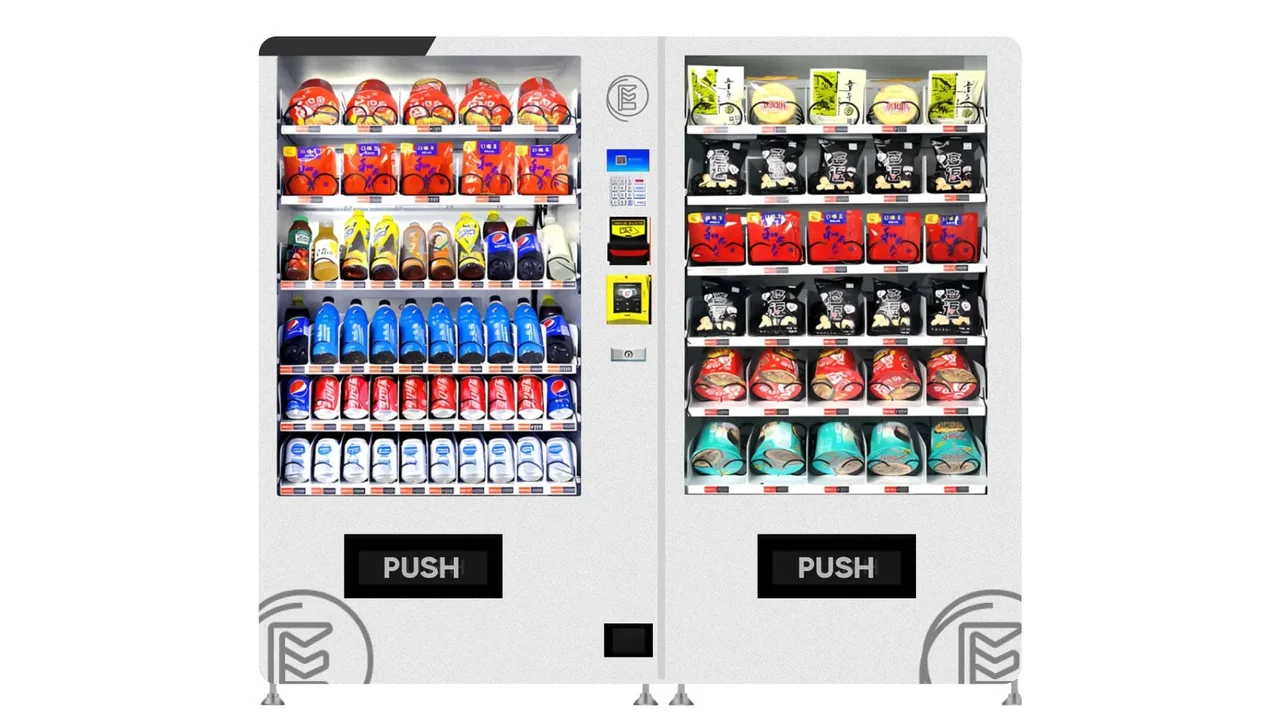
Base Cabinet Price Tiers Versus Landed Startup Cost
A private-party used combo vending machine (marketplace listing, as-is) has a machine price of under $1,000–$1,500 and a realistic all-in cost of $1,500–$2,500.
A dealer-refurbished used combo vending machine has a machine price of $1,500–$3,000 and a realistic all-in cost of $2,000–$4,000.
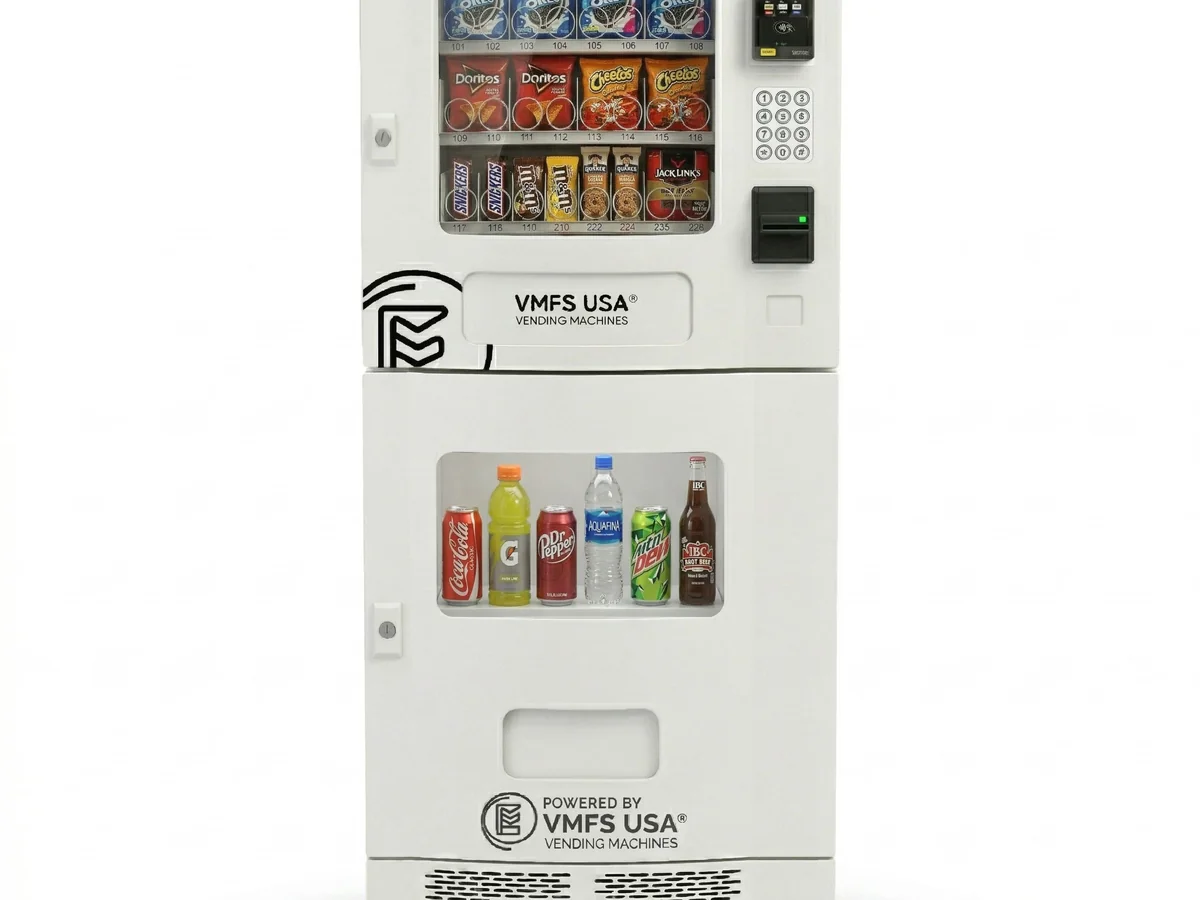
A new entry-level import combo vending machine has a machine price of $3,000–$4,000 and a realistic all-in cost of $4,000–$5,000.
A new name-brand combo vending machine with cashless has a machine price of $4,500–$6,500 and a realistic all-in cost of $5,500–$7,000.
The all-in startup add-ons for a combo machine—the card reader, opening product load, moving a 600-plus-pound cabinet through a door, and liability coverage—add roughly $700–$1,000 on top of the machine price.
Vending.com lists a typical new price range of $5,350 - $8,600 for a Combo Vending Machine, compared with $3,850 - $7,800 for a Snack Vending Machine and $5,700 - $8,300 for a Cold Drink Vending Machine.
Vending.com's startup cost example for one mid-range combo machine totals approximately $7,390, comprising $5,350 for the machine, $800 for initial inventory, $590 for multiple payment systems, and $650 for delivery and installation.
Seaga states that new vending machines usually cost $3,000–$10,000, with all-in startup cost (machine, stock, install) often landing around $2,000–$10,000 per machine.
One Combo Cabinet Versus a Separate Snack and Drink Pair
Buying one combo machine costs $3,000–$6,000 new ($1,500–$3,000 used) with one card reader ($300–$500), whereas buying a separate snack machine plus drink machine costs $6,000–$12,000 new ($3,000–$6,000 used) with two card readers ($600–$1,000).
Under roughly 50 buyers a day, a combo machine's split capacity is surplus; between 50 and 150 daily buyers it is still usually right; above roughly 150 daily buyers a combo runs dry on its fast movers.
Payment Hardware Add-Ons: Cashless Readers, Bill Validators, and Coin Mechanisms
A cashless card and tap reader module adds about $300–$500 to a combo machine (factory-fitted or retrofitted), while operating cash-only leaves roughly 25–35% of sales uncollected.
Seaga reports that upgrading a vending machine with an EMV and NFC card reader usually costs $300-500 per machine for hardware plus 2-5% per sale in transaction fees, and typically increases sales by 15-30%.
Seaga states that 57% of 2024 U.S. vending purchases are cashless (using EMV chip cards and NFC tap-and-pay), and that remote monitoring cuts downtime by up to 40%.
The Nayax MDB card reader costs $249–$399 upfront for hardware (or $0 with a contract), $7.95–$12.95 per month, and 5.95% + $0.05–$0.15 per transaction; VendBuddy lists Nayax as best for 5+ machines.
The Cantaloupe (Seed) MDB card reader costs $199–$399 for hardware, $7.95–$10.95 per month, and 5.95% + $0.10 per transaction; VendBuddy lists Cantaloupe as best for 1–5 machines.
The 365Pay MDB card reader costs $199–$349 for hardware, $6.95–$11.95 per month, and 5.9% + $0.10 per transaction.
DrylineVMS publishes pricing of $499 for its MDB-compatible Rain Pay card reader with no activation fee and no contract, alongside DrylineVMS Core at $14.95 and Pro at $34.95 per machine per month.
A replacement bill validator (Coinco, Mars/CPI, or JCM) costs $200–$400 new or $100–$180 refurbished when sourced with a 90-day warranty, plus $75–$150 labor if swapped by a technician.
A replacement coin mechanism (Coinco, Conlux, or NRI) costs $150–$300, while repairing only the sorter or hopper subcomponent costs $50–$120.
Ocean Freight, LTL Liftgate Delivery, and Doorway Clearance
In LCL (Less than Container Load) ocean freight, the minimum chargeable volume is 1 CBM, LCL is ideal for shipments under 15 CBM, and the maximum weight per CBM is 1 ton or 1,000 kg.
For FCL (Full Container Load) ocean freight, booking a full container is recommended at 15 CBM or more, with approximate container capacities of 33 CBM for a 20' container, 67.5 CBM for a 40' container, and 76 CBM for a 40' HQ container.
Basic maximum container payloads are 18.6 tons for a 20' container and 28.6 tons for 40' and 40' HC containers, while U.S. safe payload weight limits are 17 tons for a 20' container and 21 tons for 40' and 40' HC containers.
LCL ocean shipments take at least four days longer in total transit time than FCL for unloading, sorting, and deconsolidation, and if any single consignment in a shared LCL container is flagged for an X-Ray or CET customs exam, the entire container is held with examination and warehousing fees shared among all consignees.
Delivery and installation costs $300-$1,000+ depending on distance, shipping rates, and site requirements (Vending.com).
Moving a 600 to 800 pound vending machine cabinet costs $200–$400 in local freight or moving charges.
LTL carriers offer optional accessorials—including liftgate service, scheduled delivery, notification before arrival, and inside delivery—at additional cost, which remain distinct from getting a 1,000-pound kiosk off the pallet and moved to its final location.
Seaga's relocation guide states that standard vending machines weigh about 639 pounds and measure 72″ tall, 39″ wide, and 33″ deep.
A combo vending machine is a single wide cabinet commonly measuring 35 to 41 inches across and weighing well over 600 pounds, requiring doorway and stairwell turns to be measured before purchase.
Published Combo Cabinet Footprints on VendingMachineSource
On VendingMachineSource.com, the published Seaga SM2300 SnakMart Combo Vending Machine (/models/seaga-sm2300-american-combo-vending-machine/) lists source-listed reference dimensions of 69.5" H x 30" W x 29" D and weight of approximately 440 lbs.
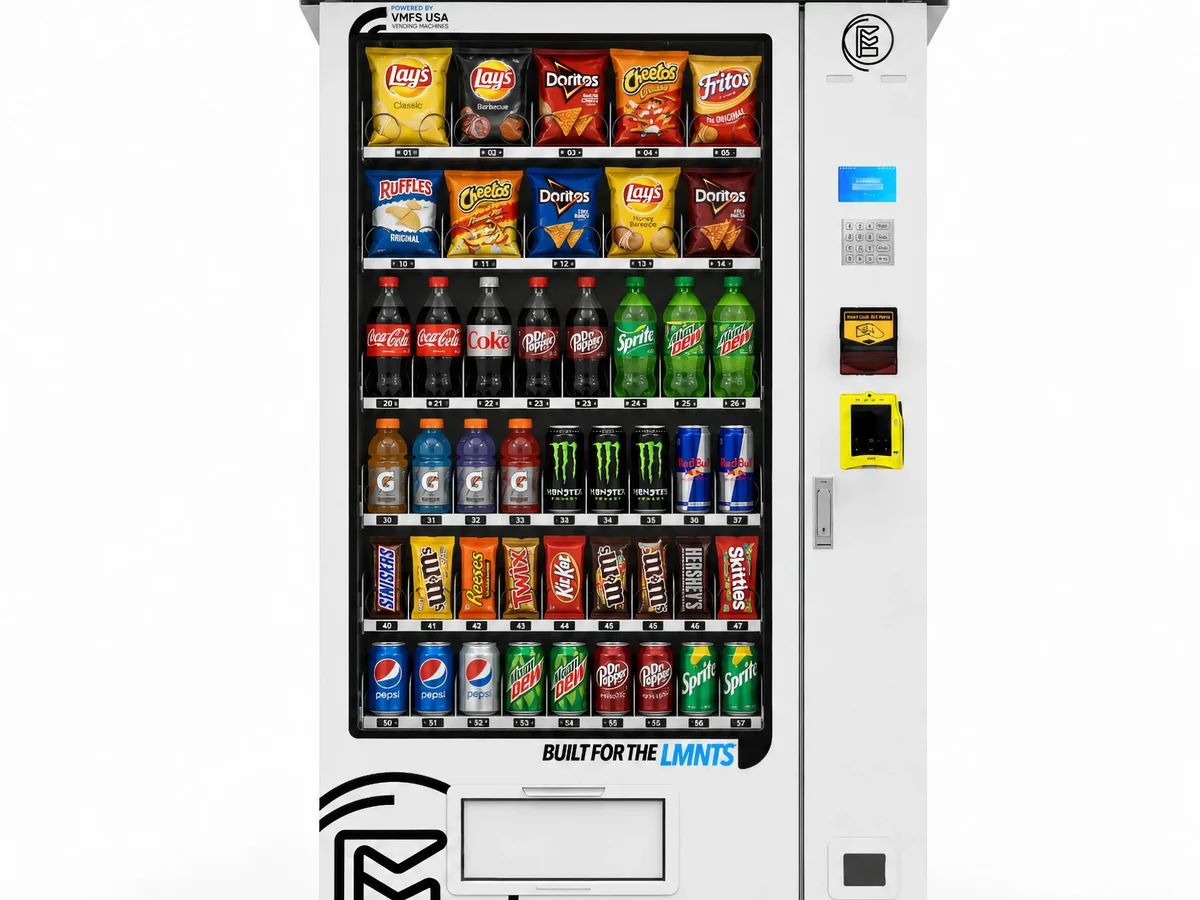
On VendingMachineSource.com, the published AI Smart Combo Vending Machine (/models/ai-smart-cooler-combo-vending-machine/) lists source-listed reference dimensions of 78.3 in H x 27.6 in W x 28.9 in D and weight of approximately 265 lbs.
On VendingMachineSource.com, the published Pro Combo Elevator AD Vending Machine (/models/pro-combo-elevator-ad-vending-machine/) lists source-listed reference dimensions of 78.5 in x 44.6 in x 31.6 in and weight of approximately 924 lbs.
On VendingMachineSource.com, both the published Seaga ENV5C Combo Merchandiser (/models/seaga-env5c-combo-merchandiser/) and the Outdoor Seaga ENV5C Combo Vending Machine (/models/outdoor-seaga-env5c-combo-vending-machine/) list source-listed reference dimensions of 73.5 x 39 x 36 in and weight of 630 lbs.
On VendingMachineSource.com, the published Seaga Envision IQ Combo Vending Machine (/models/seaga-envision-iq-combo-vending-machine/) lists source-listed reference dimensions of 73.5” H X 39” W X 39” D and weight of 775Lbs.
On VendingMachineSource.com, the published Slim Combo Vending Machine (/models/slim-combo-vending-machine/) lists source-listed reference dimensions of 76.5 x 28.7 x 31.2 in and weight of approximately 474 lbs.
On VendingMachineSource.com, the published Smart Outdoor Combo Vending Machine Weatherproof (/models/smart-combo-outdoor-vending-machine/) lists source-listed reference dimensions of 76.7 × 48.2 × 34.4 in and weight of approximately 628 lbs.
DOE Combination Definition, Daily Energy Limits, and ADA Reach Clearances
Under 10 CFR § 431.292, a Combination vending machine is a bottled or canned beverage vending machine containing two or more compartments separated by a solid partition, in which at least one compartment is designed to be refrigerated and at least one is not.
Under 10 CFR § 431.296(b), beverage vending machines manufactured on or after January 8, 2019 (measured per DOE test procedure § 431.294) have maximum daily energy consumption limits (in kilowatt hours per day) of 0.086 × V + 2.66 for Combination A, 0.111 × V + 2.04 for Combination B, 0.052 × V + 2.43 for Class A, and 0.052 × V + 2.20 for Class B.
Under 2010 ADA Standards Section 305.3 and Section 305.7, clear floor space is 30 inches (760 mm) minimum by 48 inches (1220 mm) minimum; alcoves require 36 inches (915 mm) minimum width where forward depth exceeds 24 inches (610 mm), and 60 inches (1525 mm) minimum width where parallel depth exceeds 15 inches (380 mm).
Under 2010 ADA Standards Sections 308.2.1, 308.3.1, and 309.4, unobstructed forward and side reach ranges are 48 inches (1220 mm) maximum high reach and 15 inches (380 mm) minimum low reach (with side reach permitting an obstruction up to 10 inches / 255 mm deep), and operable parts require one hand and 5 pounds (22.2 N) maximum activation force.
Monthly Operating Cost Reserves and Annual Repair Budgets
Vending.com's monthly operating cost table per machine lists $200 - $600+ for inventory, $10 - $50 for electricity, 3% - 7% of sales for payment processing, $0 - $75+ for maintenance & repairs, $0 - $30 for insurance, 10% - 30% of revenue for location fees, and 1% - 5% of inventory for product loss/spoilage.
Replacing a vending machine compressor costs $300–$800 for parts plus $150–$250 for EPA 608 certified labor ($450–$1,050 all-in total), while a replacement thermostat costs $30–$80 and professional condenser coil cleaning costs $60–$120.
Mechanical and cabinet replacement parts cost $15–$40 for a selection motor, $25–$80 for a spiral/coil ($25–$35 standard snack; $50–$80 wide-pitch drink), $150–$350 for a tempered front glass panel, and $40–$100 for a door gasket/seal.
Electronic replacement parts for snack and combo vending machines cost $400–$800 for an aftermarket main control board (MDB/DEX controller), $600–$1,200 for an OEM control board, and $100–$300 for a replacement LCD display screen.
Realistic annual repair budgets are $300–$800/year for a used combo ($1,500–$3,000 purchase price) and $200–$500/year for a refurbished name-brand unit ($3,000–$6,000), or 10–15% of purchase price per year in the first two years dropping to 5–8% thereafter.
Sources
VendBuddy — Combo Vending Machine Price: New, Used and All-In
Vending.com — How Much Does a Vending Machine Cost?
Seaga Manufacturing — New vs Refurbished Vending Machines and Buyers Guide
Dryline VMS / Vending Times — Rain Pay MDB Card Reader Fact Sheet
Guided Imports — LCL vs FCL Ocean Freight Guidance
Kiosk Marketplace — LTL Liftgate and Deployment Economics
Seaga Manufacturing — Relocation Guide
VendingMachineSource — Published Combo Vending Machine Technical Catalog
U.S. Department of Energy — 10 CFR § 431.292 and § 431.296 Beverage Vending Machine Definitions and Energy Standards
U.S. Access Board — 2010 ADA Standards Chapter 3 Reach Ranges and Clear Floor Space
VendBuddy — Vending Machine Repair Costs and Card Reader Pricing
Combo machine price tiers and realistic all-in startup ranges
| Condition tier | Verified price profile |
|---|---|
| Private-party used combo | A private-party used combo vending machine (marketplace listing, as-is) has a machine price of under $1,000–$1,500 and a realistic all-in cost of $1,500–$2,500. |
| Dealer-refurbished used combo | A dealer-refurbished used combo vending machine has a machine price of $1,500–$3,000 and a realistic all-in cost of $2,000–$4,000. |
| New entry-level import combo | A new entry-level import combo vending machine has a machine price of $3,000–$4,000 and a realistic all-in cost of $4,000–$5,000. |
| New name-brand combo with cashless | A new name-brand combo vending machine with cashless has a machine price of $4,500–$6,500 and a realistic all-in cost of $5,500–$7,000. |
| Vending.com new Combo catalog range | Vending.com lists a typical new price range of $5,350 - $8,600 for a Combo Vending Machine, compared with $3,850 - $7,800 for a Snack Vending Machine and $5,700 - $8,300 for a Cold Drink Vending Machine. |
| Vending.com mid-range startup example | Vending.com's startup cost example for one mid-range combo machine totals approximately $7,390, comprising $5,350 for the machine, $800 for initial inventory, $590 for multiple payment systems, and $650 for delivery and installation. |
Cashless reader hardware and recurring fee profiles
| Reader platform | Verified commercial profile |
|---|---|
| Nayax | The Nayax MDB card reader costs $249–$399 upfront for hardware (or $0 with a contract), $7.95–$12.95 per month, and 5.95% + $0.05–$0.15 per transaction; VendBuddy lists Nayax as best for 5+ machines. |
| Cantaloupe (Seed) | The Cantaloupe (Seed) MDB card reader costs $199–$399 for hardware, $7.95–$10.95 per month, and 5.95% + $0.10 per transaction; VendBuddy lists Cantaloupe as best for 1–5 machines. |
| 365Pay | The 365Pay MDB card reader costs $199–$349 for hardware, $6.95–$11.95 per month, and 5.9% + $0.10 per transaction. |
| DrylineVMS Rain Pay | DrylineVMS publishes pricing of $499 for its MDB-compatible Rain Pay card reader with no activation fee and no contract, alongside DrylineVMS Core at $14.95 and Pro at $34.95 per machine per month. |
Published VendingMachineSource combo footprints
| Model | Published dimensions and weight |
|---|---|
| Seaga SM2300 SnakMart Combo | On VendingMachineSource.com, the published Seaga SM2300 SnakMart Combo Vending Machine (/models/seaga-sm2300-american-combo-vending-machine/) lists source-listed reference dimensions of 69.5" H x 30" W x 29" D and weight of approximately 440 lbs. |
| AI Smart Combo | On VendingMachineSource.com, the published AI Smart Combo Vending Machine (/models/ai-smart-cooler-combo-vending-machine/) lists source-listed reference dimensions of 78.3 in H x 27.6 in W x 28.9 in D and weight of approximately 265 lbs. |
| Pro Combo Elevator AD | On VendingMachineSource.com, the published Pro Combo Elevator AD Vending Machine (/models/pro-combo-elevator-ad-vending-machine/) lists source-listed reference dimensions of 78.5 in x 44.6 in x 31.6 in and weight of approximately 924 lbs. |
| ENV5C / Outdoor ENV5C | On VendingMachineSource.com, both the published Seaga ENV5C Combo Merchandiser (/models/seaga-env5c-combo-merchandiser/) and the Outdoor Seaga ENV5C Combo Vending Machine (/models/outdoor-seaga-env5c-combo-vending-machine/) list source-listed reference dimensions of 73.5 x 39 x 36 in and weight of 630 lbs. |
| Seaga Envision IQ Combo | On VendingMachineSource.com, the published Seaga Envision IQ Combo Vending Machine (/models/seaga-envision-iq-combo-vending-machine/) lists source-listed reference dimensions of 73.5” H X 39” W X 39” D and weight of 775Lbs. |
| Slim Combo | On VendingMachineSource.com, the published Slim Combo Vending Machine (/models/slim-combo-vending-machine/) lists source-listed reference dimensions of 76.5 x 28.7 x 31.2 in and weight of approximately 474 lbs. |
| Smart Outdoor Combo Weatherproof | On VendingMachineSource.com, the published Smart Outdoor Combo Vending Machine Weatherproof (/models/smart-combo-outdoor-vending-machine/) lists source-listed reference dimensions of 76.7 × 48.2 × 34.4 in and weight of approximately 628 lbs. |
Common questions
What should a mid-range combo vending machine startup budget include beyond the cabinet price?
Vending.com's startup cost example for one mid-range combo machine totals approximately $7,390, comprising $5,350 for the machine, $800 for initial inventory, $590 for multiple payment systems, and $650 for delivery and installation. The all-in startup add-ons for a combo machine—the card reader, opening product load, moving a 600-plus-pound cabinet through a door, and liability coverage—add roughly $700–$1,000 on top of the machine price.
When is one combo cabinet the better capital choice than a snack machine plus a drink machine?
Buying one combo machine costs $3,000–$6,000 new ($1,500–$3,000 used) with one card reader ($300–$500), whereas buying a separate snack machine plus drink machine costs $6,000–$12,000 new ($3,000–$6,000 used) with two card readers ($600–$1,000). Under roughly 50 buyers a day, a combo machine's split capacity is surplus; between 50 and 150 daily buyers it is still usually right; above roughly 150 daily buyers a combo runs dry on its fast movers.
How much do cashless readers and bill or coin replacements add to combo vending machine cost?
Seaga reports that upgrading a vending machine with an EMV and NFC card reader usually costs $300-500 per machine for hardware plus 2-5% per sale in transaction fees, and typically increases sales by 15-30%. A replacement bill validator (Coinco, Mars/CPI, or JCM) costs $200–$400 new or $100–$180 refurbished when sourced with a 90-day warranty, plus $75–$150 labor if swapped by a technician. A replacement coin mechanism (Coinco, Conlux, or NRI) costs $150–$300, while repairing only the sorter or hopper subcomponent costs $50–$120.
What freight and doorway checks belong on a combo delivery quote?
Delivery and installation costs $300-$1,000+ depending on distance, shipping rates, and site requirements (Vending.com). Moving a 600 to 800 pound vending machine cabinet costs $200–$400 in local freight or moving charges. LTL carriers offer optional accessorials—including liftgate service, scheduled delivery, notification before arrival, and inside delivery—at additional cost, which remain distinct from getting a 1,000-pound kiosk off the pallet and moved to its final location. A combo vending machine is a single wide cabinet commonly measuring 35 to 41 inches across and weighing well over 600 pounds, requiring doorway and stairwell turns to be measured before purchase.
Continue exploring
Combo Vending Machines
Combo Vending Machines for commercial projects. Review product fit, configuration, sample checks, payment requirements and factory acceptance with our team.
Discuss your vending project
Send the items in the project brief above to discuss the selected configuration, sample checks and delivery scope. Share your products, site and payment requirements with our team.