

Can You Add a Card Reader? A Combo-Machine Compatibility Checklist
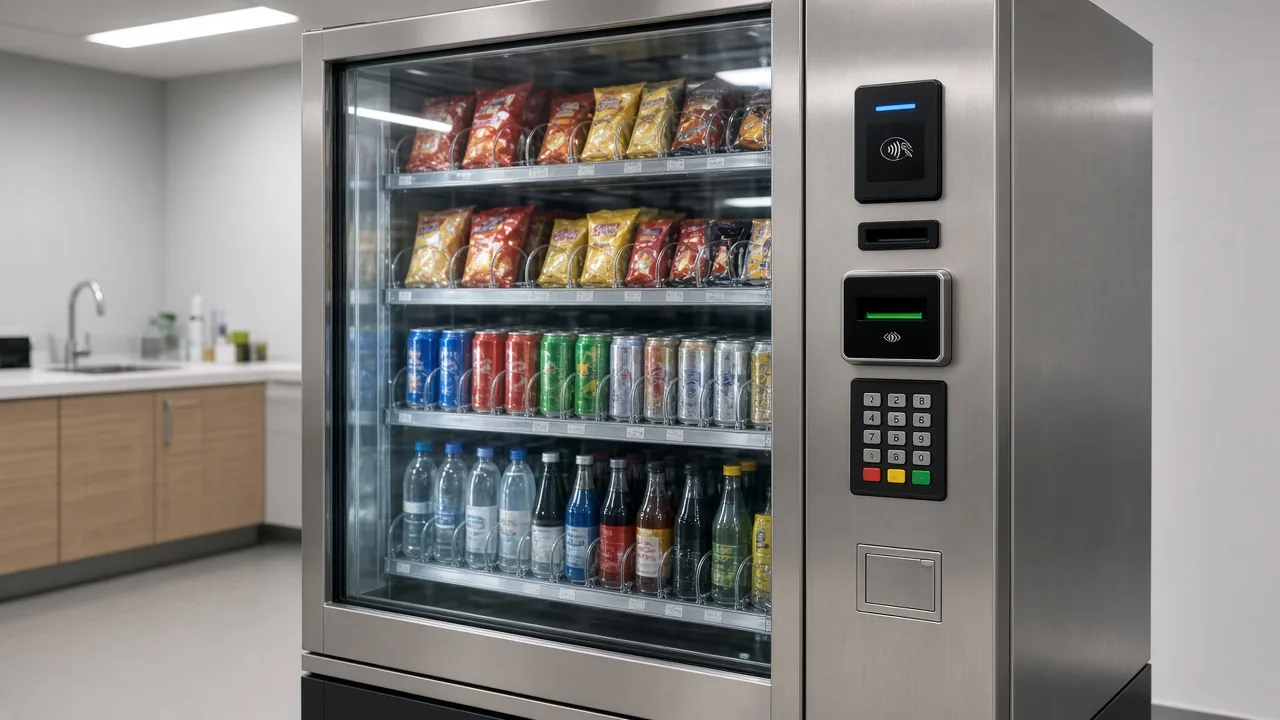
Adding a cashless payment system for a vending machine starts with verifying that the cabinet controller, internal wiring harness, power supply, door bezel, and cellular antenna path can support a commercial cashless card reader for a vending machine. According to Vending Times (citing company reports), Cantaloupe reported 1.28 million active devices in 2025, Nayax ended 2025 with approximately 1.46 million managed and connected devices, and cashless payments represented 78% of vending sales processed through Cantaloupe's platform in 2025 (up from 73% the year before). The NAMA Multi-Drop Bus / Internal Communication Protocol (MDB / ICP) specification is at Version 4.3, dated July, 2019. The MDB serial bus interface for electronically controlled vending machines is a 9600 baud Master-Slave arrangement where all peripherals are Slaves to a Master controller.
Share your products, site and payment requirements with our team.
MDB Bus Protocol, Harness Pinout, and Cashless Device Levels
Before ordering a cashless card reader for a vending machine, inspect the main controller board inside the service door to confirm native multi-drop bus serial communication and timing compatibility. In Section 2.1 Byte Format, the MDB serial bit format is 9600 NRZ with 1 Start Bit, 8 Data Bits, 1 Mode Bit, and 1 Stop Bit for 11 Bits Total. In Section 3.2 Timing Specifications, the MDB baud rate is 9600 +1%/-2% NRZ, with inter-byte time 1.0 mS (max.), response time 5.0 mS (max.), break time 100 mS (min.), and setup time 200 mS (min.). In Section 7.5 Cashless Device Non-Response Time, the default maximum non-response time for a cashless device is 5 seconds, unless superseded by a greater Application Maximum Response Time reported in byte Z7 of the Reader Configuration Data (7.4.2).
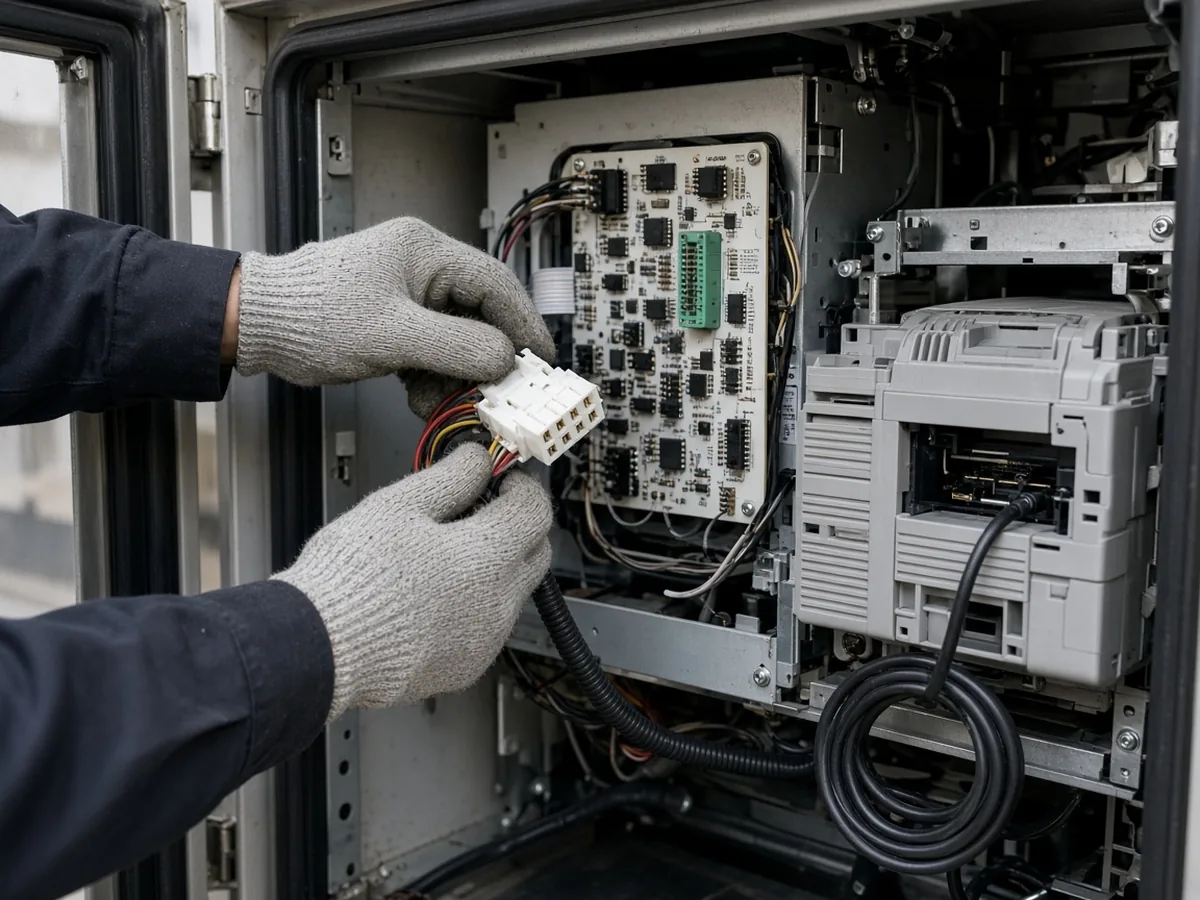
Physical harness verification requires matching the peripheral receptacle housing on the card reader pigtail to the machine bus harness plug. The standard MDB peripheral connector is a Six (6) Circuit Receptacle Housing (Molex 39-01-2060 or AMP P/N 106527-6) with female tin socket terminals (Molex 39-00-0065). The standard MDB bus harness connector is a Six (6) Circuit Plug Housing (Molex 39-01-2061 or AMP P/N 794550-6 or 794542-6) with male tin pin terminals (Molex 39-00-0067). The 6-pin MDB Connector Pin-out is Line 1 - 34 VDC, Line 2 - DC Power Return, Line 3 - N/C, Line 4 - Master Receive, Line 5 - Master Transmit, and Line 6 - Communications Common.
Combo machine operators should also verify cashless addressing and session rules in the controller firmware so pre-authorization and item selection work in the expected sequence. As defined in Section 2.3, there are two cashless device addresses on the VMC bus: Cashless #1 at 00010xxxB (10H) and Cashless #2 at 11000xxxB (60H), allowing two unique forms of cashless devices to be resident in the vending machine simultaneously. A Cashless Device does not allow an Always Idle state unless enabled by setting the corresponding enable bit in the enable options command; when the Always Idle option is enabled, VEND REQUEST, NEGATIVE VEND REQUEST, and REVALUE REQUEST are allowed during the Enabled state.
Level 1 cashless devices support standard commands and the Expansion ID command, and readers do not have revaluation capability.
In the cashless SETUP-Config command bits, b0 indicates the reader is capable of restoring funds to card, b1 indicates the reader is multivend capable, b2 indicates a display is available, and b3 indicates support for the VEND-CASH SALE command.
Level 2 cashless devices in MDB/ICP Version 4.3 support Revalue, Time/Date, Read User File (obsolete), and Write User File (obsolete) commands.
Level 3 cashless devices support the expansion ID command with option bits b0 File Transport Layer (FTL), b1 16 or 32 Bit Monetary Format, b2 Multi Currency / Multi Lingual, b3 Negative Vend, b4 Data Entry, and b5 Always Idle Session.
In MDB 4.3 expansion options, the basket / partial refund / options price feature allows performing multi-vends with a single VEND REQUEST and multiple VEND SUCCESS / VEND FAILURE responses.
Controller Bus Power Supply Voltage and Peripheral Current Budget
VMC Voltage Output on the MDB bus is Minimum 20 VDC rms (rectified and optionally filtered), Nominal 34 VDC unreg. (rectified and filtered) or 24 VDC rms (rectified only), and Maximum 42.5 VDC (ripple voltage upper limit), where high line input may allow 45 VDC peak (max.). In Section 4.2 Bus Transmitter / Receiver Specification, the MDB bus uses a 5V, optically isolated, current loop system between Master and Slave, with VMC Master minimum active source current of 100 mA @ 4V and 15 mA should be added for each peripheral over six.
When budgeting current draw for a cashless payment system for a vending machine, account for both the payment reader and its cellular communications gateway during active read, write, and transmit bursts. Under Cashless Device Power Requirements, the current draw for any cashless device at minimum VMC Voltage Output must fall within Idle mode = 300 mA (avg.) continuous and Transport or Read/Write cycle = 1.5 A @ 50% maximum duty cycle up to 5 seconds. The current draw for an MDB Communications Gateway at minimum VMC Voltage Output is 300 mA (avg.) continuous in Idle mode and 1.8 A continuous and up to 2.5 A (max) for an accumulated maximum of 10 seconds in Active mode.
The current draw for an MDB coin changer is 200 mA (max.) continuous in Idle mode and 1.8 A (max.) for up to 2 seconds during coin acceptance on solenoid-based 3 tube changers sold in the US market.
The current draw for an MDB bill validator is 200 mA (avg.) continuous in Idle mode and 2.5 A (max.) up to 30 seconds during bill transport.
The Nayax Onyx terminal requires a power supply of 12-42V DC or 12-24V AC with 5 Watts power consumption, and its recommended external power supply is 24V DC / 2Amp.
Door Mounting Formats, Bezel Dimensions, and Environmental Ratings
Combo vending machine doors offer two primary physical mounting paths for a cashless card reader: an over-bezel combo unit mounted directly on the bill validator faceplate, or a standalone payment terminal mounted on a dedicated door cutout. The Cantaloupe ePort Engage Combo is an all-in-one card reader and telemeter with a 2.5" edge-to-edge touchscreen that fits over the machine bill acceptor, supports Coinco and MEI bill acceptors (US and Canadian bills), supports Verizon or AT&T cellular, and is PCI-PTS 5.X Certified. The standalone Cantaloupe ePort Engage Series payment device is PCI PTS 5.X compliant and features anti-tamper security, an edge-to-edge 3.5" touchscreen, an all-in-one card reader, a magstripe reader, and an EMV chip reader. The USA Technologies (Cantaloupe) ePort G10-Chip reader accepts contact EMV chip cards and contactless EMV (tap) payment methods and functions with the existing G10 telemeter, while over 250,000 G10-S / compatible connected devices received a free over-the-air contactless EMV upgrade (Vendi-bundled units were compatible; non-Vendi were not).
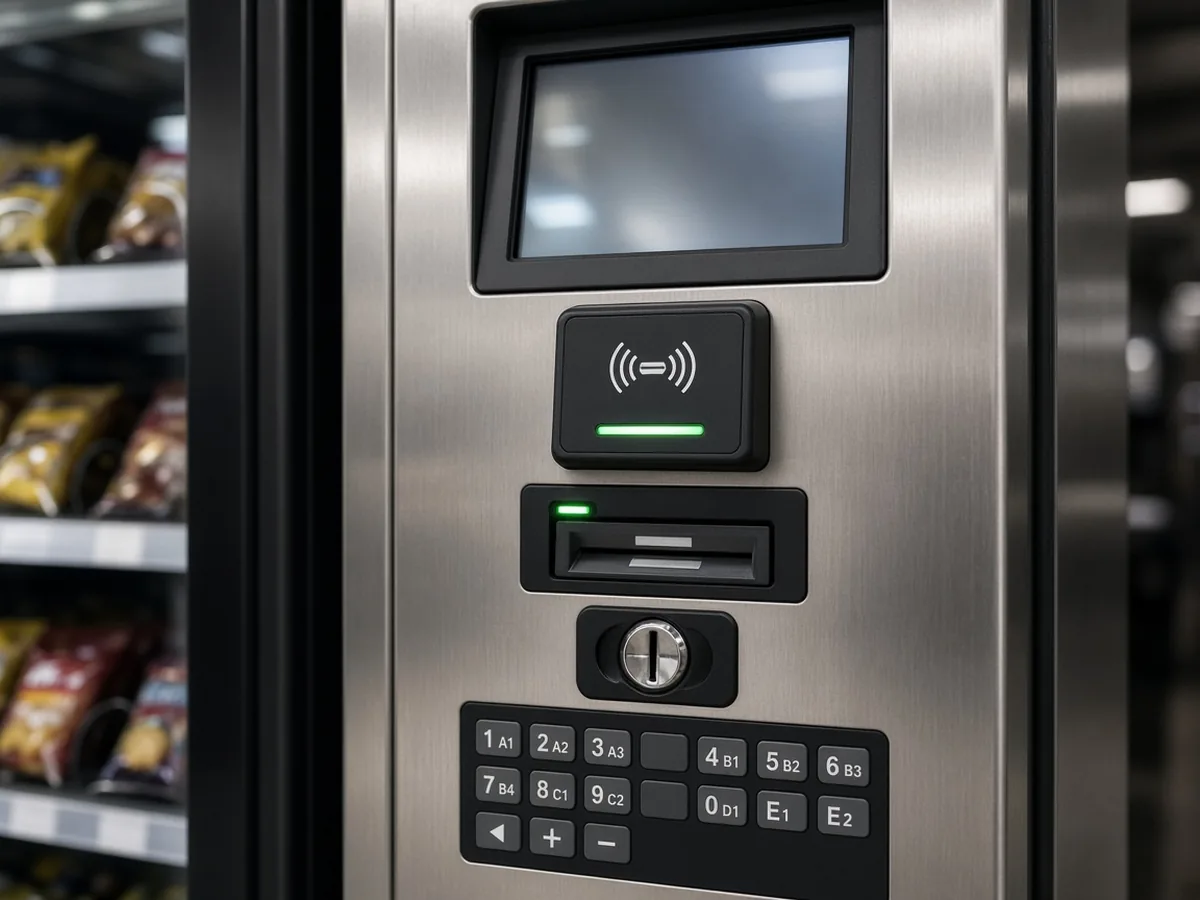
Before drilling or retrofitting a steel service door, check the terminal housing footprint and adapter bracket compatibility against interior keypad and delivery chute clearances. The Nayax VPOS Touch reader measures 4.23 inches high by 3.31 inches wide and 1.0 inches deep, weighing 8.11 ounces, with a 2.4-inch color touch LCD display screen, buzzer, speaker, and six soft-touch buttons. The Nayax VPOS Touch card reader supports EMV levels 1 and 2 contact cards, is EMV level 1 certified for contactless cards, and supports EMV level 2 for Visa PayWave MSD + qVSDC and MasterCard PayPass EMV + mag stripe, plus magnetic stripe card ISO7811 (track 1 + track 2, JIS II). Five Star Food Service deployed the Nayax VPOS Touch Reader across 20,000 machines in its eight-state unattended network using FastFit install brackets where no additional holes were needed.
The Nayax Onyx terminal has physical dimensions of 85 mm (3.3 inch) diameter and 28 mm (1.1 inch) depth.
The Nayax Onyx terminal features a 2.4 inch IPS color Touch LCD Display rated at 400nits with 4 LEDs and 6 Touch buttons, plus ARM 2xCortex 32 bit 180/216MHz architecture.
The Nayax Onyx contactless interface operates at 13.56 MHz supporting NFC, MIFARE, ISO 14443 Type A and B, and ISO 15693.
The Nayax Onyx terminal supports 3G/4G/Ethernet/NFC communication and machine protocols MDB, DEX, DDCMP, Pulse, VCCS, ccTalk, and JVMA.
The Nayax Onyx contactless payment terminal has an operating temperature range of -20 ℃ to +55 ℃ (-4°F to +131°F) and a storage temperature range of -40 ℃ to +85 ℃ (-40°F to +185°F).
The Nayax Onyx terminal is rated for 25% to 95% (non-condensing) humidity, IP 66 dust and water resistance, UL-94 V0 flammability, and CE, FCC, RoHS safety compliance.
Cellular Telemetry, Top-Mounted Antenna Placement, and Platform Pricing
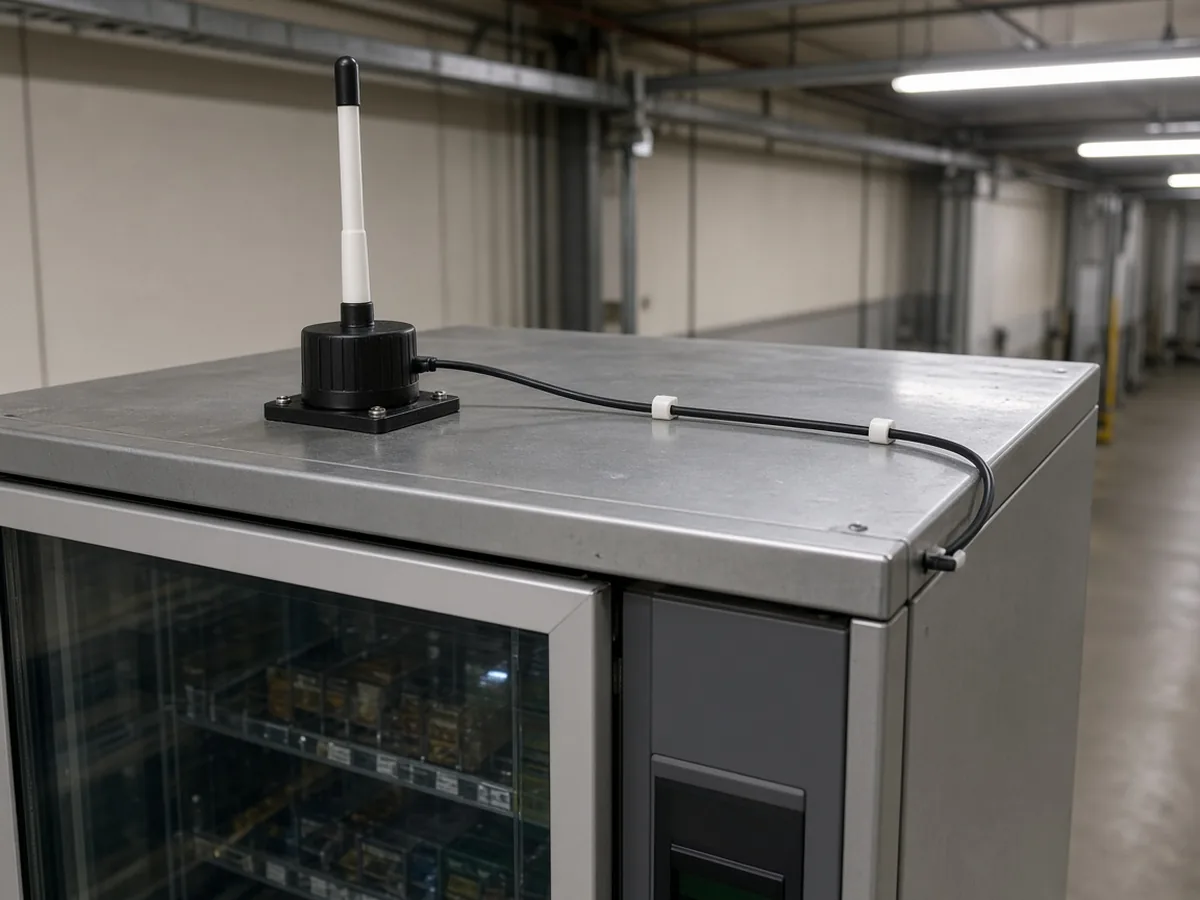
Live card authorization depends on stable cellular signal strength at the installation site, especially when combo machines are placed inside a basement, concrete stairwell, hospital corridor, or factory. Metal equipment, thick walls, and the vending cabinet itself can weaken a cellular signal; an external high-gain antenna can improve reception when mounted on top of the machine rather than enclosed inside the cabinet. During Nayax Onyx startup diagnostics, an RSSI reading of 99 indicates the operator should check the External Antenna Adapter connected to the board, whereas RSSI => 10 is normal to proceed to the next step.
Evaluating a cashless payment system for a vending machine also requires matching the cellular modem generation and vending management software integration to your route accounting workflow. The Cantaloupe P66 card reader is 4G-enabled to address 3G cellular network sunsets and integrates into Cantaloupe's Seed vending management system (VMS) as well as Vendmanager and Televend. The Rain Pay card reader supports tap, chip, and swipe over MDB cashless at a published hardware price of $499 with no activation fee and no contract, alongside DrylineVMS Core at $14.95 and Pro at $34.95 per machine per month.
Combo Vending Machine Cabinet Footprints and Protocol Readiness
When sourcing a new or replacement combo vending machine, matching the cabinet footprint, selection count, and factory protocol readiness ensures clean field installation of your chosen card terminal. The Seaga SnakMart (Sm2300) combo machine is health and safety compliant and MDB and DEX capable. The Seaga SnakMart standard tray configuration uses 3 Trays and a 7 Stack Vendor for 23 Selections total.
On VendingMachineSource, the published ENV5C Combo Merchandiser and Outdoor ENV5C Combo Vending Machine configurations each list dimensions of 73.5 x 39 x 36 in (H x W x D) and a weight of 630 lbs, with payment readers, software services, and destination compatibility specified per quotation.
On VendingMachineSource, the published SM2300 SnakMart Combo Vending Machine lists dimensions of 69.5" H x 30" W x 29" D and a weight of approximately 440 lbs.
On VendingMachineSource, the published Slim Combo Vending Machine lists dimensions of 76.5 x 28.7 x 31.2 in (H x W x D) and a weight of approximately 474 lbs.
On VendingMachineSource, the published Envision IQ Combo Vending Machine lists dimensions of 73.5” H X 39” W X 39” D and a weight of 775Lbs.
On VendingMachineSource, the published Pro Combo Elevator AD Vending Machine lists dimensions of 78.5 in x 44.6 in x 31.6 in (H x W x D) and a weight of approximately 924 lbs.
Sources
NAMA / EVA / EVMMA — Multi-Drop Bus / Internal Communication Protocol (MDB / ICP) Official Specification
Nayax Ltd. — Nayax Onyx Contactless Payment Terminal User Manual
Vending Connection — Nayax Readies EMV-Compliant VPOS Touch
Vending Connection — Five Star Deploys Nayax VPOS on 20,000 Machines in 8-State Network
Vending Connection — Cantaloupe Intros ePort Engage Combo
Vending Connection — Cantaloupe Launches ePort Engage Series
Vending Connection — USAT Enhances Fraud Protection with ePort EMV Upgrade
Vending Connection — P66 Card Reader, A Game-Changer for Your Vending Business
Vending Times — When the signal disappears: How vending machines handle cashless payment outages
Vending Times — Dryline VMS Fact Sheet and Rain Pay MDB Card Reader
Seaga Manufacturing — Seaga SnakMart SM2300 Combo Vending Machine
VendingMachineSource — Published Combo Vending Machine Technical Catalog
MDB Connector Pinout and Peripheral Current Budget
| Subsystem or Peripheral | Specification Reference | Verified Electrical or Protocol Parameter |
|---|---|---|
| MDB Serial Bus and Connector | Section 2.1 and Section 4 | The 6-pin MDB Connector Pin-out is Line 1 - 34 VDC, Line 2 - DC Power Return, Line 3 - N/C, Line 4 - Master Receive, Line 5 - Master Transmit, and Line 6 - Communications Common. |
| VMC Bus Power Output | Section 4.1 | VMC Voltage Output on the MDB bus is Minimum 20 VDC rms (rectified and optionally filtered), Nominal 34 VDC unreg. (rectified and filtered) or 24 VDC rms (rectified only), and Maximum 42.5 VDC (ripple voltage upper limit), where high line input may allow 45 VDC peak (max.). |
| MDB Cashless Device | Section 7.6 | Under Cashless Device Power Requirements, the current draw for any cashless device at minimum VMC Voltage Output must fall within Idle mode = 300 mA (avg.) continuous and Transport or Read/Write cycle = 1.5 A @ 50% maximum duty cycle up to 5 seconds. |
| MDB Communications Gateway | Section 8.5 | The current draw for an MDB Communications Gateway at minimum VMC Voltage Output is 300 mA (avg.) continuous in Idle mode and 1.8 A continuous and up to 2.5 A (max) for an accumulated maximum of 10 seconds in Active mode. |
| MDB Coin Changer | Section 5.5 | The current draw for an MDB coin changer is 200 mA (max.) continuous in Idle mode and 1.8 A (max.) for up to 2 seconds during coin acceptance on solenoid-based 3 tube changers sold in the US market. |
| MDB Bill Validator | Section 6.5 | The current draw for an MDB bill validator is 200 mA (avg.) continuous in Idle mode and 2.5 A (max.) up to 30 seconds during bill transport. |
Commercial Cashless Card Reader Hardware Comparison
| Terminal Model | Mounting Format and Display | Verified Technical and Commercial Profile |
|---|---|---|
| Nayax Onyx | Contactless circular door terminal | The Nayax Onyx terminal has physical dimensions of 85 mm (3.3 inch) diameter and 28 mm (1.1 inch) depth. |
| Nayax VPOS Touch | All-in-one telemeter and EMV reader | The Nayax VPOS Touch reader measures 4.23 inches high by 3.31 inches wide and 1.0 inches deep, weighing 8.11 ounces, with a 2.4-inch color touch LCD display screen, buzzer, speaker, and six soft-touch buttons. |
| Cantaloupe ePort Engage Combo | Over-bezel bill acceptor combo terminal | The Cantaloupe ePort Engage Combo is an all-in-one card reader and telemeter with a 2.5" edge-to-edge touchscreen that fits over the machine bill acceptor, supports Coinco and MEI bill acceptors (US and Canadian bills), supports Verizon or AT&T cellular, and is PCI-PTS 5.X Certified. |
| Cantaloupe ePort Engage Series | Standalone door touchscreen terminal | The standalone Cantaloupe ePort Engage Series payment device is PCI PTS 5.X compliant and features anti-tamper security, an edge-to-edge 3.5" touchscreen, an all-in-one card reader, a magstripe reader, and an EMV chip reader. |
| Rain Pay with DrylineVMS | MDB cashless tap, chip, and swipe reader | The Rain Pay card reader supports tap, chip, and swipe over MDB cashless at a published hardware price of $499 with no activation fee and no contract, alongside DrylineVMS Core at $14.95 and Pro at $34.95 per machine per month. |
Published Combo Vending Machine Footprint Reference
| Combo Machine Model | Catalog Category | Published Dimensions and Weight |
|---|---|---|
| SM2300 SnakMart Combo Vending Machine | Compact snack and drink combo | On VendingMachineSource, the published SM2300 SnakMart Combo Vending Machine lists dimensions of 69.5" H x 30" W x 29" D and a weight of approximately 440 lbs. |
| Slim Combo Vending Machine | Narrow-aisle combo cabinet | On VendingMachineSource, the published Slim Combo Vending Machine lists dimensions of 76.5 x 28.7 x 31.2 in (H x W x D) and a weight of approximately 474 lbs. |
| ENV5C Combo Merchandiser | Standard indoor and outdoor combo | On VendingMachineSource, the published ENV5C Combo Merchandiser and Outdoor ENV5C Combo Vending Machine configurations each list dimensions of 73.5 x 39 x 36 in (H x W x D) and a weight of 630 lbs, with payment readers, software services, and destination compatibility specified per quotation. |
| Envision IQ Combo Vending Machine | High-capacity merchandiser combo | On VendingMachineSource, the published Envision IQ Combo Vending Machine lists dimensions of 73.5” H X 39” W X 39” D and a weight of 775Lbs. |
| Pro Combo Elevator AD Vending Machine | Elevator delivery combo cabinet | On VendingMachineSource, the published Pro Combo Elevator AD Vending Machine lists dimensions of 78.5 in x 44.6 in x 31.6 in (H x W x D) and a weight of approximately 924 lbs. |
Common questions
How do I verify whether a combo vending machine has an MDB cashless harness?
Check the main controller harness inside the service door for the standard multi-drop bus interface. The MDB serial bus interface for electronically controlled vending machines is a 9600 baud Master-Slave arrangement where all peripherals are Slaves to a Master controller. The standard MDB peripheral connector is a Six (6) Circuit Receptacle Housing (Molex 39-01-2060 or AMP P/N 106527-6) with female tin socket terminals (Molex 39-00-0065). The standard MDB bus harness connector is a Six (6) Circuit Plug Housing (Molex 39-01-2061 or AMP P/N 794550-6 or 794542-6) with male tin pin terminals (Molex 39-00-0067).
What power supply output and current headroom does an MDB card reader require?
VMC Voltage Output on the MDB bus is Minimum 20 VDC rms (rectified and optionally filtered), Nominal 34 VDC unreg. (rectified and filtered) or 24 VDC rms (rectified only), and Maximum 42.5 VDC (ripple voltage upper limit), where high line input may allow 45 VDC peak (max.). Under Cashless Device Power Requirements, the current draw for any cashless device at minimum VMC Voltage Output must fall within Idle mode = 300 mA (avg.) continuous and Transport or Read/Write cycle = 1.5 A @ 50% maximum duty cycle up to 5 seconds. The current draw for an MDB Communications Gateway at minimum VMC Voltage Output is 300 mA (avg.) continuous in Idle mode and 1.8 A continuous and up to 2.5 A (max) for an accumulated maximum of 10 seconds in Active mode.
How do MDB cashless device levels affect multi-vend and Always Idle card tap selection?
Level 1 cashless devices support standard commands and the Expansion ID command, and readers do not have revaluation capability. Level 3 cashless devices support the expansion ID command with option bits b0 File Transport Layer (FTL), b1 16 or 32 Bit Monetary Format, b2 Multi Currency / Multi Lingual, b3 Negative Vend, b4 Data Entry, and b5 Always Idle Session. In MDB 4.3 expansion options, the basket / partial refund / options price feature allows performing multi-vends with a single VEND REQUEST and multiple VEND SUCCESS / VEND FAILURE responses.
Where should the cellular antenna be mounted when adding a card reader to a metal combo cabinet?
Metal equipment, thick walls, and the vending cabinet itself can weaken a cellular signal; an external high-gain antenna can improve reception when mounted on top of the machine rather than enclosed inside the cabinet. During Nayax Onyx startup diagnostics, an RSSI reading of 99 indicates the operator should check the External Antenna Adapter connected to the board, whereas RSSI => 10 is normal to proceed to the next step.
Continue exploring
Combo Vending Machines
Combo Vending Machines for commercial projects. Review product fit, configuration, sample checks, payment requirements and factory acceptance with our team.
Discuss your vending project
Send the items in the project brief above to discuss the selected configuration, sample checks and delivery scope. Share your products, site and payment requirements with our team.