
Bottled Water Vending Machines
Bottled Water Vending Machines for commercial projects. Review product fit, configuration, sample checks, payment requirements and factory acceptance with our team.

Updated October 2026
A bottled-water vending machine stores and releases sealed bottles; a water refill vending machine dispenses water into a customer's container. For the sealed-bottle format, specify package fit and refrigeration after restocking. For on-site refill, specify the incoming water, treatment, container bay and waste-water routes, with cooling added when chilled delivery is required. The choice starts with what the customer takes away: a stocked bottle or a measured refill. Use the comparison below to separate cooling load, bottle neck fit and drain requirements before choosing a cabinet or planning its connections.
| Selection check | Sealed-bottle vending | On-site water refill |
|---|---|---|
| Sale unit | A finished, sealed bottle released from stocked inventory. | Water dispensed into the customer’s container. |
| Cooling demand | Holding temperature plus pull-down after replenishing bottles. | If chilled: incoming-water cooling, peak draw and cold-storage recovery. |
| Container interface | Whole bottle envelope, neck/cap/shoulder and the vend path. | Bay envelope, handle space, mouth position and outlet clearance. |
| Incoming water | No product-fill water connection for selling sealed bottles. | Feed supply and treatment requirements for the selected configuration. |
| Drainage | Model-specific condensate handling; check any external drain. | RO reject where fitted, plus specified spill, flush and cleaning routes. |
| Acceptance evidence | Filled sample vends and cooling performance under agreed loading conditions. | Feed-water specification, connection drawing and delivery performance over peak demand. |
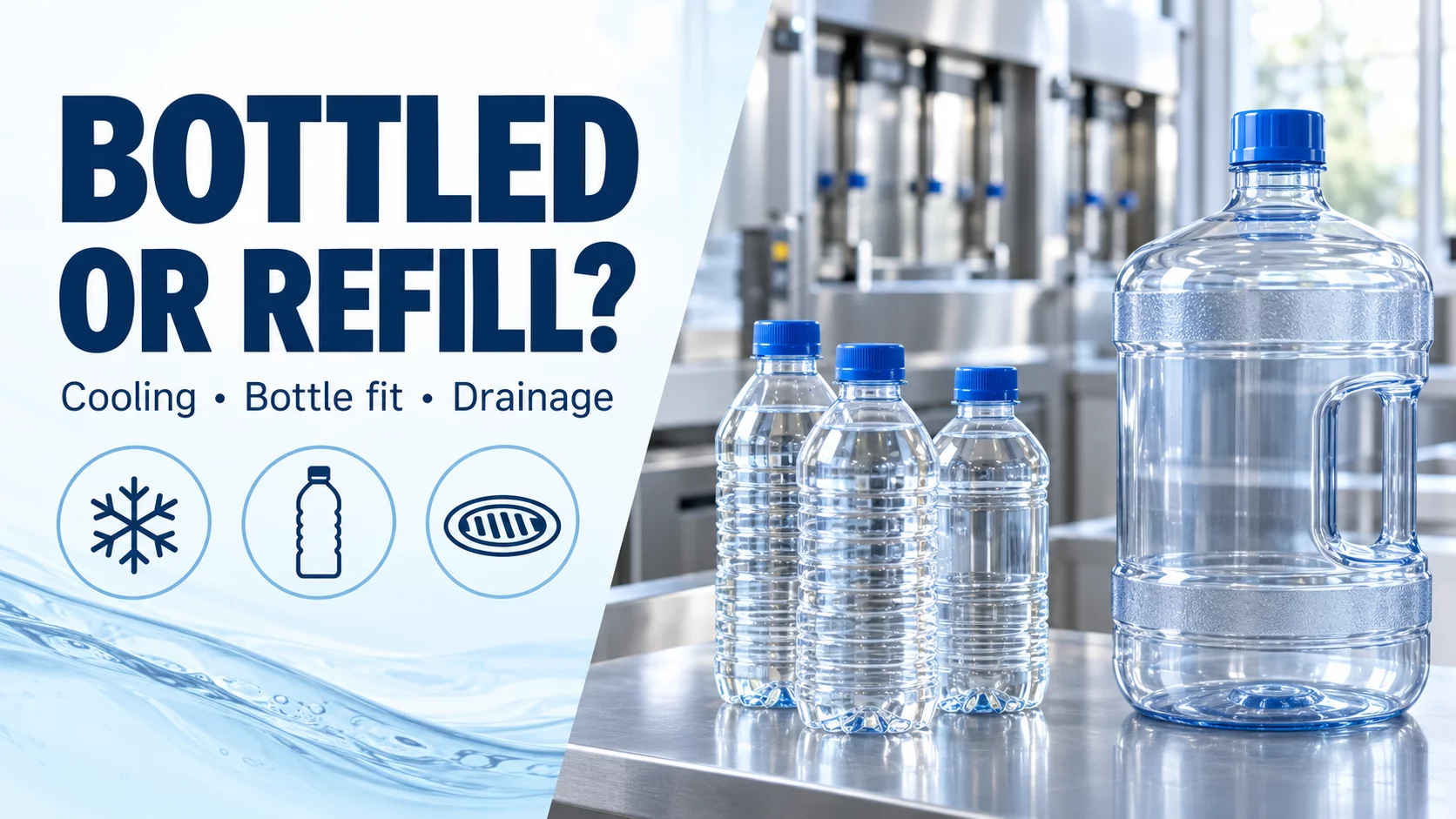
Explore our bottled-water vending machine range to connect these selection checks to the available configurations. For sealed packages, start with the water-bottle vending configuration and your intended bottle samples.
Size cooling around replenishment and peak demand. A cabinet holding already-cold bottles has a different duty from one loaded with warm stock just before a busy period. A chilled refill system must also absorb heat from incoming water while serving customers.
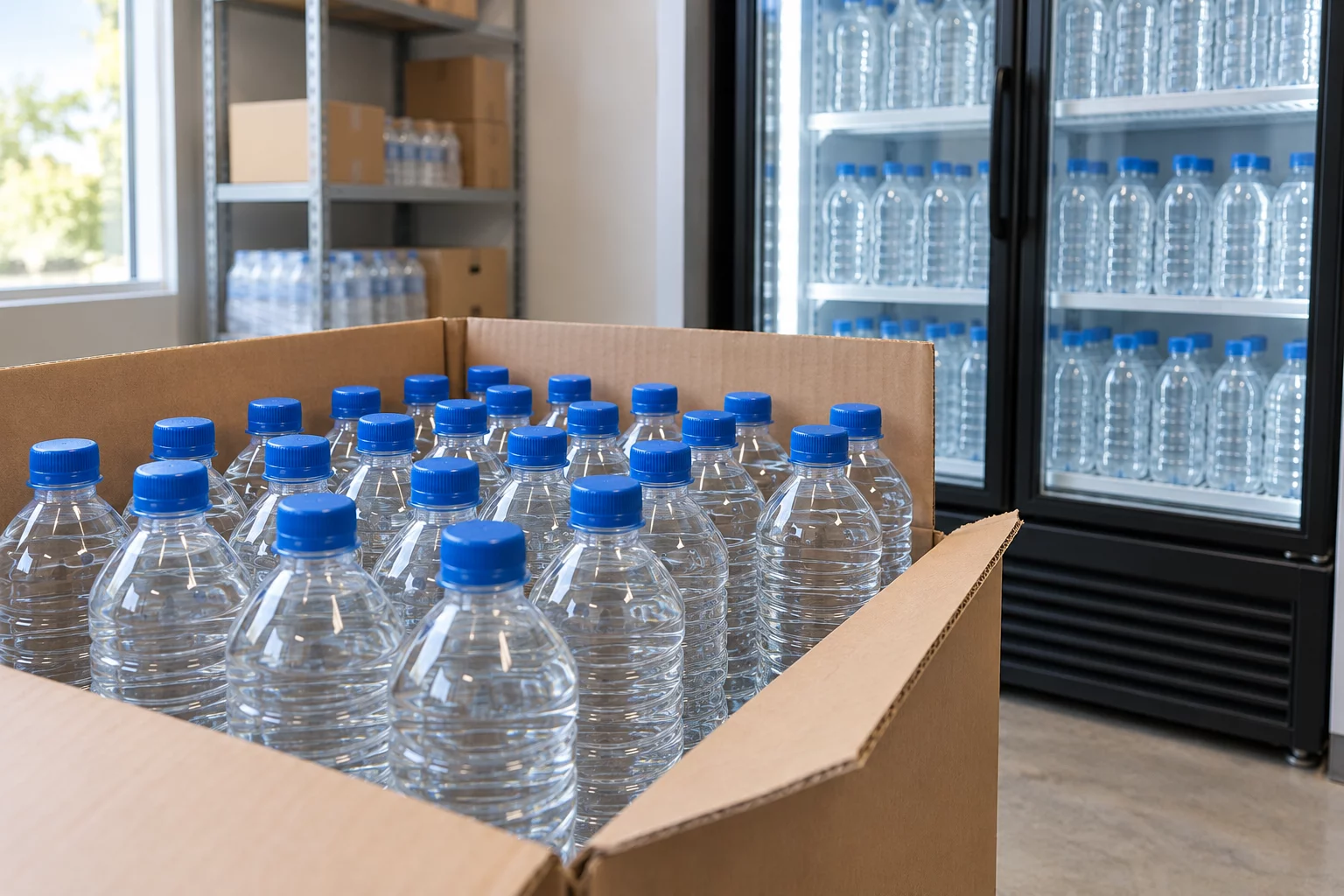
For a batch of sealed bottles, the water-only sensible heat is Q = m × cₚ × (Tload − Ttarget). With water mass m in kg, specific heat cₚ in kJ/(kg·K), and a temperature difference in K or °C, Q is in kJ. Dividing Q by the allowed pull-down time in seconds gives the average water-only thermal duty in kW. Packaging, cabinet heat gain and air entering through openings add to that duty.
For continuous chilled refill, the corresponding water-only duty is P = ṁ × cₚ × (Tin − Tout), where ṁ is water mass flow in kg/s and P is kW. Use the required delivery flow and temperatures together. Thermal duty and electrical input are different quantities; the refrigeration system's performance connects them.
ASHRAE's Refrigerated Vending Machines guidance identifies warm restocking, ambient temperature, humidity, sunlight and obstructed heat rejection as important influences. Keep the selected cabinet's ventilation path open and specify the site conditions alongside the target product temperature. DOE's refrigerated-beverage vending guidance also distinguishes full-cabinet cooling from zone cooling, which concentrates cooling near the next products to be dispensed.
If demand returns before a warm restock can reach the required temperature, change the replenishment schedule, stock temperature or cooling configuration. For a chilled refill offer, compare delivery temperature over the peak draw period as well as the recovery period afterward. A daily water-production rating alone cannot establish either result.
Cap diameter alone cannot establish bottle compatibility. Record the filled bottle's overall height, maximum body diameter or width, shoulder profile, cap and neck dimensions, and mass. Then match those measurements to the actual storage, release and delivery mechanism.
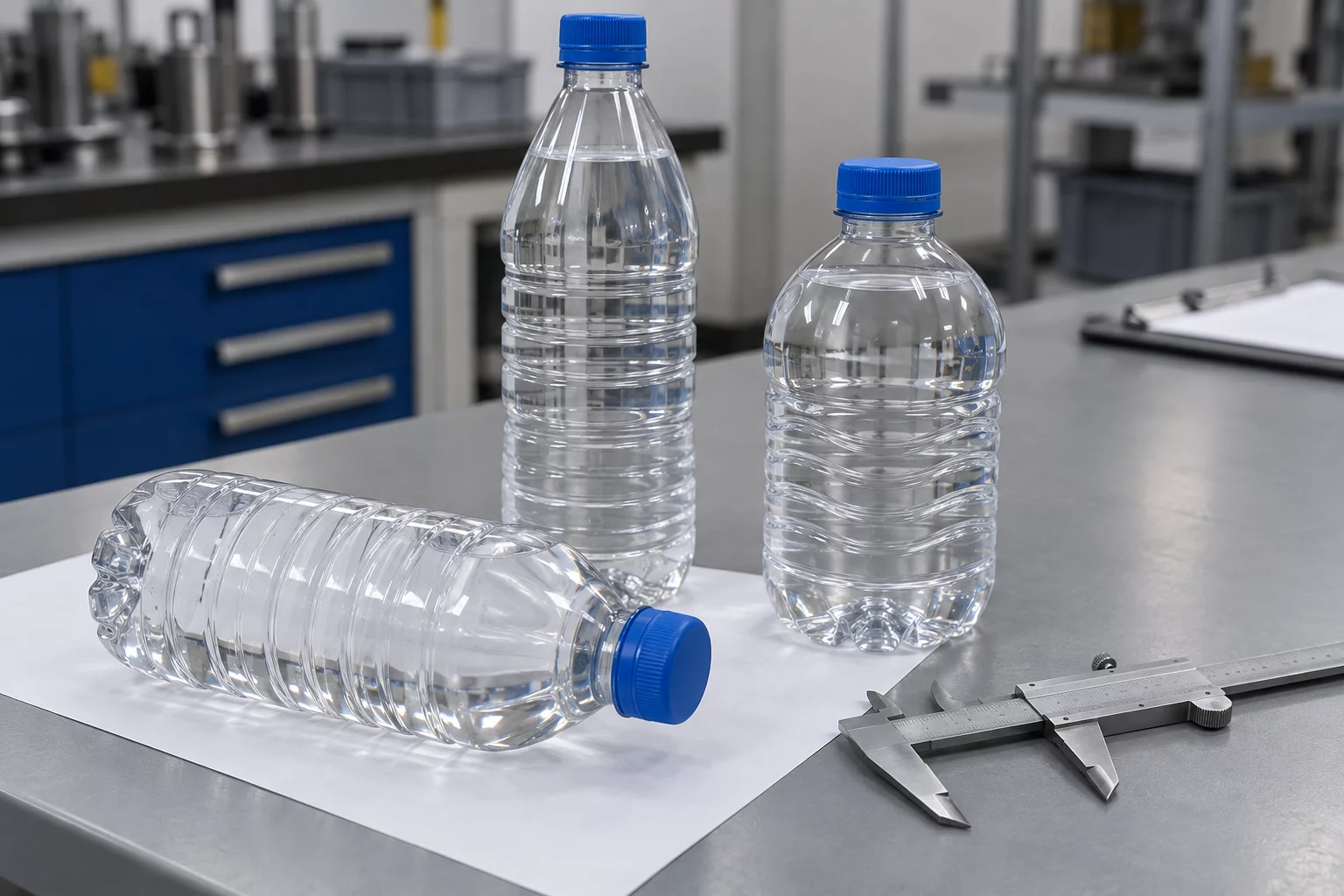
Different mechanisms create different contact points. The Royal GIII Plus manual describes product-stop settings that depend on package diameter. Vendnet's Product Loading Best Practices describes coil arrangements where poor bottle positioning can let the coil ride up and the neck overhang the tray. These examples make the neck relevant without turning it into a universal neck-clamp specification.
Use filled production samples with their intended caps and labels. Ask for a documented test through the proposed channel settings and delivery path, including loading orientation and the agreed range of stock levels. Record jams, unintended extra releases, bottle damage and retrieval problems against the sample identity and settings. A successful test of one bottle shape should stay tied to that shape.
If a bottle fits the storage channel but its shoulder or cap catches during release, a larger nominal channel capacity does not solve the interference. Resolve the contact point through the mechanism's approved adjustment or a different package/configuration, then repeat the sample check.
For refill, check the customer's container inside the dispensing bay. Measure the usable height, width and depth, including the handle and the movement needed to place and remove the jug. Check the mouth position beneath the outlet and the clearance specified for the selected dispenser.
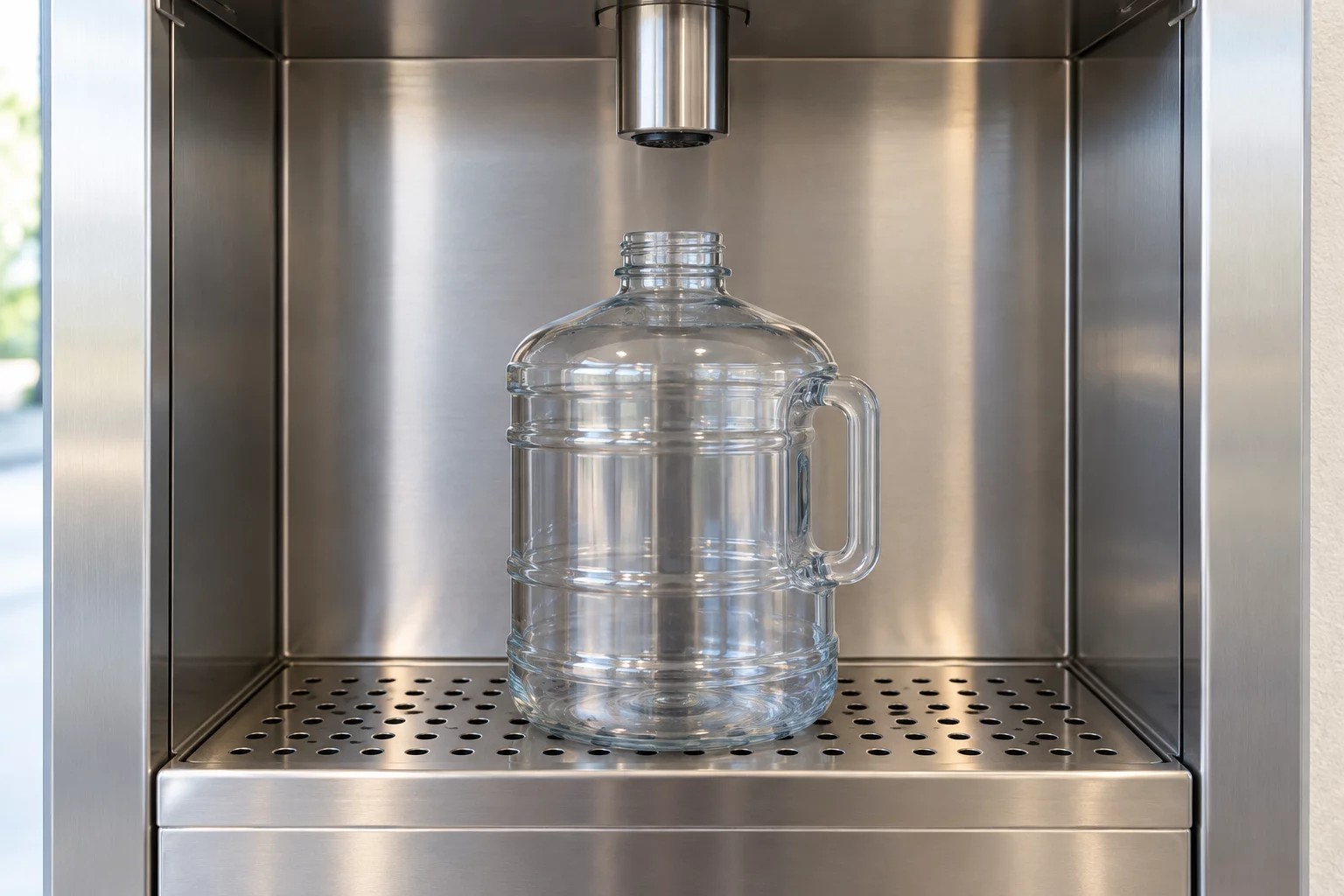
A container's stated volume is only a starting point: tall narrow and short wide containers of the same volume can fit differently. Confirm the supported container range against the actual bay drawing and samples, and keep the spill-collection surface accessible for cleaning.
Treatment, storage and dispensing capacity also need separate entries in the comparison. Aqua Star's G-2500 specifications, for example, list RO production choices, a chilled storage tank and container accommodation separately. For any chilled refill configuration, compare usable cold-water storage and recovery with consecutive fills during the busiest period. An ambient-water refill arrangement has a different cooling requirement.
Start the drainage review by naming each stream. Refrigeration condensate comes from moisture collected at the cooling system. RO reject water comes from the treatment process. Refill spills, flushing and cleaning can create additional waste-water flows. Their routing and timing determine the installation requirements.
Sealed-bottle vending does not consume building water to fill the product. Its refrigeration can still produce condensate. The Royal Vision Vender NG parts list includes a condensate pan and drain tube; the adjacent Royal Health Safety Cooler manual describes internal condensate evaporation that avoids external drain plumbing for that cooler. For the selected vending cabinet, check whether condensate evaporates internally, collects for removal or needs an external connection. A sealed refrigerant circuit does not answer that question.
Reverse osmosis water vending machines split feed water into permeate, the treated stream, and concentrate, also called reject water. EPA's WaterSense at Work defines recovery as the ratio of permeate to feed water. For the same production interval, R = Vpermeate / Vfeed, and Vreject = Vpermeate × (1 − R) / R, with R expressed as a fraction and all volumes in the same unit. Add flushing, cleaning and other waste streams separately when reviewing site water use.
Peak discharge and drainage geometry determine drain capacity; a daily average reject volume is insufficient. Obtain the connection schedule, maximum discharge for each operating mode, outlet elevations and approved routing before sizing downstream pipework.
The PureDrops WB-2000 operation and maintenance manual provides a useful model-specific example: it identifies separate feed, reject and gravity-drain connections. Its installation drawing keeps reject and drain lines separate and shows air gaps at disposal points. Have the installer apply the selected machine's drawing and the requirements for the actual site, including backflow protection and the approved disposal route. Keep an RO reject connection distinct from a gravity collection drain.
Choose sealed-bottle vending when the intended sale is a finished packaged drink, then qualify power, ventilation, replenishment and the cabinet's condensate arrangement. Choose an on-site refill configuration when the intended sale is water into a customer's container and the required feed-water, waste-water and maintenance arrangements can be provided.
For refill, record the incoming water analysis, temperature, available flow and pressure under operating demand. Compare these with the treatment system's current installation specification. Keep building inlet pressure separate from internal RO pump pressure: the WB-2000 manual treats them as different operating points. The connection size, allowable pressure and flow requirement must all match the proposed configuration.
If an RO installation has no approved reject-water route, resolve that route before ordering the equipment. If the site has only electrical service, first check whether a sealed-bottle cabinet's condensate design suits the location; the word refrigerated does not itself guarantee a plumbing-free installation.
Compare operating work as well as connections. Sealed-bottle vending needs packaged stock, replenishment visits, inventory rotation and cooling after loading. On-site refill adds water-treatment consumables, sanitation, water-quality checks and reject/flush water to the operating scope. Identify who performs each task and how the required service access will be maintained.
Start with the sale format: sealed bottled water or on-site refill. Add whether chilled delivery is required, the expected peak demand and replenishment pattern, and the warmest expected operating conditions.
For sealed bottles, include filled samples or a dimensioned drawing showing body, height, shoulder, cap and neck, plus filled mass and label details. For refill, include the container envelope, handle and mouth position, target delivery flow and temperature, and the available feed-water and drain arrangements.
Keep the cooling-performance conditions, sample-test configuration and connection drawing with the selected machine's specification. This gives the buyer and installer a common basis for checking package delivery, cold-water availability and site fit.
It depends on the cabinet’s condensate design. A sealed-bottle machine does not need water to fill the product, but refrigeration collects moisture. Check whether that model evaporates condensate internally, collects it for removal or requires an external drain.
Refill describes how the customer receives water. RO describes a treatment process. Specify the treatment train, incoming-water requirements, storage and dispensing arrangement separately; chilled delivery is another configuration choice.
No. It describes treatment production under stated conditions. Peak cold-water delivery also depends on usable chilled storage, refrigeration duty, inlet temperature and the pattern of consecutive fills. Compare these on the same operating basis.
Use the complete filled-bottle geometry and the actual dispensing mechanism. Body diameter, height, shoulders, cap/neck profile, mass and loading orientation can all affect release. Confirm the proposed setup with the intended filled samples.
Bottled Water Vending Machines for commercial projects. Review product fit, configuration, sample checks, payment requirements and factory acceptance with our team.
Water Bottle Vending Machine: A refrigerated vending configuration for sealed bottled water and other packaged drinks.
Tell us whether you plan to sell sealed bottles or dispense refills, whether chilled delivery is needed, the bottle/cap or refill-container dimensions, and the water supply and drain arrangements available at your site.